1984 Democratic Party presidential primaries
Last updated
The 1984 Democratic Party presidential primaries were the process by which the Democratic Party selected its nominee for the 1984 United States presidential election. Former Vice President Walter Mondale emerged as the nominee through a series of primary elections and caucuses, culminating in the Democratic National Convention held from July 16 to July 19, 1984, in San Francisco, California.
Background
The Commission on Presidential Nomination, formed in July 1981 under Jim Hunt, aimed to increase the power of elected officials to select a more moderate candidate. Its report, completed on February 5, 1982, allocated 568 unelected superdelegates—party leaders and elected officials—amounting to 14% of total delegates. Of these, 411 were elected officials and 157 were party officials, with 200 from the U.S. House and Senate. Mondale's campaign, led by Richard Moe with 20 lobbyists, secured support from members of Congress, while Thomas Hale Boggs Jr. lobbied for John Glenn.
The primary schedule was reduced to March through June, except for Iowa and New Hampshire. Twenty-six primaries were held, down from thirty-one in 1980. The minimum delegate threshold was raised from 15% to 20%.
Timeline
Ted Kennedy announced in December 1982 that he would not seek the nomination. In June 1983, Alan Cranston won straw polls in Alabama, California, and Wisconsin, and placed second in Massachusetts. Mondale won a Maine straw poll in October.
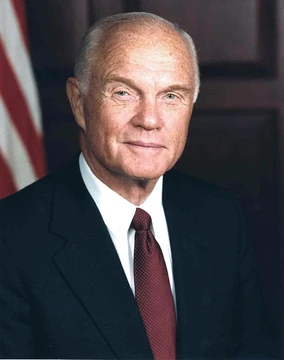
John Glenn criticized excessive spending on straw polls, noting Cranston and Mondale each spent $100,000 and Hollings spent $25,000. Gary Hart, little-known when he announced in February 1983, began an early canvassing tour in New Hampshire in late September, attracting national media attention. By late 1983, Hart had risen moderately in the polls, partly at the expense of the sinking candidacies of John Glenn and Cranston.
Analysis
Mondale performed best in states with primaries. Hart won more states overall, taking 16 of 27 primaries and 13 of 23 caucuses, but those states had lower delegate counts and allocated delegates proportionally. Mondale won four of five winner-take-all states, securing all of Pennsylvania's 80 delegates and 102 of New Jersey's 107 delegates. Strong superdelegate support gave Mondale control of delegations in five states Hart won: Massachusetts, Rhode Island, Indiana, Ohio, and New Mexico.
Under a fully proportional system, Mondale would have received 1,591 delegates, Hart 1,307, and Jackson 645, leaving Mondale short of the nomination. Mondale lost all of New England and nearly every state west of the Mississippi. Two-thirds of convention delegates identified as liberals.
Results by state
In his acceptance speech, Mondale stated, 'Mr. Reagan will raise taxes, and so will I. He won't tell you. I just did. He chose U.S. Rep. Geraldine A. Ferraro of New York as his running mate, making her the first woman nominated for vice president by a major party.
Jackson criticized the screening process as a 'P.R. parade of personalities' but praised the choice. Some preferred Senator Lloyd Bentsen for his appeal to conservative Southern voters. Hart lobbied for the vice-presidential spot after Mondale clinched the delegate majority, but a June 1984 Gallup poll showed both men nine points behind President Reagan.
More in John Glenn
Sources
Compiled from Wikipedia and the sources listed below. Text from Wikipedia is available under CC BY-SA 4.0; this entry is adapted from it.
- Wikipedia: 1984 Democratic Party presidential primaries (CC BY-SA 4.0).
Spotted an error? Know more?
Reader corrections go straight into our review queue. Suggest an edit · How this site is sourced