The Case of the Animals versus Man
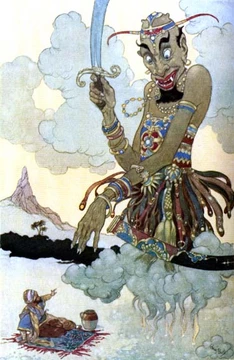
A trial of humans and animals before the King of the Jinn.
The Case of the Animals versus Man, known in English as The Case of the Animals versus Man Before the King of the Jinn, is an epistle written by the Brethren of Purity in the 960s. It was first published as Epistle 22 in the Encyclopedia of the Brethren of Purity. The longest entry in that encyclopedia, it has been favorably received by literary critics and translated into several languages.
Quick Facts
- Title orig
- Fī aṣnāf al-ḥayawānāt wa-ʿajāʾib hayākilihā wa-gharāʾib aḥwālihā
- Country
- Iraq
- Language
- Arabic
- Series
- Encyclopedia of the Brethren of Purity
- Genre
- Epistle
- Format
Facts from the source article.
Plot
Seventy men are stranded on an island after a shipwreck. The island is home to talking animals who had previously escaped from the descendants of Adam to avoid mistreatment and enslavement. Mistaking the animals for potential slaves, the men try to force them into submission. In response, the animals call for justice, leading to a trial organized by the island’s Muslim governor and Bīwarāsp the Wise, the King of the Jinn. Seven spokespeople represent the humans: an Iraqi, a Sri Lankan, a Syrian Jew, a Syrian Christian, a Qurayshi, a Byzantine Greek, and a Shiite Muslim. Their arguments for human superiority over animals are not persuasive. The animals are led by a group of kings: the bee (king of insects), the griffin or anqa (king of predatory birds), the lion (king of predatory land animals), the simurgh (king of birds), the sea serpent (king of aquatic animals), the snake (king of ground-crawling animals), and an unspecified king of the cattle, likely the horse. Each king appoints a representative: the bee, the nightingale, the jackal, the parrot, the frog, the cricket, and an unspecified cattle ambassador, possibly the mule. During the trial, the Quran is cited repeatedly, with some references also to the Torah and the Gospels. The mule points to Quran 55:10 to argue that mankind does not hold exclusive rights over creation, while the humans counter with Quran 11:6. The bee invokes Quran 16:68 to claim that bees possess a skill set superior to humans. The animals hint that humanity is confused by the existence of many religions, prompting a Persian attendee to quote Quran 2:115: “Whichever path we take, there is the face of God.” A human speaker from the Hejaz delivers the final argument, emphasizing that only humans will be resurrected at the Last Judgment. The jinn weigh both sides; they feel sympathy for the animals but worry about how the men might react, comparing them to angels. The trial ends with closing words from a mysterious figure described as “Persian by breeding, Arabian by faith, a by confession, Iraqi in culture, Hebrew in lore, Christian in manner, Damascene in devotion, Greek in science, Indian in discernment, Sufi in intimations.” He suggests that humans have not yet reached their full potential. The verdict is abruptly announced in favor of mankind.
Publication
Written in the 960s by the anonymous Iraqi Brethren of Purity, who drew inspiration from earlier fables, this work was originally titled in Arabic as The Case of the Animals versus Man. It appeared as Epistle 22 in the tenth-century Encyclopedia of the Brethren of Purity, a collection of fifty-two entries. This epistle is the longest of them all and the only one written as a fable. In the early 1300s, Kalonymus ben Kalonymus translated it into Hebrew. A lost Catalan work, Llibre de la disputació de l’ase (Book of the Disputation of the Donkey) by Anselm Turmeda, first published in 1417, was modeled on it. Lenn E. Goodman published an English translation in 1978. A critical Arabic edition by Goodman and Richard McGregor came out from Oxford University Press in 2009, featuring a 250-page English translation with annotations; that translation was republished on its own in 2012.
Reception
Literary critics have paid close attention to this epistle. Ignacio Sánchez considers it the most famous work in the Brethren of Purity’s encyclopedic collection, a view shared by Godefroid de Callataÿ, who calls it the standout piece of their corpus. Richard C. Foltz, in the Encyclopedia of Religion and Nature, describes the work as unusual, noting its argument for animal rights was remarkably exceptional for a tenth-century Muslim context. Sarra Tlili finds the ending puzzling, yet praises the work as an admirable effort to challenge human-centered thinking and explore Qur’anic themes about animals. Eric Ormsby hails it as a literary masterpiece, both charming and profound.
More in Jinn in Popular Culture
Spotted an error? Know more?
Reader corrections go straight into our review queue. Suggest an edit · How this site is sourced