Jewish rye bread
A diaspora bread with regional variations and caraway seeds.
Found in Jewish communities worldwide, this rye bread comes in many regional styles because of the Jewish diaspora. It is also called sissel or cissel bread, since sissel is the Yiddish word for caraway seed.
Quick Facts
- Country
- Jewish communities of Central and Eastern Europe, Scandinavia, Canada, the United States, Israel
- Creator
- Ashkenazi Jews
- Course
- Appetizer or main
- Main ingredients
- Wheat flour
- rye flour
- water
- yeast
- caraway seeds (optional)
- egg wash
- salt
Facts from the source article.
Israel
In Israel, rye bread is very popular due to the large Jewish population of Ashkenazi Jewish descent, and it has also become popular with Sephardic and Mizrahi Jews. It is commonly used in restaurant kitchens and is a staple at many bakeries, found in virtually every bakery and grocery store. The mass-produced version is similar to the American but often very soft. Many bakeries in places such as Tel Aviv and Jerusalem are redefining rye bread with their own versions, sometimes a twist on the traditional Jewish rye bread and sometimes harkening back to the most traditional Ashkenazi-style rye bread.
United States
In the United States, a category of wheat-rye breads—including light rye (sissel), American pumpernickel, and marble rye (a swirl of the two)—is strongly tied to Jewish and Jewish-American cooking, especially the delicatessen. Most of the flour is white wheat flour, often a less-refined type called first clear, with a good amount of rye added for its color and taste. The dough usually rises with sourdough, though sometimes a little citric acid or vinegar is used to lower the pH enough to stop the rye’s amylases.
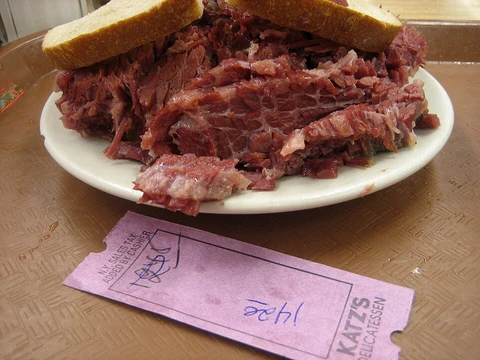
This Jewish rye gets its flavor from whole caraway seeds and a shiny egg-wash glaze, and it is traditionally paired with salted meats like corned beef and pastrami. High-gluten wheat flour can be combined with rye to create a dough for bagels. This American Jewish-style rye is also called corn rye, possibly from the Yiddish word korn (meaning ‘grain’) or because cornmeal is used for coating and handling. Its roots are in Eastern European Jewish baking, including Russian Jewish brown bread, Polish Jewish rye, and Latvian Jewish rye.
Canada
In Canada, Jewish rye bread comes in a few varieties. Loaves with caraway seeds are often called kimmel bread, a name from Yiddish. Mass-produced options like Oroweat are available. In cities with large Jewish communities, including Montreal, Toronto, Winnipeg, and Vancouver, authentic Ashkenazi-style rye bread can be found at kosher bakeries, delis, restaurants, and grocery stores. Another type is Winnipeg-style rye bread, which uses little to no rye flour. Instead, it combines wheat flour with coarse or cracked rye meal, and it does not include caraway seeds.
Frequently Asked Questions
Where does Jewish rye bread come from?
Jewish rye bread originates from Jewish communities of Central and Eastern Europe, Scandinavia, Canada, the United States and others.
When is Jewish rye bread served?
Jewish rye bread is served as Appetizer or main.
More in Jewish American Cuisine
Spotted an error? Know more?
Reader corrections go straight into our review queue. Suggest an edit · How this site is sourced