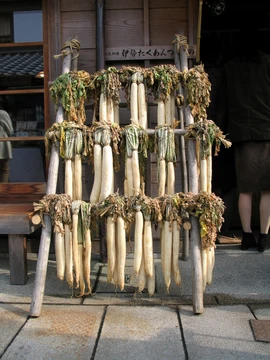
Satoimo
A starchy root vegetable staple across tropical regions.
Satoimo is the Japanese name for taro, a root vegetable from the species Colocasia esculenta. It is the most widely cultivated of several Araceae plants grown for their edible corms, leaves, stems, and petioles. Taro is a staple food in many African, Caribbean, Oceanian, and Asian cultures.
Quick Facts
- Scientific name
- Colocasia esculenta
- Family
- Araceae
- Leading producer
- Nigeria (46% of total)
- Average yield
- 7 tons per hectare
- Rich in
- Vitamin B6
- vitamin E
- manganese
Facts from the source article.
Did You Know?
- The specific epithet esculenta means 'edible' in Latin.
- Raw taro leaves are 86% water and provide 103% of the daily value for vitamin K per 100 g.
Distribution and habitat
Colocasia esculenta is thought to be native to Southern India and Southeast Asia, but is widely naturalized. It likely originated in the Indomalayan realm, possibly in East India, Nepal, and Bangladesh. From there it spread by cultivation eastward into Southeast Asia, East Asia, and the Pacific Islands; westward to Egypt and the eastern Mediterranean; and then to East and West Africa, the Caribbean, and the Americas. In Australia, a variety is considered native to the Kimberley region of Western Australia, while the common type is naturalized and invasive in several states.
In Europe, it is cultivated in Cyprus, where it is called Colocasi and certified as a PDO product. It also grows on the Greek island of Ikaria. In Turkey it is known as gölevez and grown on the Mediterranean coast. In Macaronesia it became naturalized after Portuguese discoveries.
In the southeastern United States it is recognized as an invasive species, often found near drain ditches and bayous in Houston, Texas.
Cultivation
Taro is one of the most ancient cultivated crops, found widely in tropical and subtropical regions of South Asia, East Asia, Southeast Asia, Papua New Guinea, northern Australia, and the Maldives. It is highly polymorphic, making taxonomy and distinction between wild and cultivated types difficult. Domestication likely occurred independently multiple times, with possible locations including New Guinea, Mainland Southeast Asia, and northeastern India.
Archaeological traces of taro exploitation have been recovered from sites such as the Niah Caves of Borneo around 10,000 years ago, Ille Cave of Palawan dated to at least 11,000 years ago, Kuk Swamp of New Guinea dated to between 8250 BC and 7960 BC, and Kilu Cave in the Solomon Islands dated to around 28,000 to 20,000 years ago. At Kuk Swamp there is evidence of formalized agriculture emerging by about 10,000 years ago. Taro was carried into the Pacific Islands by Austronesian peoples from around 1300 BC, becoming a staple crop of Polynesians.
It was also carried by Micronesians and spread to Madagascar as early as the 1st century AD. In 2022, world production of taro was 18 million tonnes, led by Nigeria with 46% of the total. Taro has the fifth largest production among root and tuber crops worldwide, with an average yield of around 7 tons per hectare.
Uses
Taro is a dietary mainstay across parts of Africa, Asia, and Oceania. Its edible corm and leaves are commonly eaten. The corms have a light purple hue from phenolic pigments and are typically roasted, baked, or boiled. Their natural sugars produce a sweet, nutty taste.
The starch is fine-grained and easy to digest, making it a common ingredient in baby food. Raw taro is toxic to people and pets because it contains calcium oxalate and needle-like raphides, but cooking or soaking it in cold water overnight removes the danger. Small, round corms are often peeled, boiled, and then sold frozen, canned, or packed in their own liquid. In the Cook Islands, taro is the leading crop, grown throughout the country and important for both local diets and export.
In Fiji, taro has been a centuries-old staple, honored with Taro Day. Fiji’s export industry took off in 1993 after a leaf blight hit Samoa’s taro. Today, nearly 80% of Fiji’s exported taro comes from Taveuni, an island free of the taro beetle that damages crops on the main islands.
In culture
In Meitei mythology and folklore of Manipur, taro plants appear in a folktale about an old couple deceived by monkeys. The monkeys tricked the couple into peeling, boiling, and burying the best tubers, then ate them and replaced them with inedible wild plants. When the couple cooked and ate the wild plants, they suffered a tingling sensation in their throats. Native Hawaiians believe the taro plant (kalo) grew from the still-born body of one of the first two humans conceived by the gods Hoʻohokukalani and Wākea, connecting it to humans beyond sustenance.
In Cyprus, a taro festival (Greek: Γιορτή Κολοκασ̌ιού) takes place every year in the village of Sotira. Colocasia has been used in Cyprus since the Roman Empire, where it is known as kolokasi and prepared fried or cooked with corn, pork, or chicken in tomato sauce. In the Caribbean and West Indies, taro is known as dasheen. In the Philippines, the whole plant is called gabi, and taro is a popular flavor for milk tea and an ingredient in savory dishes such as sinigang.
More in Japanese Vegetables
Spotted an error? Know more?
Reader corrections go straight into our review queue. Suggest an edit · How this site is sourced