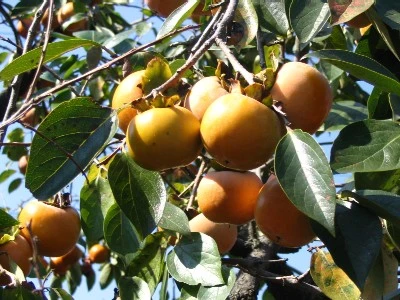
Prunus salicina
A deciduous tree bearing drupes with yellow-pink flesh.
Prunus salicina, also known as the Chinese plum or Japanese plum, is a small deciduous tree native to China, Taiwan, and Southeast Asia. It is widely cultivated for its fruit and should not be confused with Prunus mume or the loquat.
Quick Facts
- Species
- salicina
Facts from the source article.
Did You Know?
- The specific epithet salicina derives from the Latin word for willow, referencing the leaf shape.
- The Latin generic name Prunus comes from the Ancient Greek προύνη (proúnē), meaning plum.
- In Swedish, the plant is called Japanskt plommon.
Description
The Japanese plum tree can grow 9 to 12 meters tall. Its branches are purplish- to reddish-brown, and its lateral shoots are yellowish-red. The leaves are 6 to 12 centimeters long and 2.5 to 5 centimeters wide, with scalloped edges that, when young, often mix in simple, gland-tipped teeth. Leaf shapes are usually oblong but can be obovate, narrowly elliptic, or rarely ovate.
The leaf base is wedge-shaped, and the tip ranges from pointed to having a slender tail. The upper leaf surface is dark green and shiny, with six or seven secondary veins on each side of the midvein that stop short of the edge. Winter buds are purplish red and rarely hairy along the scale margins. In early spring, around April, flowers about 2 centimeters across appear in groups of three, each with five white petals.
The flower stalk is 1.0 to 1.5 centimeters long. The sepals are oblong-ovate, roughly 5 millimeters, hairless on the outside, with loosely serrated edges and a pointed to blunt tip. The petals are white, oblong-obovate, with a wedge-shaped base and a jagged edge near the tip. The ovary is hairless, and the stigma is disc-shaped.
The fruit is a drupe 4 to 7 centimeters in diameter, with yellow-pink flesh. Its skin can be yellow, red, green, or purple and has a powdery coating. The pit is ovoid to oblong and wrinkled. This species is mostly self-incompatible and needs cross-pollination to set fruit.
Ecology
Prunus salicina depends strongly on endomycorrhizal relationships. An ectomycorrhizal association with Hebeloma hiemale increased net growth in a hybrid compared to chemical fertilizer, compost, or a control. In karst areas of China, the tree combined with certain mosses and herbs proved suitable for restoring eroded soil, though its fast growth and high output limited soil improvement by increasing nutrient absorption.
Cultivation
China is the main producer of Japanese plums, followed by the United States, Mexico, Italy, Spain, Pakistan, Korea, Australia, Chile, France, South Africa, and Argentina. In Vietnam, the Tam Hoa plum grown in Bắc Hà town is a famous variety. Japanese cultivars entered the United States in the late 19th century, where Luther Burbank hybridized P. salicina with other species to create cultivars such as 'Beauty', 'Santa Rosa', and 'Shiro'. Most fresh plums in North American supermarkets are P. salicina cultivars or hybrids. In France, Japanese plum production volumes surpassed those of European plums in 2020. The Community Plant Variety Office of the European Union registered 155 new Japanese plum cultivars from 1995 to 2021.
Uses
The fruit has a short shelf-life of 3–4 days at room temperature and 1–2 weeks in cold storage, so it is often made into jams, jellies, wine, and other beverages. Spices such as black pepper, coriander, cinnamon, and ginger are used in aromatized plum wine; the 'Santa Rosa' cultivar produces the best-quality wine. In China, candied fruits are preserved with sugar, salt, and liquorice. In Taiwan, liquor from P. salicina is mixed with P. mume liquor and oolong tea liquor to make wumeijiu.
In Japan, the fruit is pickled and colored similarly to P. mume, and summer festivals sell pickled fruits covered in mizuame candy called anzuame. Half-ripe fruit flavors a liqueur called sumomo shu. The fruit is used in Traditional Chinese medicine to enhance immunity and treat cancers. 'Crimson Globe' plums may serve as a source of antioxidants.
The fruit contains fiber and bioactive compounds such as vitamin C and phenolics, and ethanol extracts from the Japanese plum were the most effective Glucosyltransferase inhibitor among 400 herbs tested.
More in Japanese Fruit
Spotted an error? Know more?
Reader corrections go straight into our review queue. Suggest an edit · How this site is sourced