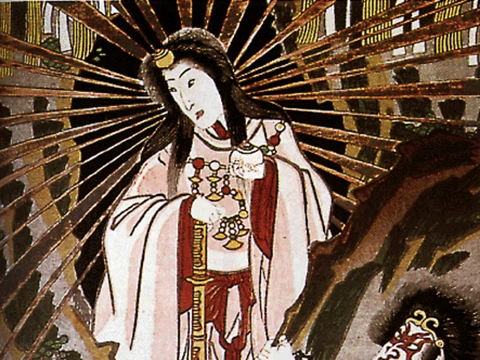
Abe no Seimei
Heian-era onmyōji and legendary figure in Japanese folklore.
Last updated
Abe no Seimei was a Japanese onmyōji and court official during the Heian period, also becoming a legendary figure in folklore.[1] The exact origins of Abe no Seimei remain uncertain, but according to Anderson, he was a descendant of the poet Abe no Nakamaro.[2][3]
Key facts and history
From the late 10th century, the Onmyōryō was controlled by the Abe clan due to Seimei's reputation.[4] The mystical pentagram known as the Seiman was originally his personal seal, later becoming the symbol for Onmyōdō.[5] According to legend, his mother Kuzunoha was a kitsune, and he was allegedly able to command weak oni by age five.[6] After his death, Emperor Ichijo made a shrine in his honor, the Seimei Jinja, erected at his home in 1007 AD.[7]
The original shrine was destroyed in war during the fifteenth century but was rebuilt in the same location and still stands today.[7] After Kamo no Yasunori, Seimei took over the roles of astrology and divination, while the calendar-making duties, considered less significant, went to Yasunori's son.[8] Among Seimei's responsibilities were the investigation of unusual occurrences, the performance of exorcisms, protection against malevolent spirits, and carrying out geomancy rituals.[8] Legends attribute to him remarkable abilities in predicting the gender of unborn children and locating misplaced items.[1]
The Konjaku Monogatarishu recounts that Seimei foresaw Emperor Kazan's decision to step down from the throne after studying the heavens.[1]
What the cited sources add
The Seimei Jinja in Kyoto enshrines Abe no Seimei, a contemporary of Murasaki Shikibu, and his birthplace is said to have been Abemonju-in Temple in Sakurai.[9] Japanese figure skater Yuzuru Hanyu portrayed Abe no Seimei in his Olympic free skate program Seimei, using the soundtrack of the Onmyōji movies.[10][11] With that program, Hanyu became the first skater to score above 200 points in the free skate and set back-to-back world records in the 2015–16 season.[10] The 2021 Chinese film The Yinyang Master is an adaptation of a NetEase game based on Baku Yumemakura's novel series Onmyōji.[12][13]
That game follows Abe no Seimei on a quest to retrieve his lost memories, joined by shikigami spirits.[13] A renovation of the shrine took place in 2005, during which pentagrams were added as decoration.[14] Visitors can purchase amulets at the shrine that feature pentagrams and the Chinese bellflower, both of which are linked to Seimei.[14]
References
- Wikipedia, "Abe no Seimei" (CC BY-SA 4.0), which cites: Miller, Laura. "Extreme Makeover for a Heian-era Wizard". Mechademia 3: Limits of the Human. Minneapolis: University of Minnesota Press, 2008. 33. (original not read by us) en.wikipedia.org
- Wikipedia, "Abe no Seimei" (CC BY-SA 4.0), which cites: ; ; ; (original not read by us) en.wikipedia.org
- Wikipedia, "Abe no Seimei" (CC BY-SA 4.0), which cites: Anderson, William. Descriptive and Historical Catalogue of a Collection of Japanese and Chinese Paintings in the British Museum. London: Longman's & Co., 1886. (original not read by us) en.wikipedia.org
- Wikipedia, "Abe no Seimei" (CC BY-SA 4.0), which cites: Itō, Satoshi. Shinto — a Short History. New York: RourledgeCurzon, 2003. 98. ( ) (original not read by us) en.wikipedia.org
- Wikipedia, "Abe no Seimei" (CC BY-SA 4.0), which cites: Miller. Extreme Makeover. 44 (original not read by us) en.wikipedia.org
- Wikipedia, "Abe no Seimei" (CC BY-SA 4.0), which cites: Goff. Conjuring Kuzunoha. 269–270. (original not read by us) en.wikipedia.org
- Wikipedia, "Abe no Seimei" (CC BY-SA 4.0), which cites: Miller, "A wizard shrine charms girls and women", Japan Notes, 2011, p. 3; "Seimei Shrine", The Tale of Genji, 2007; Dougill, John. Kyoto: a Cultural History. New York: Oxford University Press, 2005. 19. (we also read that source) en.wikipedia.org
- Wikipedia, "Abe no Seimei" (CC BY-SA 4.0), which cites: Mikami, Yoshio. "The Development of Mathematics in China and Japan." Abhandlungen zur Geschichte der mathematischen Wissenschaften mit Einschluss ihrer Anwendun; Goff, Janet. Conjuring Kuzunoha from the World of Abe no Seimei. A Kabuki Reader: History and Performance, ed. Samuel L. Leiter. New York: M. E. Sharpe, 2001. 2 (original not read by us) en.wikipedia.org
- "Seimei Shrine", The Tale of Genji, 2007. facts only, no text reused. taleofgenji.org
- Wikipedia, "Abe no Seimei" (CC BY-SA 4.0), which cites: "Figure skating: Hanyu to skate to "Onmyoji" during Olympic season", Kyodo News, August 9, 2017; nonno.hpplus.jp, October 7, 2021 (we also read that source) en.wikipedia.org
- "Figure skating: Hanyu to skate to "Onmyoji" during Olympic season", Kyodo News, August 9, 2017. facts only, no text reused. english.kyodonews.net
- Wikipedia, "Abe no Seimei" (CC BY-SA 4.0), which cites: Rui, "'The Yinyang Master' brings mobile game to the big screen", China Internet Information Center, 2021-02-09; Brzeski, "Netflix Acquires Chinese Fantasy Film 'The Yin Yang Master'", Hollywood Reporter, 2021-02-09; Rui, "'The Yinyang Master' brings mobile game to the big screen", China Internet Information Center, 2021-02-09 (we also read that source) en.wikipedia.org
- Rui, "'The Yinyang Master' brings mobile game to the big screen", China Internet Information Center, 2021-02-09. facts only, no text reused. china.org.cn
- Wikipedia, "Abe no Seimei" (CC BY-SA 4.0), which cites: Miller, "A wizard shrine charms girls and women", Japan Notes, 2011, p. 3 (original not read by us) en.wikipedia.org
Each numbered sentence above was checked against the source it cites before publication. Sentences citing Wikipedia adapt text from the English Wikipedia article Abe no Seimei (contributors), used under CC BY-SA 4.0; this entry is available under the same licence. Other sources were used for facts only; no text or images are copied from them.
More in Japanese folklore
Sources
Compiled from Wikipedia and the sources listed below. Text from Wikipedia is available under CC BY-SA 4.0; this entry is adapted from it.
- Wikipedia: Abe no Seimei (CC BY-SA 4.0).
Spotted an error? Know more?
Reader corrections go straight into our review queue. Suggest an edit · How this site is sourced