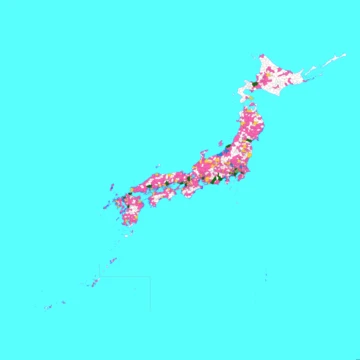
Kōchi, Kōchi
Capital of Kōchi Prefecture on Shikoku, Japan.

via Wikipedia: Kōchi, Kōchi · see source
Kōchi, the capital of Kōchi Prefecture, is situated on the southern coast of Shikoku Island, facing the Pacific Ocean. The city’s geography is divided into three distinct sections: a narrow alluvial plain at the head of Urado Bay, which forms the urban core and is crossed by the Kagami and Kokubu rivers; a mountainous northern region, where the highest point is Mount Kuishi at 1,176 meters; and a hilly southern area around Urado Bay and a strip of coastline, which houses port-related industry and residential zones. The city experiences a very wet humid subtropical climate, receiving roughly twice the rainfall of Shikoku’s other major cities, Matsuyama and Takamatsu, and is the most typhoon-prone major city in Japan due to its direct exposure to the open Pacific. Historically, the area was part of ancient Tosa Province. The river plain was first settled as a castle town after Yamauchi Kazutoyo chose the site for Kōchi Castle in 1601, replacing earlier seats of the Chōsokabe clan. The city’s name comes from the castle. During the Meiji Restoration, Kōchi became known as a center for pro-imperial ideology and later for incubating democratic and human rights movements. It was incorporated as a modern municipality on April 1, 1889. A tram service began in 1904, and the city connected to the national rail network in 1951. On July 3, 1945, during World War II, 129 U.S. aircraft dropped 1,060 tons of incendiary bombs, destroying 48% of built-up areas, killing 401 civilians, and leaving over 40,000 homeless. Kōchi was designated Shikoku’s first core city on April 1, 1998. Subsequent mergers incorporated the villages of Kagami and Tosayama in 2005, and the town of Haruno in 2008. The city’s population grew rapidly in the 1960s and 1970s, peaked around 2000, and has since declined.
- population
- 311,224 (as of 1 April 2023)
- area
- 309.00 km²
- population_density
- 1,000 persons per km²
- founded
- April 1, 1889 (city incorporation)
- country
- Japan
- region
- Shikoku
- known_for
- Kōchi Castle, katsuo tataki, Yosakoi festival
Verified Timeline
Lore & Background
Kōchi was originally settled as a castle town around Kōchi Castle, built in 1601 by Yamauchi Kazutoyo to replace the earlier seats of the Chōsokabe clan. The city takes its name from that of the castle. During the Meiji Restoration, Kōchi became famous as a centre of pro-imperial ideology, and later for incubating democratic and human rights movements. The city was incorporated on April 1, 1889, with the establishment of the modern municipalities system. Tram service began on May 2, 1904, and the city was connected to the national rail network on November 12, 1951. On July 3, 1945, at 6:22 pm (JST), 129 aircraft took off to bomb Kōchi. 1,060 tons of incendiary bombs were dropped, destroying 48% of the built up areas of the city, killing 401 civilians and rendering over 40,000 homeless. The city was designated as the first core city on Shikoku on April 1, 1998. It expanded through mergers: the villages of Kagami and Tosayama on January 1, 2005, and the town of Haruno on January 1, 2008. Kōchi has a mayor-council form of government with a directly elected mayor and a unicameral city council of 42 members. The current mayor since 2023 is Ryugo Kuwana. The city is home to two universities, Kōchi University (national) and University of Kochi (prefectural). Its most famous dish is katsuo tataki, made by lightly searing and seasoning bonito.
Reader's Guide
Kōchi's significance lies in its role as the political, commercial, and industrial hub of Kōchi Prefecture, holding over 40% of the prefectural population. Its history as a castle town under the Tosa Domain and its later prominence in pro-imperial and democratic movements during the Meiji period mark it as a key site in Japanese regional history. The city's survival and reconstruction after the devastating 1945 air raid, which destroyed 48% of built-up areas and killed 401 civilians, underscore its resilience. Kōchi's designation as the first core city on Shikoku in 1998 reflects its administrative importance. Culturally, the city is known for the Yosakoi festival held in August, its Sunday street markets close to a kilometre in length, and the preserved Kōchi Castle, which still exists in its pre-restoration form. Notable figures from Kōchi include Sakamoto Ryōma (1836–1867), samurai and politician, and botanist Tomitaro Makino (1862–1957). The city's wet subtropical climate is the most typhoon-prone of Japan's major cities, and has twice received over 50 cm of rainfall in a day from a typhoon. Its urban character is shaped by the tram service run by Tosaden Kōtsū and JR Shikoku's Dosan Line. Its legacy is that of a regional capital that balances historical heritage with modern governance and economic activity.
Did You Know?
- Kōchi has twice received over 50 cm (20 in) of rainfall in a single day from a typhoon.
- The city's tram service began on May 2, 1904, making it one of Japan's older tram systems.
- Kōchi was the first city on Shikoku to be designated as a core city, on April 1, 1998.
- The Yosakoi festival, held in August, features thousands of dancers performing at various places around the city.
- The city's most famous dish, katsuo tataki, is made by lightly searing and seasoning bonito.
Frequently Asked Questions
Who is Kōchi, Kōchi?
Kōchi is the capital city of Kōchi Prefecture, located on the Shikoku island of Japan. It functions as the prefecture's administrative seat and its largest urban center.
What role does Kōchi, Kōchi play in the prefecture?
As the primate city of Kōchi Prefecture, it anchors the region's commercial and industrial activity. More than 40 percent of the prefectural population lives within its borders, making it the clear economic and demographic hub of Shikoku's southern coast.
What is Kōchi, Kōchi's historical significance?
The city grew around Kōchi Castle, which served as the seat of the Tosa Domain's daimyō. During the Meiji era it became a notable birthplace of pro-imperial thought and early democratic activism in Japan.
How large is Kōchi, Kōchi in terms of population and area?
As of April 2023 the city had roughly 311,224 residents spread across 309 square kilometres, giving it a density of about 1,000 people per square kilometre.
When was Kōchi, Kōchi officially established as a city?
Kōchi received its municipal incorporation on April 1, 1889, marking the formal creation of the modern city within the new Meiji-era local-government framework.
More in Japanese Cities 1-23
Spotted an error? Know more?
This is a living reference — every entry is fact-audited, and reader corrections feed straight into our audit queue. Suggest an edit · See this site's audit record