Nagasaki
Capital of Nagasaki Prefecture on Kyushu, Japan.
Last updated
Where it is
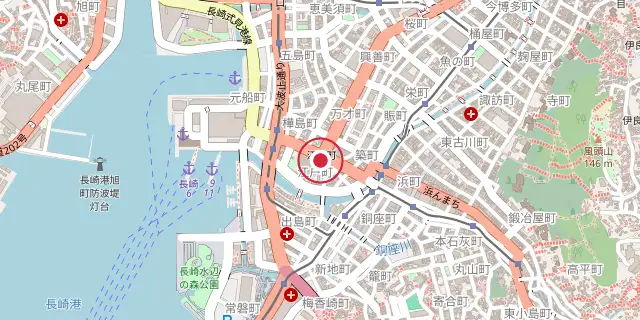
Coordinates: 32°44′42″N 129°52′26″E (32.7450, 129.8740) · Open in OpenStreetMap
Coordinates and connected clubs: the infobox of Wikipedia: Nagasaki (CC BY-SA 4.0). Map: drawn by Codexery from OpenStreetMap tiles.
Nagasaki, the capital and largest city of Nagasaki Prefecture on Kyushu, was founded by the Portuguese. Its port was Japan’s only trading link with the Portuguese and Dutch from the 1500s to the 1800s. During World War II, it became the second city ever hit by an atomic bomb, and was later rebuilt.
History
The first recorded contact between Portuguese explorers and Japan occurred in 1543, when a Portuguese ship, possibly a Chinese junk carrying Portuguese sailors, landed on Tanegashima. Two Portuguese traders, António Mota and Francisco Zeimoto, were among the crew and introduced harquebuses to the Japanese. The local lord Tanegashima Tokitaka purchased two firearms and had them replicated, leading to the Tanegashima matchlock. Portuguese ships soon began regular trade with Japan, serving as intermediaries with China after Japan had severed ties due to wokou piracy.
The lack of a proper seaport in Kyūshū for foreign ships posed a problem for merchants and daimyōs. Spanish Jesuit missionary St. Francis Xavier arrived in Kagoshima in 1549; after two years in Japan he left for China in 1552 and died soon after. His followers converted several daimyōs, notably Ōmura Sumitada. In 1569, Ōmura granted a permit for a port in Nagasaki, established in 1571 under Jesuit missionary Gaspar Vilela and Portuguese Captain-Major Tristão Vaz de Veiga, with Ōmura's assistance.
Geography
Nagasaki and Nishisonogi Peninsulas lie within the city limits. The city is surrounded by Isahaya, Saikai, and the towns of Togitsu and Nagayo. Nagasaki sits at the head of a long bay forming the best natural harbor on Kyūshū. The main commercial and residential area occupies a small plain near the bay's end; two rivers divided by a mountain spur form the two main valleys.
The built-up area is confined by terrain to less than 4 square miles. Nagasaki has a humid subtropical climate with mild winters and long, hot, humid summers. It is among the wettest sizeable cities in Japan.
Summers bring persistent heat and high humidity, with wet-bulb temperatures sometimes reaching 26°C. Winters are drier and sunnier than Gotō to the west, and slightly milder than inland Kyūshū. The wettest month since 1878 was July 1982 with 1178 mm; the driest was September 1967 with 1.8 mm. Precipitation peaks in June and July; August is the warmest month. On January 24, 2016, 17 cm of snow fell.
Did You Know?
- The Nagasaki Lantern Festival is celebrated annually over the first 15 days of Chinese New Year and is the largest of its kind in Japan.
- Kunchi, the most famous festival in Nagasaki, is held from October 7–9.
- The Prince Takamatsu Cup Nishinippon Round-Kyūshū Ekiden, the world's longest relay race, begins in Nagasaki each November.
More in Japanese Cities
Sources
Compiled from Wikipedia and the sources listed below. Text from Wikipedia is available under CC BY-SA 4.0; this entry is adapted from it.
- Wikipedia: Nagasaki (CC BY-SA 4.0).
Spotted an error? Know more?
Reader corrections go straight into our review queue. Suggest an edit · How this site is sourced