Fall of the Fascist regime in Italy
Parallel plots and a no-confidence vote ended Mussolini's regime.
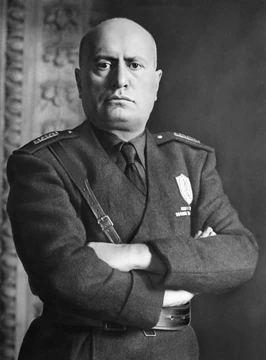
The fall of the Fascist regime in Italy, known in Italy as 25 Luglio, resulted from parallel plots by Dino Grandi and King Victor Emmanuel III during spring and summer 1943. A vote of no confidence against Prime Minister Benito Mussolini at the Grand Council of Fascism on 24–25 July 1943, though lacking de jure value, led to a new government and ended nearly 21 years of Fascist rule. Mussolini was placed under arrest.
Quick Facts
- Date
- 24–25 July 1943
- Location
- Rome, Italy
- Participants
- Benito Mussolini
- Duce of Fascism; ----Dino Grandi
- President of the Chamber
Facts from the source article.
Background
By early 1943, Italy faced defeat after the collapse of the African front in November 1942 and Allied landings in North Africa. The defeat of the ARMIR on the Eastern Front, heavy aerial bombings, and shortages of food and fuel demoralized the population, many of whom wanted to end the war and renounce the alliance with Nazi Germany. Italy required German aid to hold Tunisia, the last Axis stronghold in Africa. Mussolini believed the war could be decided in the Mediterranean, but at a meeting on 29 April 1943 in Klessheim, Adolf Hitler rejected his proposal for a separate peace with Russia and refused to send reinforcements to Tunisia, distrusting Italian resolve. Mussolini's health declined due to gastritis and duodenitis of nervous origin, often keeping him from effective governance. Four circles—the Royal Court, anti-Fascist parties, Fascists, and the General Staff—began seeking a way out. Aristocrats like Crown Princess Marie-José and pre-Fascist politicians independently contacted the Allies, but the Anglo-Americans, demanding unconditional surrender per the Casablanca declaration, awaited action from higher figures like the King. Anti-Fascist parties, weakened by dictatorship, waited for King Victor Emmanuel III, whose inaction stemmed from his character, fears, constitutional scruples, and concern that the monarchy might be doomed regardless of the war's outcome.
Two parallel plots
After the failed Feltre meeting and the first bombing of Rome, the crisis accelerated. On 20 July, Mussolini met Ambrosio twice, telling him he would write to Hitler about leaving the alliance. Ambrosio, angered by the missed opportunity at Feltre, offered his resignation, which Mussolini rejected, and Ambrosio then decided to set a putsch in motion. Meanwhile, Grandi and Luigi Federzoni estimated that among the 27 Grand Council members, 4 supported Grandi's document, 7 opposed it, and 16 were undecided. Grandi could not reveal that the document's approval would mean Mussolini's dismissal, the end of the Fascist Party, and war with Germany; only a few gerarchi understood this. He wrote the OdG in vague terms, beginning with a rhetorical appeal to the nation and armed forces, then calling for restoration of pre-Fascist institutions and laws, and ending with an appeal for the King to assume supreme civil and military power under Article 5 of the constitution. Grandi believed the King awaited such a signal. On 21 July, Mussolini ordered Scorza to convoke the Grand Council. Scorza, after seeing Grandi's OdG, agreed to support it but secretly prepared another OdG that concentrated power in the Fascist Party.
Events of 24–25 July 1943
At 17:00 on 24 July 1943, the 28 Grand Council members met in the parrot room of Palazzo Venezia. For the first time, neither Mussolini's bodyguard nor the 'M' battalions were present, though armed blackshirts occupied the yard and antechamber. No stenographer was present, so no minutes were taken. Grandi brought two hidden Breda hand grenades, having revised his will and gone to confession, expecting he might not leave alive. Mussolini began by summarizing the supreme command's history and war events, proposing moving the government to the Po Valley, and asking participants to choose between war or peace. He hoped to sway the undecided to vote for Scorza's OdG, which returned only military powers to the King. De Bono, Farinacci, and De Vecchi spoke after the Duce's introduction.
Aftermath
The Germans learned of Mussolini's arrest around 19:30 and informed Berlin; Hitler was infuriated. Farinacci went to the German embassy, where Kesselring suggested joining the armored Division 'M' to march on Rome and free the Duce, but Farinacci refused and flew to Munich. German units from the 44th Infantry Division and 36th Mountain Brigade entered Italy through the Brenner, Reschen, and Toblach passes, occupying South Tyrol, while other units crossed from the Julian and Piedmontese borders. From 26 July to 8 August, eight German divisions and one brigade moved into northern and central Italy without Italian consent—troops Hitler had denied Mussolini at Feltre. The forty-six days from Mussolini's arrest to the public notification of the Armistice of Cassibile on 8 September set off numerous actions. The 25 July communiqué stating 'The war goes on. Italy will be true to its word' did not deceive Hitler, who understood the regime change could lead to Italian defection. The Badoglio government made no initial contact with the Allies, while alternating between requests for help and obstructionism toward German forces. The King, after his activism on 25 July, became inactive, delegating action to d'Acquarone and Badoglio.
More in Italian Fascism
Spotted an error? Know more?
Reader corrections go straight into our review queue. Suggest an edit · How this site is sourced