Aldabra
A wonder of nature, Aldabra is the world's largest raised coral reef and a vital sanctuary for giant tortoises.
Last updated
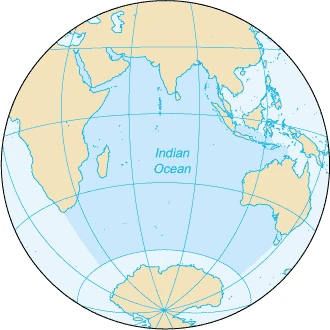
East of Africa lies Aldabra, which ranks as the second-largest coral atoll globally, with Kiritimati being the largest.[1][2] This atoll features a raised coral structure containing an extensive shallow lagoon; during low tide, roughly two-thirds of this lagoon's area becomes dry.[3][4] UNESCO designated Aldabra a World Heritage Site on 19 November 1982, and the Seychelles Islands Foundation holds responsibility for its management.[5][6]
Geography and history
The atoll is 34 km long and 13 km wide, with a total land area of 155.4 km².[4][3] Arab seafarers gave the atoll its name, originally Al-Hadra or Al-Khadra, for its harsh, sun-baked environment.[7] After World War II, commercial exploitation ended and restrictions were imposed on the number of people who could stay on the islands.[8] In 1511, Portuguese navigators made a visit to the atoll.[8]
Great Britain gained possession of Aldabra in 1810.[9] Following a Concession awarded by Seychelles authorities, the atoll saw its first permanent settlement in 1888.[10] Because the atoll lacked sufficient freshwater, attempts to cultivate coconuts, cotton, and sisal as plantation crops proved unsuccessful.[8]
What the cited sources add
The Aldabra Marine Programme was established following the discovery of extensive damage to the coral reef ecosystem caused by the 1998 Indian Ocean coral-bleaching event.[11] The Programme's primary goal was to establish the first permanent underwater survey sites for long-term, quantitative studies at Aldabra.[11] AMP surveys at Aldabra have been conducted in November 1999, February 2001 and 2002, May 2003, March 2004, April 2005 and December 2006.[11] In February 2002, three new permanent monitoring sites were established: two on Assomption and Astove (both in the Aldabra group) and one on St. Pierre (located in the Farquhar group).[11]
That same publication reports that the Madagascar fody, after its introduction to Assumption Island, subsequently expanded its range to Aldabra.[12][13]
References
- Wikipedia, "Aldabra" (CC BY-SA 4.0), which cites: Matthew Murrie, "The First Book of Seconds: 220 of the Most Random, Remarkable, Respectable (and Regrettable) Runners-Up and Their Almost Claim to Fame", Adams Media, 21 September 2010, p. 180 (we also read that source) en.wikipedia.org
- Open Library record, ISBN 9781440510687 ("The first book of seconds"). CC0 (metadata); book content not read. openlibrary.org
- Wikipedia, "Aldabra" (CC BY-SA 4.0), which cites: Coe 1998 (original not read by us) en.wikipedia.org
- Wikipedia, "Aldabra" (CC BY-SA 4.0), which cites: SwinglandKlemens 1989; Carpin, Sarah,(1998) Seychelles, Odyssey Guides, p. 161, The Guidebook Company Limited, Accessed 22 June 2008 (original not read by us) en.wikipedia.org
- Wikipedia, "Aldabra" (CC BY-SA 4.0), which cites: MairBeckley 2012; "Ramsar", Official web site of Ramsar (original not read by us) en.wikipedia.org
- Wikipedia, "Aldabra" (CC BY-SA 4.0), which cites: MairBeckley 2012; Seychelles Islands Foundation. Accessed 22 June 2008; "Aldabra Atoll", Unesco; "Aldabra atoll", Bird Life Organization; "Aldabra Atoll", Unesco (original not read by us) en.wikipedia.org
- Wikipedia, "Aldabra" (CC BY-SA 4.0), which cites: Dodd, "Mauritius, Réunion and Seychelles", Lonely Planet, 2004, p. 268; Anthony Cheke, "Timing of arrival of humans and their commensal animals on the western Indian Ocean oceanic islands"; "Aldabra Atoll: Aldabra Group", Tourism Department of Seychelles (original not read by us) en.wikipedia.org
- Wikipedia, "Aldabra" (CC BY-SA 4.0), which cites: MairBeckley 2012 (original not read by us) en.wikipedia.org
- Wikipedia, "Aldabra" (CC BY-SA 4.0), which cites: Anthony Cheke, "Timing of arrival of humans and their commensal animals on the western Indian Ocean oceanic islands" (original not read by us) en.wikipedia.org
- Wikipedia, "Aldabra" (CC BY-SA 4.0), which cites: Aldabra from Ministry of environment website; Anthony Cheke, "Timing of arrival of humans and their commensal animals on the western Indian Ocean oceanic islands"; MairBeckley 2012 (original not read by us) en.wikipedia.org
- "Aldabra", Aldabra Foundation Organization. facts only, no text reused. aldabra.org
- Open Library record, ISBN 9782880326012 ("The IUCN amphibia-reptilia red data book"). CC0 (metadata); book content not read. openlibrary.org
- Wikipedia, "Aldabra" (CC BY-SA 4.0), which cites: Brian Groombridge, "Iucn Amphibia-Reptilia Red Data Book", IUCN, 1982, p. 79– (we also read that source) en.wikipedia.org
Each numbered sentence above was checked against the source it cites before publication. Sentences citing Wikipedia adapt text from the English Wikipedia article Aldabra (contributors), used under CC BY-SA 4.0; this entry is available under the same licence. Other sources were used for facts only; no text or images are copied from them.
More in Islands Of The Indian Ocean
Sources
Compiled from Wikipedia and the sources listed below. Text from Wikipedia is available under CC BY-SA 4.0; this entry is adapted from it.
- Wikipedia: Aldabra (CC BY-SA 4.0).
Spotted an error? Know more?
Reader corrections go straight into our review queue. Suggest an edit · How this site is sourced