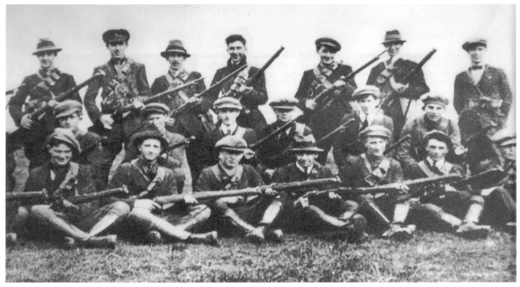
The Troubles in Ulster (1920–1922)
Sectarian conflict in Ulster during and after the Irish War of Independence.
The Troubles in Ulster of the 1920s was a period of communal conflict in the Irish province of Ulster from June 1920 until June 1922, occurring during and after the Irish War of Independence and the partition of Ireland. It was primarily a sectarian struggle between unionists, who were mainly Ulster Protestants, and nationalists, who were mainly Irish Catholics. The violence was most intense in Belfast, where more than 500 people were killed, 500 interned, and 23,000 made homeless, with the term 'Belfast Pogrom(s)' used due to the disproportionate number of Catholic casualties and sustained attacks involving police or special constabulary forces.
Quick Facts
- Duration
- June 1920 – June 1922
- Location
- Ulster, primarily Belfast
- Total killed in belfast
- more than 500
- Interned in belfast
- 500
- Made homeless in belfast
- 23,000
- Fled the province
- approximately 50,000
- Nationalist proportion of victims
- 73%
Facts from the source article.
Background
Before 1922, the whole island of Ireland belonged to the United Kingdom. Most Irish people were Catholic nationalists, seeking either self-rule or full independence. But in the northeast, a Protestant and unionist majority had grown, mainly because of the 1600s Plantation of Ulster. The push for Irish home rule stretched back decades. Britain’s first Home Rule Bill, in 1886, sparked violent resistance from Ulster unionists, with between 31 and 50 deaths during riots in June and July of that year. A second bill in 1893 led to more unrest, including Catholic workers being forced out of Belfast’s shipyards. Belfast saw regular riots throughout the 1800s, starting as early as 1815, with serious outbreaks in 1835 (two rioters shot dead), 1841, 1843, 1857, 1864, 1872, 1880, 1884, and 1898. By 1912, the city experienced what was called “fullscale sectarian rioting,” which deepened the divide between Catholics and Protestants. Home rule for all Ireland was scheduled under the Government of Ireland Act 1914. During the crisis that followed, from 1912 to 1914, unionists threatened to use violence to block any Irish government. They created a paramilitary group, the Ulster Volunteers (or Ulster Volunteer Force), and smuggled in weapons. On 20 March 1914, the Curragh Mutiny saw British Army officers declare they would rather resign or be dismissed than enforce the Home Rule Act. Unionists then argued that if home rule could not be stopped, at least part of Ulster should be kept out. The Government of Ireland Act 1920 split Ireland along existing county borders, forming two self-governing regions inside the UK: Northern Ireland, with Belfast as its capital, and Southern Ireland, with Dublin as its capital. The six Ulster counties unionists thought they could control were Antrim, Down, Armagh, Londonderry, Tyrone, and Fermanagh. Most Irish nationalists rejected this partition. In the 1918 general election, five of Ulster’s nine counties voted for Sinn Féin or Irish nationalist candidates.
Troubles
The conflict in Derry began in April 1920 with a clash on Long Tower Street, where Protestants and Catholics fought for an hour while republican prisoners were moved to Bishop Street jail. On 18 April, Catholics rioted in the city center, leading to gunfire entering the Bogside and a bayonet charge by the Royal Irish Constabulary. A four-hour gun battle on 14 May between the RIC and the Irish Republican Army ended with the death of the local RIC Special Branch chief. In reaction, loyalists revived the Ulster Volunteer Force, set up roadblocks, and abused Catholics crossing Carlisle Bridge; one Catholic, a wounded war veteran, was killed. On 13 June, the UVF attacked Catholics at Prehen Wood, triggering fierce rioting at the junction of Long Tower Street and Bishop Street. This wave of violence lasted a week. At least nineteen people died or were fatally wounded: fourteen Catholics and five Protestants. By 18 June, unrest reached the Protestant Waterside area, where Catholic homes were burned. The UVF, joined by former soldiers, took the Guildhall and the Diamond, and beat back an IRA counterattack. In the Catholic Bogside, the IRA burned Protestants out of their homes and shot two dead. Loyalists in the Fountain neighborhood fired into nearby Catholic streets. The IRA, carrying rifles and machine guns, occupied St Columb’s College, which became a site of heavy gunfire. The IRA’s General Headquarters sent two senior officers, Peadar Clancy and Dick McKee, to help. On 23 June, 1,500 British troops arrived to restore order, martial law was declared, and a destroyer anchored on the River Foyle near the Guildhall. The military did not stop the violence. In the last week of June, after the army’s arrival, six more people died: four Catholics and two Protestants. Some accounts say soldiers killed six Catholics in the Bogside with heavy machine-gun fire. By the end of this period, forty people had lost their lives.
Aftermath
By late June 1922, Belfast had grown calmer, and the IRA’s push in the north had run out of steam. A few key factors explain this shift. The Northern government cracked down hard, introducing internment at the end of May, which quickly weakened the IRA’s northern wing. Within four months, 446 republicans and nationalists were locked up, a number that climbed to 700 by December 1924. Of those, 263 were held on the HMS Argenta, a prison ship moored in Belfast Lough that earned the nickname “floating gulag.” The Ulster Special Constabulary, with 19,400 members in its A and B units, also presented a challenge the northern IRA simply could not overcome. Meanwhile, nationalists in the South were increasingly consumed by the growing rift between pro-treaty and anti-treaty factions. In early June, the Irish Provisional Government chose a “policy of peaceful obstruction” toward the North, and Michael Collins halted his use of force. The Irish Civil War erupted on 28 June 1922, pulling the IRA’s focus away from its northern campaign. Many IRA men from the North headed south to join the newly formed Free State Army. That same June, the Belfast IRA launched an arson spree, but the government responded quickly and harshly. Seamus Woods, the IRA’s Belfast leader, described the grim reality: “The enemy are continually raiding and arresting; the heavy sentences and particularly the flogging making the civilians very loath to keep wanted men or arms.” Michael Collins’s death on 22 August was another heavy blow. He had secretly supplied weapons and support to the northern IRA, and his loss made many fighters there believe their cause was hopeless. Roger McCorley, head of the IRA’s Belfast Brigade, put it bluntly: “When Collins was killed the northern element (of the IRA) gave up all hope.” Hopes that the Irish Boundary Commission might transfer large chunks of Northern territory to the new Free State may have also helped quiet the violence. By the close of 1922, Northern Ireland was largely peaceful, a calm that held through 1924, when internment ended and the Belfast curfew was finally lifted.
More in Irish War of Independence
Spotted an error? Know more?
Reader corrections go straight into our review queue. Suggest an edit · How this site is sourced