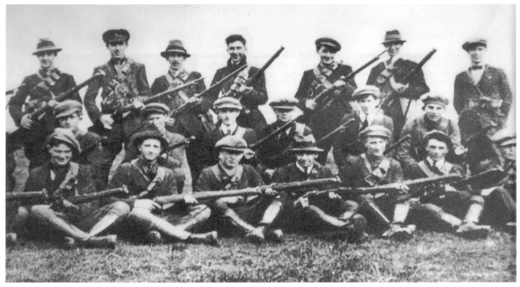
Irish Republican Police
Police force of the 1919–1922 Irish Republic.

via Wikipedia: Irish Republican Police · see source
The Irish Republican Police (IRP; Poilíní Poblachtacha na hÉireann) was the police force of the 1919–1922 Irish Republic, administered by the Department for Home Affairs. It was established to provide security for the Republican Courts, enforce Dáil decrees, and maintain general order. Its existence was also intended to undermine the authority of the Royal Irish Constabulary.
Quick Facts
- Abbreviation
- IRP
- Formed
- 1920
- Dissolved
- 1922
- Superseding
- Civic Guard
- Country
- Irish Republic
Facts from the source article.
Foundation
The Irish Republican Police was established between April and June 1920, operating under the authority of Dáil Éireann. Its creation was driven by IRA Chief of Staff Richard Mulcahy and Minister for Defence Cathal Brugha. Control later passed to Minister for Home Affairs Arthur Griffith, then to his successor Austin Stack. Simon Donnelly, an IRA staff officer, became Chief of Police. Initially, only six full-time officers served in Dublin. Donnelly then directed that a paid policeman be appointed to each of the seventy-two IRA Brigade areas, with most recruits coming from IRA volunteers. The force secured Republican Courts, enforced their rulings, carried out Dáil decrees, and kept general order. It also handled routine tasks like licensing enforcement, theft cases, and street patrols. Propagandistically, the IRP demonstrated Ireland’s secession from the United Kingdom and aimed to weaken the Royal Irish Constabulary’s authority. By 1920, the force operated in twenty-one of Ireland’s thirty-two counties. In June 1920, the Irish Bulletin claimed that within thirteen days, the IRP had arrested eighty-four criminals across twenty-four counties.
Functioning
The IRP faced considerable difficulties enforcing its authority, as it was considered illegal by the Dublin Castle administration and members sometimes clashed with Crown forces. On 22 July 1920 in Clonsilla, IRP members James Cogan and Harry Sheridan arrested a suspected cattle thief, John Farrelly. When their commandeered vehicle encountered a British Army checkpoint, a shootout killed Cogan and wounded Sheridan and Farrelly. During and briefly after the war, the Royal Irish Constabulary repeatedly challenged the Dáil Courts and threatened judges with prosecution. Confusion between civil and military structures also hampered operations; for individual volunteers, their IRA military role and IRP police function were not always clearly differentiated, nor was this difference obvious to the public. The IRP had no permanent jails or prisons. Improvised solutions included expelling offenders from the area or country. In one incident, three offenders banished by a Republican Land Court to an island off County Clare for three weeks refused rescue by the RIC, declaring that as citizens of the Irish Republic the RIC had no jurisdiction. Abandoned buildings, such as a former barracks in the Nire Valley in the Comeragh Mountains, were used for detention. A suggestion by the Chief of Police that 'incorrigible criminals' be flogged was rejected by his superiors as 'a barbarous form of punishment'.
Policing emigration
On 4 June 1920, Cathal Brugha as Minister for Defence issued a manifesto condemning those who had emigrated during the war as 'deserters' and 'degenerates'. A Dáil proclamation followed with instructions for obtaining an Emigration Permit. For travel other than to Britain, a British Passport and often a visa were required. The Republican Police were responsible for issuing permit application forms, forwarding them with a five-shilling fee to the Minister for Home Affairs, and transmitting the permit or a letter of refusal. Local IRP members noted the irony of enforcing deportation orders while preventing voluntary emigration of people they knew. Considerable correspondence from local officials sought a more lenient interpretation of the ban. Because the ban was rigidly applied with little prospect of enforcement, it was widely ignored, further undermining local officers' authority. The Department responded by ordering shipping companies and emigration agents not to accept money from prospective migrants without a permit, under threat of their premises being raided or burned. The manager of Thomas Cook's offices on Grafton Street, Dublin, narrowly avoided being killed for persistent non-compliance; Simon Donnelly had ordered him shot, but Austin Stack decided instead to destroy the offices. The operation was scheduled for the morning of 11 July 1921 but was not carried out before the Truce took effect at noon.
Civil war and replacement of IRP
On 25 August 1922, following the outbreak of civil war, the Adjutant-General of the National Army, Gearóid O'Sullivan, addressed Kevin O'Higgins, Acting Minister of Home Affairs, in an internal memorandum about local policing in Cork. O'Sullivan reported that before and during the Irregular occupation of Cork, the IRP had policed the city, paid by merchants who voluntarily contributed up to £200. They were considered fairly efficient in preventing ordinary crime, but when the Irregulars fled at the approach of National Forces, Cork was left without a police force, and robbery, burglary, and looting became rife. O'Sullivan confirmed authorisation for a force of one hundred locally recruited men, paid £3 6s 0d per week by the government, called the Cork City Civil Patrol. Recruiting began on 11 August, drawing from 'neutral' IRA men and Irishmen formerly in the British Army and Royal Navy. They were to be augmented by 50 Civic Guards from Dublin, and suitable members would be gradually absorbed into the new national police force. The Cork police were unarmed and wore a white brassard with the letters CCP in black. Each new member took a pledge to obey the lawful orders of Captain Joseph MacCarthy or any other officer nominated by General Dalton, acknowledging that employment was purely temporary and terminable on one week's notice.
More in Irish War of Independence
Spotted an error? Know more?
Reader corrections go straight into our review queue. Suggest an edit · How this site is sourced