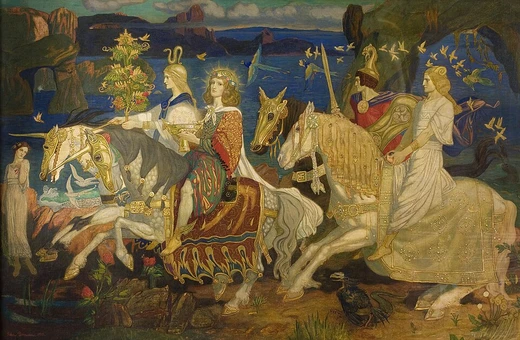
Echtra Cormaic
A high-king's journey to the Land of Promise.

via Wikipedia: Echtra Cormaic · see source
Echtra Cormaic, or Echtra Cormaic i Tir Tairngiri (Cormac's Adventure in the Land of Promise), is a tale in Irish mythology which recounts the journey of the high-king Cormac mac Airt to the Land of Promise resided by the sea-god Manannán mac Lir.
Quick Facts
- Full manuscript title
- (Scel na Fir Flatha,) Echtra Cormaic i Tir Tairngiri ocus Ceart Claidib Cormaic
- First recension date
- 1150–1200
- Second recension manuscript
- Book of Fermoy
- Third recension title
- Fagháil Chraoibhe Cormaic
- Third recension language
- late Middle Irish
Facts from the source article.
Texts
The full manuscript title of this tale, as edited by Whitley Stokes, is "(Scel na Fir Flatha,) Echtra Cormaic i Tir Tairngiri ocus Ceart Claidib Cormaic." Stokes translated it as "The Tale of the Ordeals, Cormac’s Adventure in the Land of Promise, and the Decision as to Cormac’s Sword." His edition uses the Book of Ballymote as its main source, with additional readings from the Yellow Book of Lecan. These two manuscripts show only small differences and together form the first recension, which linguistic evidence dates to between 1150 and 1200, based on an earlier exemplar. A second recension appears in the Book of Fermoy, edited and translated by Vernam Hall, with an excerpt also translated by Eugene O'Curry. The story is also called Fagháil Chraoibhe Cormaic, edited by Standish H. O'Grady and translated as "How Cormac mac Airt Got his Branch." This version belongs to a third recension in late Middle Irish. The manuscript O'Grady used is unknown, but nine other paper manuscripts survive, none older than 1699. O'Grady's translation was shortened and reprinted in one of Joseph Jacobs's anthologies. Lady Augusta Gregory retold the narrative as the chapter "His Three Calls to Cormac" in her book Gods and Fighting Men.
Summary
High King Cormac mac Airt was at the Hill of Tara when a stranger approached him. The stranger carried a Silver Branch adorned with three golden apples; its music could put anyone to sleep. Cormac accepted the branch, promising the stranger three wishes in return, to be claimed later. A year passed, and the stranger returned. First, he asked for Cormac’s daughter, then his son, and finally his wife, Eithne. Furious, Cormac chased the stranger across the land until a magical fog swallowed him. When the fog lifted, Cormac stood before a castle ruled by a different stranger. Inside, a pig was presented, but it could not be roasted until a true story was told for each of its four quarters. Cormac recounted how his family had been taken, and the pig cooked fully. When the meat was served, Cormac remarked that he only dined with fifty men. The host then sang a magical lullaby, and Cormac fell asleep. He awoke to find himself surrounded by fifty warriors, his wife, and his children. The host revealed his true identity: Manannán mac Lir, the sea god, who had been the stranger with the Silver Branch. He had set these trials so Cormac could journey to his realm, Tír na nÓg. Manannán allowed Cormac to return to Ireland with his family, the Silver Branch, and a magical cup that shattered upon hearing a lie and reformed when truth was spoken. He warned, however, that these treasures were only for Cormac’s lifetime. After Cormac died, neither the branch nor the cup was ever seen in Ireland again.
More in Irish Mythology
Spotted an error? Know more?
Reader corrections go straight into our review queue. Suggest an edit · How this site is sourced