Croagh Patrick
A holy mountain and pilgrimage site in County Mayo, Ireland.
Last updated
Where it is
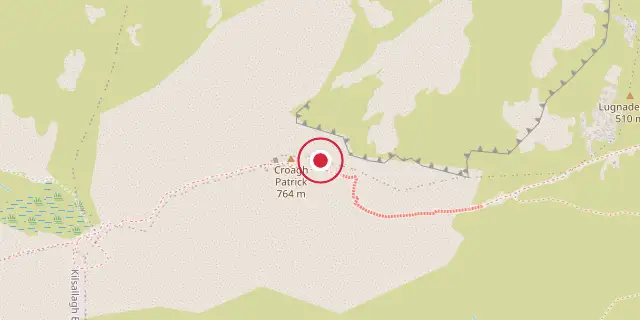
Coordinates: 53°45′36″N 9°39′29″W (53.7600, -9.6580) · Open in OpenStreetMap
Coordinates and connected clubs: the infobox of Wikipedia: Croagh Patrick (CC BY-SA 4.0). Map: drawn by Codexery from OpenStreetMap tiles.
Croagh Patrick is a 764 m mountain in County Mayo, Ireland, known locally as "the Reek"[1][2] For many centuries, this location has been regarded as a sacred mountain and serves as a key destination for pilgrims.[1][3] The Irish language name Cruach Phádraig, which translates to "(Saint) Patrick's stack", is the origin of the mountain's English name.[2]
Key facts and history
Archaeologist Christiaan Corlett writes that Croagh Patrick was a spiritual focus since at least the Neolithic period and became the center of an extensive ritual landscape during the Bronze Age.[4] The Boheh Stone, an outcrop with over 260 ancient carvings, is located east of the mountain.[5] The 9th century Bethu Phátraic describes Patrick being harassed by demonic birds on the peak, which he banished by ringing his bell.[6] Observers at the Boheh Stone witness the setting sun descend along Croagh Patrick's slope on April 18 and August 24 each year.[7]
According to the 7th-century writer Tírechán, Saint Patrick observed a forty-day fast while on the mountain.[6][7] Archaeological findings indicate a stone oratory occupied the summit from the 5th century onward, and the present chapel received its dedication on July 20, 1905.[8] During the 1980s, a gold vein was found within the mountain, but local opposition stopped any mining operations.[9]
What the cited sources add
The Croagh Patrick Visitor Centre states the mountain's history as a place of worship reaches back to 3,000 BC.[10] The same source notes that evidence of a Celtic hill fort encircling the summit indicates pre-Christian importance.[10] The Mayo Advertiser reports that Tírechán, writing in 700 AD, provides the earliest known reference to Croagh Patrick.[7] The Tóchar Phádraig pilgrim path follows the route of the ancient royal road from Cruachán to Croagh Patrick, according to Pilgrim Paths of Ireland.[11]
The same article notes that Patrick ascended the already sacred mountain during the Lughnasa festival in 441 CE.[12] Recent archaeological findings, including a hill fort and Neolithic rock art, indicate the mountain's sacred use extends back nearly 6,000 years to pre-Celtic times.[12]
References
- Wikipedia, "Croagh Patrick" (CC BY-SA 4.0), which cites: Cruach Phádraig/Croagh Patrick. Placenames Database of Ireland.; Cruach Phádraig/Croagh Patrick. Placenames Database of Ireland. (original not read by us) en.wikipedia.org
- Wikipedia, "Croagh Patrick" (CC BY-SA 4.0), which cites: Cruach Phádraig/Croagh Patrick. Placenames Database of Ireland.; New Shorter Oxford English Dictionary, CD edition 1997, Oxford University Press, Oxford 1973, 1993, 1996.; CELT: The Second Battle of Moytura (translation) - Irish; CELT: Buile Shuibhne (translation) - Irish (Cruachán Oighle); CELT: The Metrical Dindshenchas, 88 Cruachán Aigle (translation) - Irish; CELT: Annals of Ulster 1113 (translation) - Irish (original not read by us) en.wikipedia.org
- Wikipedia, "Croagh Patrick" (CC BY-SA 4.0), which cites: Meehan, "Sacred Ireland", Gothic Image Publications, 2004, p. 656 (we also read that source) en.wikipedia.org
- Wikipedia, "Croagh Patrick" (CC BY-SA 4.0), which cites: Corlett, Christiaan. "The Prehistoric Ritual Landscape of Croagh Patrick, Co Mayo". The Journal of Irish Archaeology, Vol. 9. Wordwell, 1998. pp.9–10 (original not read by us) en.wikipedia.org
- Wikipedia, "Croagh Patrick" (CC BY-SA 4.0), which cites: Corlett, p.12; Corlett, p.14 (original not read by us) en.wikipedia.org
- Wikipedia, "Croagh Patrick" (CC BY-SA 4.0), which cites: Ó hÓgáin, "Myth, Legend & Romance: An encyclopaedia of the Irish folk tradition", Prentice Hall Press, 1991, p. 358; Catholic Encyclopedia (we also read that source) en.wikipedia.org
- "Croagh Patrick, then and now". Mayo Advertiser, 9 September 2016.. facts only, no text reused. advertiser.ie
- Wikipedia, "Croagh Patrick" (CC BY-SA 4.0), which cites: McDonald, Michael. "Croagh Patrick." The Catholic Encyclopedia. Vol. 4. New York: Robert Appleton Company, 1908. 21 February 2014; Haggerty, Bridget. "He Came To Mock - But Stayed to Pray", Irish Culture and Customs (original not read by us) en.wikipedia.org
- Wikipedia, "Croagh Patrick" (CC BY-SA 4.0), which cites: "Obituary Paddy Hopkins", The Mayo News, 30 July 2013; Corlett, p.18 (original not read by us) en.wikipedia.org
- "The History of Croagh Patrick from the Croagh Patrick Visitor Centre - Teach na Miasa", www.croagh-patrick.com. facts only, no text reused. croagh-patrick.com
- "Tóchar Phádraig Pilgrim Passport", Pilgrim Paths of Ireland. facts only, no text reused. pilgrimpath.ie
- Claffey, Patrick. "A holy mountain: Croagh Patrick in myth, prehistory and history". The Irish Times, 18 November 2016.. facts only, no text reused. irishtimes.com
Each numbered sentence above was checked against the source it cites before publication. Sentences citing Wikipedia adapt text from the English Wikipedia article Croagh Patrick (contributors), used under CC BY-SA 4.0; this entry is available under the same licence. Other sources were used for facts only; no text or images are copied from them.
More in Irish folklore
Sources
Compiled from Wikipedia and the sources listed below. Text from Wikipedia is available under CC BY-SA 4.0; this entry is adapted from it.
- Wikipedia: Croagh Patrick (CC BY-SA 4.0).
Spotted an error? Know more?
Reader corrections go straight into our review queue. Suggest an edit · How this site is sourced