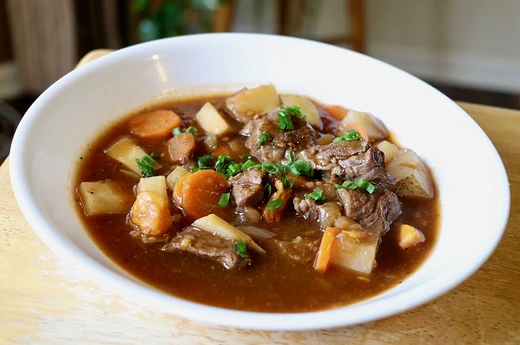
Nettle soup
Last updated
Stinging nettles are the key ingredient in nettle soup.[1] The collection of young nettle buds for soup occurs mainly in spring and early summer.[1] Scandinavia, Finland, Iran, Ireland, the United Kingdom, and Eastern Europe are regions where nettle soup is commonly consumed today.[1]
Key facts and history
Various Native American tribes have used stinging nettles for centuries, including the Lakota using the root for stomach pain.[2] Stinging nettles have a high nutritional value, including calcium, magnesium, iron, and vitamins A and B.[3][4] Boiling water deactivates the nettle from stinging, making soup or tea an easy way to consume them.[3] In medieval Europe, the medicinal use of young stinging nettle included serving as a diuretic and treating joint pain and arthritis.[2]
Sliced boiled eggs or crème fraîche are common accompaniments for the soup from Sweden.[5] In Ireland, nettle soup is traditionally eaten in late Spring (April and May), and it is thought to purify the blood and "keeps the rheumatics away".[6][7]
What the cited sources add
A 2010 Smithsonian article notes that stinging nettles (Urtica dioica) are a common weed throughout North America.[4] The water that the Iranian nettles are cooked in is saved and used as a drinking tea for medicinal purposes.[8] A 2019 Saveur article states that nettles have always been one of the most important and abundant wild foods in Ireland.[7]
References
- Wikipedia, "Nettle soup" (CC BY-SA 4.0), which cites: Fiegl, "Stinging Nettle Soup", Smithsonian, 2010-05-04 (we also read that source) en.wikipedia.org
- Wikipedia, "Nettle soup" (CC BY-SA 4.0), which cites: Alberge, "Bronze age man's lunch: a spoonful of nettle stew", The Guardian News, 2011-12-04; Vincent, "A British feast from garden weeds", BBC Travel, 8 May 2020; Duke, "Handbook of Medicinal Herbs: Herbal Reference Library", CRC Press, 2002; "Nettles 'ease arthritis suffering'", BBC News, HEALTH, 2000-05-31; Blaine, "Ouch! Why nettles sting, and how you can put them to good use", Daily Herald; Blaine, "Ouch! Why nettles sting, and how you can put them to good use", Daily Herald (we also read that source) en.wikipedia.org
- Wikipedia, "Nettle soup" (CC BY-SA 4.0), which cites: Fiegl, "Stinging Nettle Soup", Smithsonian, 2010-05-04; Blaine, "Ouch! Why nettles sting, and how you can put them to good use", Daily Herald (we also read that source) en.wikipedia.org
- Fiegl, "Stinging Nettle Soup", Smithsonian, 2010-05-04. smithsonianmag.com
- Wikipedia, "Nettle soup" (CC BY-SA 4.0), which cites: "Nettle soup (Nässelsoppa)", SwedishFood.com (original not read by us) en.wikipedia.org
- Wikipedia, "Nettle soup" (CC BY-SA 4.0), which cites: "Irish Nettle Soup", Saveur, 18 March 2019; Skehan, "Nettle soup", The Irish Times; "Irish Nettle Soup", Saveur, 18 March 2019; O’Connor, "Treat yourself to some delicious nettle soup", Irish Examiner, 2016-04-17 (we also read that source) en.wikipedia.org
- "Irish Nettle Soup", Saveur, 18 March 2019. saveur.com
- Wikipedia, "Nettle soup" (CC BY-SA 4.0), which cites: Shafia, "The New Persian Kitchen", Ten Speed Press, 2013, p. 52; Shafia, "The New Persian Kitchen", Ten Speed Press, 2013, p. 52; "Mazandarani Style Nettle Soup آش گزنه مازندرانی", www.cafeleilee.com; "Mazandarani Style Nettle Soup آش گزنه مازندرانی", www.cafeleilee.com; Shafia, "The New Persian Kitchen", Ten Speed Press, 2013, p. 52 (we also read that source) en.wikipedia.org
Each numbered sentence above was checked against the source it cites before publication. Sentences citing Wikipedia adapt text from the English Wikipedia article Nettle soup (contributors), used under CC BY-SA 4.0; this entry is available under the same licence. Other sources were used for facts only.
More in Irish cuisine
Sources
Compiled from Wikipedia and the sources listed below. Text from Wikipedia is available under CC BY-SA 4.0; this entry is adapted from it.
- Wikipedia: Nettle soup (CC BY-SA 4.0).
Spotted an error? Know more?
Reader corrections go straight into our review queue. Suggest an edit · How this site is sourced