Persian art
Court-led art of successive Iranian dynasties, blending figures with refined decoration.
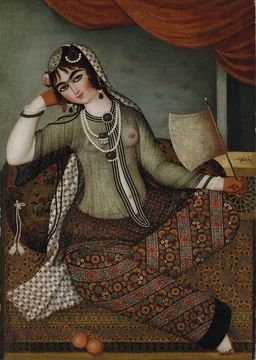
Persian art encompasses the visual traditions of successive Iranian-speaking dynasties, often centered on the court, which have ruled over areas similar to modern Iran and beyond. It is notable for a long-standing emphasis on the human figure and animals, and for developing a refined, geometrically organized decorative style that blended plant motifs with Chinese elements. Under the Safavid dynasty in the 16th century, this style was disseminated across many media from the shah's court artists.
Quick Facts
- Earliest evidence
- c. 5000 BCE painted pottery at Susa
- Achaemenid empire
- 550 BC–330 BC
- Sasanian empire
- 3rd to 7th centuries AD
- Muslim conquest completed
- 654
- Safavid dynasty
- 1501 to 1722
- Key achaemenid site
- Naqsh-e Rostam (500–330 BC)
- Key sasanian ruler
- Shapur I (r. AD 240–272)
Facts from the source article.
Did You Know?
- Evidence of a painted-pottery civilization around Susa has been dated to c. 5000 BCE.
- Luristan bronzes, small cast objects from the Early Iron Age, have been found in large numbers in Lorestān Province and Kermanshah.
- Elamite art shared many characteristics with Mesopotamian art, including cylinder seals and small figures of worshippers.
Rock reliefs
Persian rulers often used large rock reliefs, carved high on cliffs near roads and water, to celebrate their power and control over land. This tradition started with the Lullubi and Elamite peoples, seen in works like those at Sarpol-e Zahab in Iranian Kurdistan, as well as at Kul-e Farah and Eshkaft-e Salman in southwest Iran, and later continued under the Assyrians. The Behistun relief, created for Darius the Great around 500 BC, is much more massive and shows the strength of the Achaemenid Empire.
It stands out because it includes a long inscription written in three languages—Old Persian, Elamite, and Babylonian—all in cuneiform, which later helped scholars understand these ancient scripts. Most other Persian reliefs have no inscriptions, so identifying the kings is often guesswork. For Sasanian reliefs, this is easier because each king wore a distinct crown, which matches images on their coins. At Naqsh-e Rostam, the Achaemenid royal burial site, four large tombs are cut high into the cliff.
Their facades are mostly architectural, but each has a panel above the doorway showing the king receiving power from a god, with smaller figures of tribute-bearers, soldiers, and officials below. These three groups are shown at very different sizes. Each tomb entrance, at the center of a cross shape, leads to a small chamber holding the king’s sarcophagus. The horizontal beam on each facade is thought to copy the entrance of Persepolis’s palace.
Sasanians
Sasanian art was produced under the Sasanian Empire, which ruled from the 3rd to 7th centuries AD, before the Muslim conquest of Persia was completed around 651. The dynasty began in 224 AD when Ardashir I defeated the last Parthian king, and it ruled modern Iran, Iraq, and much territory to the east and north, at times including parts of the Levant, Anatolia, Egypt and Arabia. The art built on Achaemenid traditions but also incorporated influences from as far as China and the Mediterranean.
Surviving Sasanian art is best seen in architecture, reliefs and metalwork, with some paintings. Stone reliefs were probably outnumbered by interior plaster ones, of which only fragments survive. Free-standing sculptures faded in popularity compared to the Parthian period, but the Colossal Statue of Shapur I, carved from a stalagmite in a cave, is a major exception. Sasanian art depicts courtly and chivalric scenes, with images of rulers dominating, and hunting and battle scenes enjoying special popularity.
Representations are often arranged like a coat of arms, and narrative scenes frequently show figures in profile or three-quarter view, unlike the frontal view preferred in Parthian art.
Early Islamic period
After the Muslim conquest of Persia, completed by 654, the region retained its cultural identity, and Arabic was not imposed on the population, though it became the language of scholars. Turkic peoples became increasingly important in Greater Iran, leading to a cultural Turko-Persian tradition. Nishapur, during the Islamic Golden Age of the 9th and 10th centuries, was a major centre for pottery and related arts, with most ceramic artefacts now in the Metropolitan Museum of Art and museums in Tehran and Mashhad.
Ceramics from Nishapur showed links with Sasanian and Central Asian art. Geometric Islamic architectural decoration in stucco, tiling, brick and carved materials became elaborate, and highly decorated metalwork in copper alloys was produced for a sophisticated urban market. Sasanid iconography of mounted heroes, hunting scenes, and seated rulers remained popular in pottery and metalwork, often surrounded by geometrical and calligraphic decoration.
Rich silk textiles continued to use animal and human figures from Sasanid predecessors. The Samanid period saw the creation of epigraphic pottery, typically earthenware vessels with black slip lettering in Kufi script on a white slip base, inscribed with blessings or proverbs and used to serve food, produced at Samarqand and Nishapur.
Safavids
Safavid art, from 1501 to 1722, was a high point for the art of the book and architecture, also including ceramics, metal, glass, and gardens. The arts show a far more unitary development than in other periods, with the same style diffused from the court appearing in carpets, architectural tiles, ceramics, and manuscript illumination. When the Safavids seized the throne, Persian art had been divided into two styles: a continuation of Timurid styles in the east and a Turkman style in the west.
Two rulers encouraged new styles that spread over their territories: Shah Tahmasp I (r. 1524–1576) and Shah Abbas I (r. 1588–1629). Chinese imitation drawings emerged in 15th century Persian art, with motifs like dragons, simurgh, cloud-bands, and lotus and peony flowers. Themes that became standard by the 16th and 17th centuries included hunting scenes, landscapes with animals and horsemen battling lions, and literary scenes with animal fables and dragons.
The art of the book, especially Persian miniature painting, was the essential driving force of the arts, with the royal library-workshop providing motifs for carpets, ceramics, and metal. Various types of books were copied, illuminated, and illustrated, including religious works and Persian literature such as the Shahnameh.
More in Iranian Art
Spotted an error? Know more?
Reader corrections go straight into our review queue. Suggest an edit · How this site is sourced