Frequently Asked Questions
The most-asked questions about international and comparative law.
What is the difference between international law and comparative law?
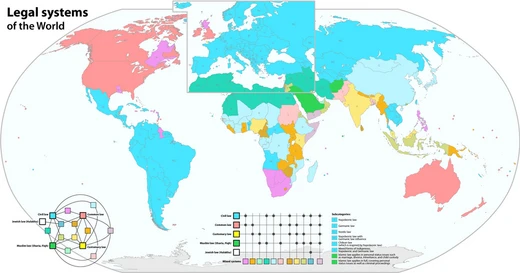
International law governs the relationships between sovereign states, international organizations, and in some cases individuals across borders. Comparative law, by contrast, is the academic study of how different domestic legal systems (common law, civil law, religious law, etc.) approach the same legal problems, often to inform reform or scholarship.
Where should a complete beginner start with these fields?
A good entry point is understanding the three core sources of international law—treaties, custom, and general principles—then pairing that with a survey of the world's major legal families (common, civil, Islamic, and customary law). Most law schools offer an 'Introduction to International Law' course alongside a 'Comparative Legal Systems' course that together give the full picture.
Who are the most influential figures in the history of these disciplines?
Hugo Grotius is often credited as the father of modern international law for his 1625 treatise on the law of nations, while Franz von Liszt and later James Brown Scott helped shape the institutional architecture of the 20th century. In comparative law, Eugen Ehrlich's sociological approach and later Simeon Glasser's functional methodology are frequently cited as turning points.
What are the main institutions that make or adjudicate international law?
The International Court of Justice in The Hague is the principal judicial organ of the UN, while the International Criminal Court handles individual criminal accountability for genocide, war crimes, and crimes against humanity. Regional bodies like the European Court of Human Rights and the Inter-American Court of Human Rights also play major roles in their respective areas.
What counts as a 'source' of international law?
Article 38 of the ICJ Statute lists treaties, international custom, general principles of law recognized by civilized nations, and—subsidiarily—judicial decisions and the teachings of leading publicists. In practice, soft-law instruments such as UN General Assembly resolutions and ILO conventions also carry significant persuasive weight.
What is a landmark moment in the development of international law?
The 1945 establishment of the United Nations and the concurrent Nuremberg Trials are widely regarded as the watershed that shifted the field from a loose set of diplomatic conventions to a structured legal order with individual accountability. The 1948 Universal Declaration of Human Rights is often cited as the next critical milestone.
How does comparative law actually get used in practice?
Lawyers and legislators consult foreign jurisprudence to fill gaps, draft new statutes, or interpret ambiguous constitutional provisions, as seen in the South African and Canadian courts' willingness to cite foreign judgments. Scholars also use comparative analysis to test whether a legal rule is culturally specific or reflects a broader functional need.
Can individuals be subjects of international law, or only states?
Traditionally the field was state-centric, but developments like the ICC, human-rights treaties with individual petition mechanisms, and the growing body of international criminal law have given natural persons both rights and obligations directly under international norms. Corporations, too, are increasingly addressed through investment treaties and transnational environmental standards.
What is the relationship between international law and a country's domestic law?
Whether an international treaty is automatically enforceable domestically depends on the state's constitutional structure—monist systems like France incorporate treaties directly, while dualist systems like the United Kingdom require an implementing act of parliament. This tension between international obligations and national sovereignty is one of the field's most persistent debates.
Why do fans and students often pair these two fields together?
Because understanding a single domestic system in isolation rarely explains how that system interacts with trade agreements, human-rights courts, or foreign regulatory regimes. Studying them side by side reveals both the universal problems every legal order must solve and the distinctive cultural and historical choices each one makes in solving them.