Gracemont (microarchitecture)
Last updated

Saneandsad · CC BY-SA 4.0
Gracemont is a low-power processor microarchitecture from Intel, designed for use in systems on a chip (SoCs). It follows Tremont and appears as the efficient cores in the hybrid designs of the Alder Lake, Raptor Lake, and Raptor Lake Refresh processors.
This microarchitecture represents the fourth generation of out-of-order, low-power Atom designs, fabricated on the Intel 7 process. Compared to Tremont, Gracemont brings several improvements. Each core gets an eight-way-associative 64 KB instruction cache and an eight-way-associative 32 KB data cache in its Level 1 cache. A new on-demand instruction-length decoder is included.
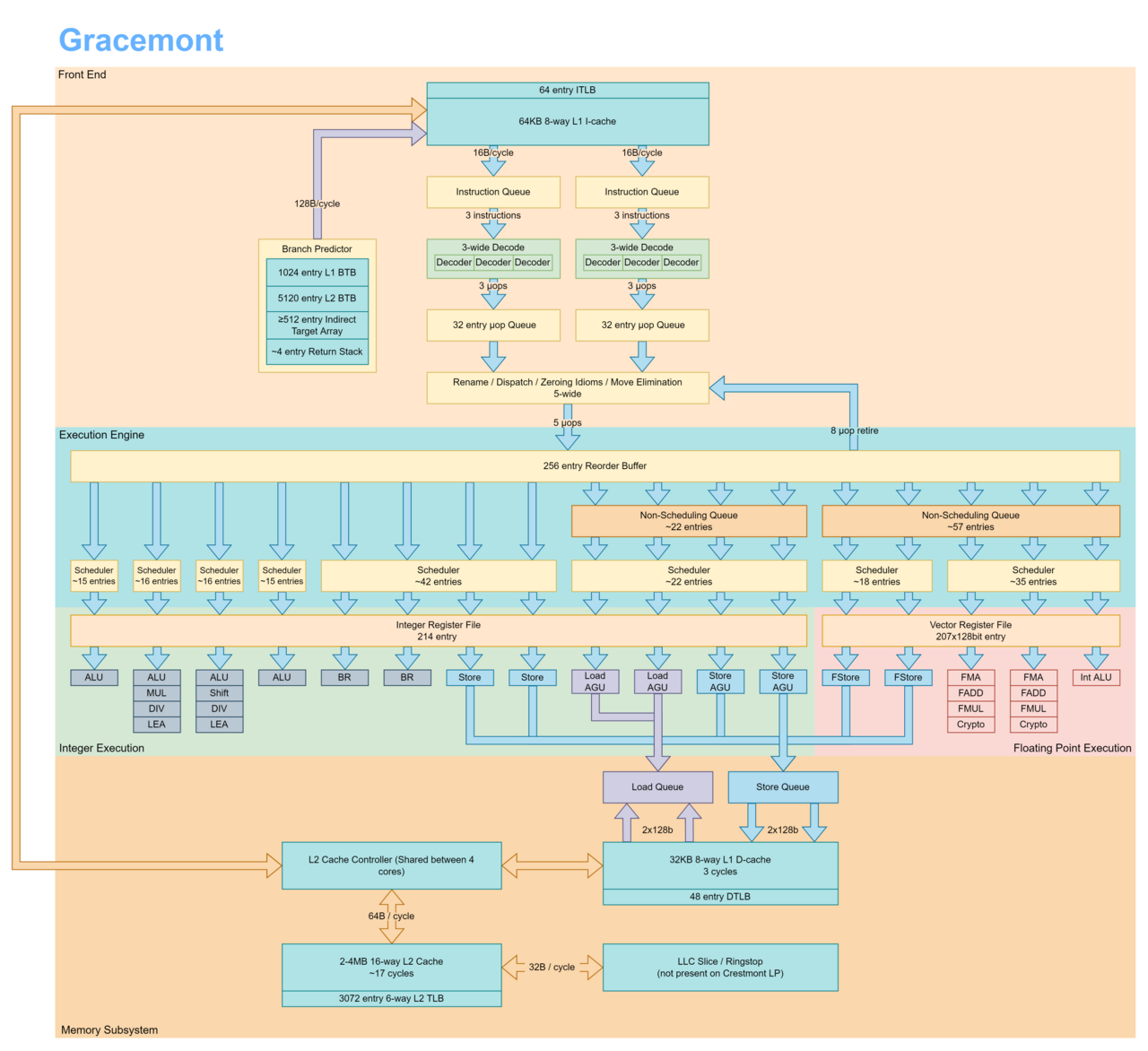
The microarchitecture can issue up to five instructions per clock cycle (up from four) and retire up to eight per clock (up from seven). It features 17 execution ports (functional units), up from ten, and a reorder buffer expanded to 256 entries from 208. Branch prediction has been improved, and support is added for AVX, AVX2, FMA3, and AVX-VNNI instructions. The shared L2 cache per four-core cluster is either 2 MB or 4 MB: Alder Lake family chips have 2 MB; higher-end Raptor Lake family chips with Raptor Cove cores have 4 MB, while lower-end Raptor Lake family chips with Golden Cove cores have 2 MB.
The technology uses a system-on-a-chip (SoC) architecture with 3D tri-gate transistors. Thermal design power (TDP) ratings are 10 W for desktop processors and 6 W for mobile processors.
Gracemont serves as the efficient cores in Intel’s 12th-generation (Alder Lake), 13th-generation (Raptor Lake), and 14th-generation (Raptor Lake Refresh) hybrid Core processors. It is also used as the sole core cluster in the Alder Lake-N lineup, which targets low-power applications.
Frequently Asked Questions
What is Gracemont (microarchitecture) known for?
In Alder Lake, Raptor Lake, and Raptor Lake Refresh, Gracemont cores handle background and low-priority workloads at minimal energy draw while the performance cores tackle heavy tasks. Each core issues five instructions per clock and retires up to eight, backed by 17 execution ports.
What are Gracemont (microarchitecture)'s key specs compared to Tremont?
Gracemont upgrades the L1 cache to a 64 KB eight-way-associative instruction cache and a 32 KB eight-way-associative data cache per core, both larger than its predecessor. It also widens the issue and retire pipelines to 5-wide and 8-wide respectively, while being manufactured on the Intel 7 node.
More in Intel and AMD Microprocessors
Sources
Compiled from Wikipedia and the sources listed below. Text from Wikipedia is available under CC BY-SA 4.0; this entry is adapted from it.
- Wikipedia: Gracemont (microarchitecture) (CC BY-SA 4.0).
Spotted an error? Know more?
Reader corrections go straight into our review queue. Suggest an edit · How this site is sourced