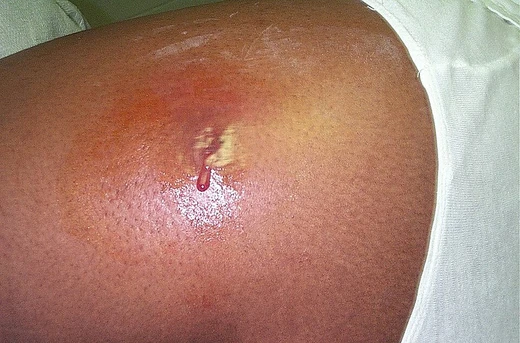
Gangrene
Tissue death from lack of blood supply, often requiring surgical removal.

Gangrene happens when body tissue dies because it isn't getting enough blood. You might notice the skin turning red or black, along with numbness, swelling, pain, the skin breaking down, or a cool feeling—most often in the feet or hands. If an infection is behind it, fever or sepsis can also occur. Things that raise your risk include diabetes, peripheral artery disease, smoking, major injuries, alcoholism, HIV/AIDS, frostbite, influenza, dengue fever, malaria, chickenpox, plague, high sodium levels, radiation damage, meningococcal disease, Group B strep infection, and Raynaud's syndrome. Doctors sort gangrene into several types: dry, wet, gas, internal, and necrotizing fasciitis. Diagnosis relies on symptoms and can be backed up by imaging tests. Treatment often involves surgery to remove dead tissue, antibiotics for any infection, and fixing the root cause. Surgery might mean debridement, amputation, or even maggot therapy. Addressing the underlying issue could involve bypass surgery or angioplasty. In some cases, hyperbaric oxygen therapy helps. How often gangrene occurs isn't known.
- Classification
- Dry, wet, gas, internal, necrotizing fasciitis
- Common sites
- Feet and hands
- Risk factors
- Diabetes, smoking, peripheral arterial disease, trauma, frostbite, HIV/AIDS
- Treatment
- Surgery, antibiotics, hyperbaric oxygen therapy
- Etymology
- From Latin gangraena and Greek gangraina, meaning 'putrefaction of tissues'
Lore & Background
Gangrene is a condition known since antiquity, with its name deriving from the Greek word for 'putrefaction of tissues'. It arises when a critically insufficient blood supply, often due to peripheral vascular disease or infection, leads to tissue death. Dry gangrene develops from chronic ischemia without infection, resulting in dry, shrunken, dark tissue that may eventually autoamputate. Wet gangrene involves bacterial infection, causing swelling, foul odor, and rapid progression to sepsis if untreated. Gas gangrene, a medical emergency, is caused by bacteria such as Clostridium perfringens that produce gas within tissues and spread quickly.
Reader's Guide
Gangrene remains a significant medical condition due to its potential for severe outcomes, including limb loss and death. Its classification into dry, wet, gas, internal, and necrotizing fasciitis types guides treatment urgency and approach. Dry gangrene, often linked to diabetes and smoking, may be managed conservatively, while wet and gas gangrene require prompt surgical debridement or amputation to prevent sepsis. Antibiotics and hyperbaric oxygen therapy play roles in specific cases. The condition's association with numerous risk factors—from chronic diseases to infections like influenza and plague—highlights its broad relevance. Though its overall prevalence is unknown, gangrene's impact on quality of life and healthcare systems is substantial, particularly in populations with high rates of diabetes and peripheral artery disease.
Did You Know?
- The word gangrene comes from the Greek gangraina, meaning 'putrefaction of tissues'.
- Dry gangrene may result in autoamputation, where the dead tissue falls off without surgery.
- Gas gangrene is a medical emergency caused by bacteria that produce gas within tissues.
- Wet gangrene has a mortality of about 80% without treatment and 20% with treatment.
More in Infectious Diseases 1-24
Spotted an error? Know more?
This is a living reference — every entry is fact-audited, and reader corrections feed straight into our audit queue. Suggest an edit · See this site's audit record