I Want to Hold Your Hand
The Beatles' first American number-one hit and best-selling single.
Last updated

polutropon_95 · CC BY 3.0
"I Want to Hold Your Hand" was written by John Lennon and Paul McCartney for the Beatles. It became the group’s biggest-selling single worldwide, with over 12 million copies sold. The song was recorded on 17 October 1963 and released in the United Kingdom on 29 November 1963.
While often noted for its technical innovation, it was not the first Beatles record to use four-track recording equipment; earlier tracks like 'She Loves You' had already employed four-track. In the UK, advance orders for the single passed one million copies. It would have gone straight to number one on its release day, but it was blocked by the Beatles’ own previous single, "She Loves You," which had surged back in popularity due to intense media coverage. "I Want to Hold Your Hand" took two weeks to dislodge its predecessor, then stayed at number one for five weeks.
It spent 21 weeks in the UK top 50 and became the Christmas number one of 1963. This was not the first time a British act had replaced itself at number one; the Beatles had already achieved this feat when 'From Me to You' succeeded 'Please Please Me' at the top of the charts. The song was also the Beatles’ first American number-one hit. It entered the Billboard Hot 100 on 18 January 1964 at number 45, kicking off the British Invasion of the US music industry.
By 1 February, it had reached the top spot and remained there for seven weeks, until replaced by "She Loves You." It stayed on the Billboard chart for 15 weeks. In 2018, Billboard ranked it the 48th biggest hit of all time on the Hot 100. In the UK, it was the second-highest-selling single of the 1960s, behind "She Loves You."
The song’s composition was encouraged by manager Brian Epstein, who wanted Lennon and McCartney to write something that would appeal to the American market after Capitol Records had repeatedly rejected the group’s recordings. Producer George Martin later said he believed Capitol had no choice but to release the song due to rising demand.
Background and composition
McCartney had recently moved into 57 Wimpole Street in London, lodging with Dr. Richard and Margaret Asher, whose daughter Jane Asher was McCartney’s girlfriend. The basement music room there became Lennon and McCartney’s new writing base. In 1980, Lennon recalled to Playboy that they wrote the song “eyeball to eyeball,” and that the key chord came when McCartney hit a particular note on the piano.
Background
The song was composed in the basement music room of 57 Wimpole Street, London, where Paul McCartney was lodging with the family of his girlfriend Jane Asher. Lennon and McCartney wrote it together, with Lennon recalling the moment McCartney hit a chord that made the song. The composition is an example of modified 32-bar form with a two-bridge model, and the song has no real lead singer, as Lennon and McCartney sing alternately in unison and harmony.
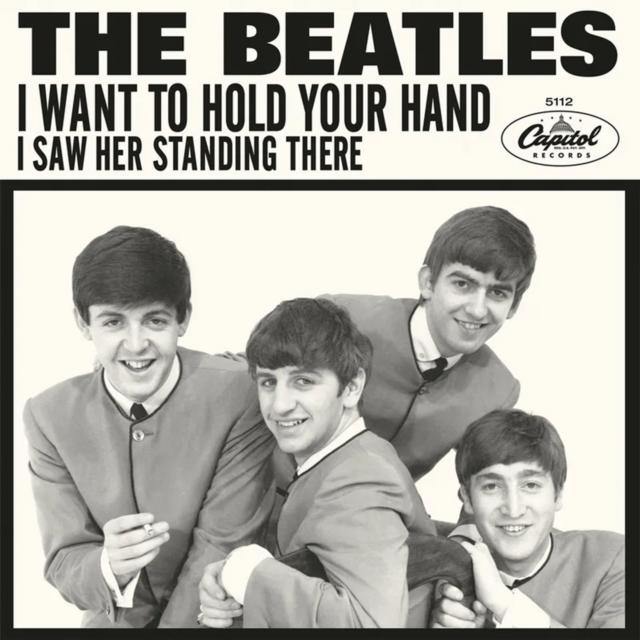
Recorded on 17 October 1963 at EMI Studios, the song required seventeen takes. It was later recorded in German as "Komm, gib mir deine Hand" at EMI's Pathe Marconi Studios in Paris on 27 January 1964, after the Beatles initially boycotted the session.
The Basement Composition Session
The song emerged from an intimate, almost accidental creative moment at 57 Wimpole Street in London, where McCartney was lodging with Dr. Richard and Margaret Asher and their daughter Jane, who had become his girlfriend earlier in the year. The pair's new writing base was a small, stuffy basement music room where Margaret taught oboe lessons. It was there, seated at the same piano, that Lennon and McCartney composed the track. In a 1980 interview with Playboy, Lennon recalled the pivotal instant: McCartney struck a chord, and he immediately turned and shouted, "That's it!
Do that again!" He described their method as writing "eyeball to eyeball," both playing into each other's noses. McCartney confirmed this in 1994, calling it "very co-written." Musicologist Ian MacDonald suggested that in keeping with their collaborative style of the era, the pair would call out random, lyrically simple phrases and keep whichever ones fit the overall sound. The title itself may have been a playful riff on "I Wanna Be Your Man," which the group had recently recorded at EMI Studios.
Four-Track Pioneer and Musical Architecture
Recorded on 17 October 1963 in Studio 2 at EMI Studios, the track holds a technical milestone: it was the first Beatles recording to use four-track tape, a capability that would shape the group's subsequent production. Both sides of the single, including the B-side "This Boy," required seventeen takes each during that session. George Martin handled the mono and stereo mixes just four days later, on 21 October, with additional stereo versions produced in 1965 and 1966 for international compilations. Musically, the song sits in G major and follows a modified thirty-two-bar form built on a two-bridge structure with only a single intervening verse.
There is no designated lead vocalist; instead, Lennon and McCartney trade lines in unison and harmony, a choice that gives the track its distinctive call-and-response feel. The opening lyric lands two beats early over a D-to-B melodic figure on a G chord. Scholars debate which chord represents the pivotal moment Lennon described: Wolf Marshall and Walter Everett identify the minor vi (E minor) in a G–D7–Em progression, while Dominic Pedler points to a more unexpected B-to-F-sharp drop against a B7 chord on the word "understand."
The German Boycott and Enduring Legacy
Odeon, the German division of EMI, was convinced the Beatles' records would fail in the German market unless performed in the local language. The group detested the idea. When they were scheduled to record a German version titled "Komm, gib mir deine Hand" on 27 January 1964 at Pathe Marconi Studios in Paris—where they were in the middle of an eighteen-day Olympia Theatre residency—they simply did not show up. George Martin, who had waited for hours, was furious and insisted they at least attempt it.
Two days later, the Beatles complied, making it one of the rare occasions they recorded outside London. Martin later admitted they were right that the German version was unnecessary, though he conceded they "did a good job." The translated lyrics were the work of Luxembourg musician Camillo Felgen, who used the pseudonym Jean Nicolas. The German single appeared in March 1964, and the track also found its way onto Capitol's July 1964 album Something New and the 1988 compilation Past Masters.
Frequently Asked Questions
Who wrote I Want to Hold Your Hand?
John Lennon and Paul McCartney penned the song for the Beatles. It was recorded in a single session on 17 October 1963 and released on Parlophone in the UK on 29 November 1963.
How did I Want to Hold Your Hand perform on the charts?
In the UK it spent five weeks at number one and a total of 21 weeks inside the top 50. It also became the Beatles' first number-one single in the United States, where it was issued on Capitol Records.
Why is I Want to Hold Your Hand considered a landmark Beatles record?
With more than 12 million copies sold worldwide, it became the group's biggest-selling single of all time. In the UK alone, advance orders exceeded one million before the release date, making it a genuine cultural event.
More in Iconic Songs & Albums
Sources
Compiled from Wikipedia and the sources listed below. Text from Wikipedia is available under CC BY-SA 4.0; this entry is adapted from it.
- Wikipedia: I Want to Hold Your Hand (CC BY-SA 4.0).
Spotted an error? Know more?
Reader corrections go straight into our review queue. Suggest an edit · How this site is sourced