Karhuha
Tutelary god of Carchemish, closely linked with Kubaba.
Karhuha, also called Karḫuḫi, was the guardian deity of the ancient city of Carchemish. He first appears in records from the late second millennium BCE. He may have been linked to deer, and his nature is thought to resemble that of the Hittite god Kurunta.
Quick Facts
- Deity of
- Tutelary god of Carchemish
Facts from the source article.
Name
Karhuha's name appears in cuneiform as dKar-ḫu-ḫa or dKar-ḫu-u-ḫi-iš, reflecting the forms Karḫuḫa and Karḫuḫi. The logogram dLAMMA and possibly CERVUS in Luwian hieroglyphs could also represent it. The etymology is uncertain; Livio Warbinek tentatively suggests a derivation from the Hurrian verb karḫ- (possibly meaning "to hinder" or "to encumber"), though the evidence is not conclusive. Luwian speakers may have reinterpreted the suffix -ḫuḫa as their word for "ancestor," possibly shifting the form from Karḫuḫi to Karhuha.
Character and iconography
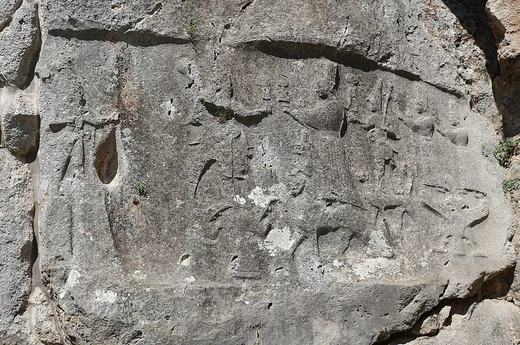
Karhuha's character is poorly known. Some scholars suggest he was regarded as warlike or associated with game animals. Based on shared logograms, Piotr Taracha assumes he was a Kurunta-like stag god, while Volkert Haas outright identified the two as identical. Alfonso Archi and Tatiana Frühwirt argue they should be kept separate, noting they were worshiped separately in Malatya. Livio Warbinek instead suggests Karhuha's character might have resembled that of Šarruma or a weather god. On a limestone stela from Malatya, Karhuha is portrayed as an armed deity with a curved blade, a spear, and a three-pronged object (possibly a plant, not lightning). He stands on a lion, while the accompanying deity Kubaba stands on an animal that might be a stag or a bull, representing an exchange of symbols. Textual sources indicate Karhuha was closely associated with Kubaba, never appearing without her, and likely served as her paredros; Archi assumes they were envisioned as a couple.
Worship
Karhuha is attested in sources from between the fourteenth and eighth centuries BCE. He was a main deity in Carchemish alongside Kubaba. Few references come from other locations. Gianni Marchesi and Nicolò Marchetti assume he was Hurrian in origin, entering the pantheon under Mitanni control; Alfonso Archi argues he predated Hurrian rule. He is largely absent from Hittite texts except for treaties between Hittite kings and rulers of Carchemish (Šuppiluliuma I and Šarri-Kušuḫ, and Šuppiluliuma II and Talmi-Teššup) that mention him. An account of Šuppiluliuma I's conquest of Carchemish states he restored the temples of Karhuha and Kubaba. A hieroglyphic Luwian inscription on a silver bowl mentions a ruler named Mazi-Karḫuḫa, possibly a local ruler of Carchemish, but its dating is uncertain (thirteenth or eleventh century).
Mythology
Alfonso Archi suggests the Hurrian myth Song of dLAMMA originated in Carchemish and involved Karhuha, though in the known Hittite version dLAMMA was read as Kurunta. In this composition, a god designated by dLAMMA temporarily becomes king of the gods after defeating Teshub and Shaushka, but proves unsuitable and is deposed after ignoring Kubaba's advice, later being subjugated by the weather god he had displaced.
More in Hurrian Deities
Spotted an error? Know more?
Reader corrections go straight into our review queue. Suggest an edit · How this site is sourced