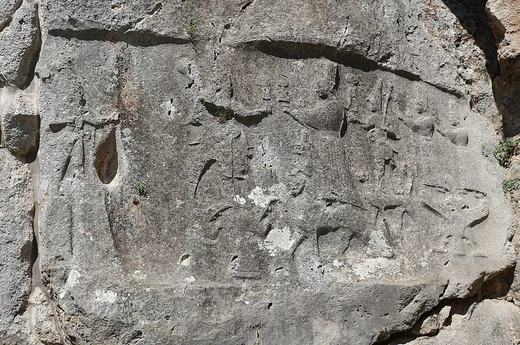
Išḫara
Goddess of love, marriage, and oaths from Ebla.
Išḫara was a goddess originally worshipped in Ebla and nearby settlements in northern Syria during the third millennium BCE. She served as the tutelary deity of the Eblaite royal family and was associated with love, marriage, oaths, and divination. Her name's origin is disputed, possibly deriving from a linguistic substrate.
Quick Facts
- Deity of
- Tutelary deity of Ebla
- goddess of love
- oaths and divination
- Cult center
- Ebla
- Mane
- Alalakh
- Emar
- Išur
- Artanya
- Tauriša
- Neriša
- Festivals
- kissu
- zukru
- ḫišuwa
- de
- išuwa-Fest
- Parents
- Enlil and Apantu
Facts from the source article.
Did You Know?
- Išḫara was portrayed as a youthful goddess and could be referred to with the Hurrian epithet šiduri, 'young woman'.
- In Mesopotamia, her symbol was initially the bašmu, a mythical snake elsewhere associated with underworld gods such as Tishpak or Ninazu.
- The Epic of Gilgamesh and Atrahasis both mention Išḫara in passing as a goddess of marriage.
Name
The goddess Išḫara’s name appears in many different forms across cuneiform texts. A bilingual word list from Ebla records the entry ŠARA8 (BARA10 = GÁ×SIG7)-ra equals iš-ḫa-ra. Another spelling from the same city is dŠÁR-iš. In the 1980s, some scholars thought that a month name and personal names from Ebla containing the sign AMA referred to Išḫara, but this idea is no longer considered likely. A possible partially logographic writing, dLAGABxIGI-gunû, was found on a vase fragment from Tell Agrab. It was once read as Shara, but Giovanni Marchesi and Nicolo Marchetti noted that it would be strange for that Mesopotamian god to be worshipped in that area. The syllabic spelling daš2-ḫa-ra appears in a treaty between Naram-Sin of Akkad and an Elamite ruler, reflecting the form Ašḫara. An Old Babylonian legal text from Sippar preserves the variant eš-ḫar-ra. In the Ugaritic alphabetic script, Išḫara’s name was usually written as ušḫry, though one Hurrian text, RS 24.261, has the single instance išḫr. Volkert Haas suggested that the Ugaritic form could be romanized as Ušḫara and compared it to a variant in a single Hittite text, KUB 27.19, where it is written duš-ḫa-ra. Dennis Pardee vocalizes the Ugaritic form as Ušḫaraya. In Hurrian sources from Alalakh, the logogram dIŠTAR could sometimes stand for Išḫara, though in some personal names from that city it is unclear whether it refers to her, Ishtar, or Šauška. The variant dIŠTAR-ra used the sign -ra as a phonetic indicator to make the goddess’s name clear. Another logographic writing, dÍB.DU6.KÙ.GA, a synonym of GÍR.TAB meaning “scorpion,” comes from the Mesopotamian god list An = Anum. The Egyptian version of a treaty with the Hittite Empire from the twenty-first year of Ramesses II’s reign (1259 BCE) preserves the spelling isḫr. In that text, her name is preceded by the cobra determinative, which is also used to mark the names of Egyptian goddesses in other sources.
Character
The earliest records of Išḫara, found in Ebla during the reign of Irkab-Damu, show her as a protective goddess of the royal family. Unlike Kura and Barama, who mirrored the current king and queen, Išḫara was a dynastic guardian rather than a divine reflection of the ruling couple. Joan Goodnick Westenholz argued that when her worship spread eastward to Mesopotamia in the third millennium BCE, this protective role faded. Still, later texts continued to identify her as the tutelary goddess of Ebla. A Hurrian tablet from Emar calls her eb-la-be, meaning "of Ebla." The goddess Iblaītu, mentioned in Tākultu rituals, may be the same figure, though some scholars see that name as a title for Ishtar. Alfonso Archi suggested Išḫara originally developed as a local form of herself tied to Ebla, later reaching Assyria during the Middle Assyrian period through Hurrian channels.
In Eblaite texts, Išḫara was linked to love, which Piotr Taracha thought was her oldest trait. This aspect continued in Mesopotamia, partly because she became associated with Ishtar, though Frans Wiggermann considered them independent love goddesses. She was called the "lady of love," bēlet râme. Her connection to marriage appears in several Akkadian šuillakku prayers, which typically contain personal requests. However, Gioele Zisa noted that incantations also tie her to erotic love.
Associations with other deities
No surviving texts attempt to establish Išḫara’s family tree. The sole reference to her having parents comes from a single Hittite document found at Hattusa, which records a Hurrian tradition that she was the daughter of Enlil. In his edition of this text, called the Song of Going Forth, Gary Beckman fills in the parents’ names as Enlil and Apantu, though a later passage in the same work pairs Enlil with Ninlil instead. Alfonso Archi, translating the same passage, leaves the names blank. According to Volkert Haas, Išḫara was considered neither married nor a mother. Archi notes she was one of the three most frequently worshipped Hurrian goddesses without a spouse, alongside Allani and Šauška. Lluís Felieu observes that while Išḫara was linked to various male gods across different times and places, most evidence does not suggest she had a permanent husband in other traditions either. In several Mesopotamian love incantations, she appears alongside almanu, a common noun of uncertain meaning. Proposed translations include “widower,” “man without family obligations,” or simply “lover.” In one instance, the word is written with a divine determinative, as if it were a god’s name. Išḫara and almanu occur in parallel with pairs like Ishtar and Dumuzi or Nanaya and an unnamed lover. Ryan D. Winters argues that almanu was likely a title for a deity considered Išḫara’s spouse, reflecting a myth now lost. A single Mesopotamian text about protective house spells calls the Sebitti her sons, but Frans Wiggermann, in his study of that group of gods, believes this arose from confusion between Išḫara and the underworld god Enmesharra, whose children the Sebitti often were.
Worship
Išḫara appears in records from ancient Syria as early as the third millennium BCE, with the Ebla texts providing the earliest evidence. Her worship was a deep-rooted tradition across the Eblaite region, stretching from the modern Syria-Turkey border in the north down to Emesa and Qatna in the south, and from Jebel Ansariyah in the west to Emar and the Euphrates in the east. Many towns within this area honored her, as shown by the Eblaite archives. Alongside Resheph, she had the highest number of local forms, with ten distinct hypostases documented by 2020. These included the Išḫaras of Aḫadamu, Arugadu, Banaium, Guwalu, Mane, Uguaš, wa-NE-duki, Zidara, Zitilu, and Zuramu. Among these, only Mane held notable administrative importance, serving as Ebla’s harbor on the Euphrates. Most of these settlements did not draw royal pilgrimages, but some received visits from queens. Evidence exists for journeys to Zuramu, Uguaš, and Mane, all then under Ebla’s control. The queen mother Dusigu once traveled to these three sanctuaries. Offerings from the queen and various princesses to the Išḫara of Zidara are also recorded, though these occurred within Ebla itself. Additionally, references place her worship in the cult centers of Hadabal, Arugadu, Hamadu, and Luban. According to Alfonso Archi, in Hadabal she was venerated alongside Eblaite rulers, as that city served as their secondary residence.
More in Hurrian Deities
Spotted an error? Know more?
Reader corrections go straight into our review queue. Suggest an edit · How this site is sourced