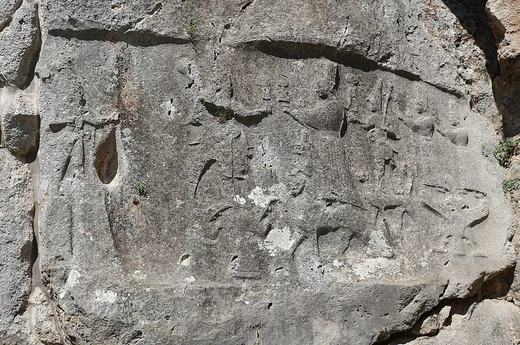
Goddess of the Night (Hurrian)
Hurrian goddess of the night sky and dreaming.
The Goddess of the Night (𒀭𒈪, DINGIR.GE6) was a deity worshiped in the Hurrian kingdom of Kizzuwatna and later in Šamuḫa within the Hittite Empire. Only the logographic writing of her name is known, and she is thought to represent the night sky and dreaming. She is closely associated with the Elamite-origin goddess Pinikir.
Quick Facts
- Deity of
- "Goddess of the Night"
- Cult center
- Kizzuwatna
- Šamuḫa
- Laḫḫurama
Facts from the source article.
Proposed identification
The origin and identity of the Goddess of the Night are debated. Piotr Taracha considers her Hurrian; Gary Beckman suggests her rituals may stem from northern Syrian and transtigridian culture. Jared L. Miller argues she originated in Kizzuwatna, noting no other night deity is known from Syria or Mesopotamia except the phrase 'gods of the night' for stars. A deity Mušītu, 'night,' was worshiped in Emar with Saggar. Alfonso Archi thinks her name might be a mistaken writing of Mušuni, 'order.' In Mesopotamia, night could be personified as a 'veiled bride' but not always marked as divine; Daniel Schwemer still considers her a deity. Personified night appears with Ea and the Sebitti in a dream incubation ritual and is mentioned in Maqlû, where a commentary identifies her with Gula. A fragment may link her to Ishtar, but the restoration is uncertain.
Character and iconography
The Goddess of the Night was likely understood as a divine representation of the night sky and was associated with dreaming. She may have been regarded as chthonic, as she was invoked through ritual pits. She wore a white or red kureššar, a shawl typical for Hittite women, and the use of a feminine verb form confirms her as a goddess. Yet she received both feminine and masculine clothing sets, which Jared L. Miller suggests points to a partially ambiguous identity; Richard H. Beal thinks she crossdressed, and Gary Beckman notes ambiguous gender was characteristic of Ishtar-like goddesses. A text on her new temple describes her statue made of gold encrusted with carnelian, lapis, alabaster, and 'Babylon stone' (cast glass), with separate golden objects for her navel and purka. She was equipped with silver and iron brooches, ivory combs, musical instruments, a bronze basin, stools, tables, and five-colored woolen tapestries for privacy. A golden disk representing Pinikir accompanied her.
Associations with other deities
The Goddess of the Night was associated with Ishtar; a Hittite oracular text lists her hypostases among Ishtar's, and a ritual invocation names Ishtar's cult centers (Agade, Babylon, Hursagkalama). This list and the worship of Pinikir indicate transfer of Mesopotamian knowledge, possibly from a document like the Canonical Temple List. However, not all her traits were identical to Ishtar's. She has been compared to Hurrian Šauška, but unlike Šauška, she was never linked to Nineveh. Similarities to Išḫara include shared underworld associations and ties to Ishtar. She was closely linked to Pinikir, an Elamite goddess of Venus equated with Ninsianna in Emar. They functioned as a dyad, a common Hurrian practice for deities with similar domains. In a ritual for her new temple, she was summoned from cities of Ishtar and from Susa and Elam, where Pinikir was worshiped. A golden disk on her statue likely represented Pinikir, together forming a 'rendering of night sky with its luminaries.' Pinikir received the same goodwill offering as the Goddess of the Night, but on the roof, and they shared purification rites.
Worship
The Goddess of the Night was worshiped in Kizzuwatna, where clergy included SANGA priests (Ilī-ma-abī and Ulippi) and katri priests (Arazakiti, co-author of a ritual text). During the reign of Tudḫaliya I or Tudḫaliya II, she was introduced to Hittite lands, with Šamuḫa near modern Sivas as her new cult center; she was also worshiped in Laḫḫurama. The 'Expansion of the Goddess of the Night' describes her transfer to a new temple: a new statue and temple were built, purification water from the old temple was brought and kept on the roof for a day, she was summoned from various locations, and a string representing her path was tied to the statue. Pinikir also received offerings during this ritual.
More in Hurrian Deities
Spotted an error? Know more?
Reader corrections go straight into our review queue. Suggest an edit · How this site is sourced