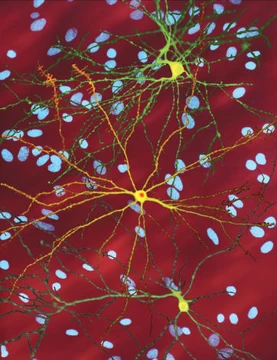
Cagla Eroglu
Neuroscientist studying astrocyte roles in synaptic development and connectivity.
Cagla Eroglu, a Turkish neuroscientist, serves as an associate professor of cell biology and neurobiology at Duke University and is an investigator for the Howard Hughes Medical Institute. She also directs graduate studies in cell and molecular biology at Duke University Medical Center. A prominent figure in glial biology, her research investigates how glial cells, particularly astrocytes, influence the development and connectivity of synapses.
Quick Facts
- Birthplace
- Ankara, Turkey
- Fields
- Neuroscience, molecular biology
- Workplaces
- Duke University
- Known for
- Discovery of astrocyte factors implicated in regulation of synaptogenesis
Facts from the source article.
Early life and education
Eroglu was born in Turkey. She earned a bachelor's degree in chemical engineering from the Middle East Technical University in Ankara, Turkey, between 1992 and 1996. In 1996 she began a master's degree in molecular biology at Bilkent Üniversitesi in Ankara, completing it in 1998. She then moved to Germany for graduate studies in molecular biology at Ruprecht-Karls-Universität Heidelberg. Her Ph.D. was supported by the European Molecular Biology Laboratory Ph.D. program, and she worked under the mentorship of Irmgard Sinning, whose lab moved from EMBL to Heidelberg University in 2000. Eroglu's doctoral research broadly focused on membrane protein biology, using Drosophila as a model organism to study how metabotropic glutamate receptor (mGluR) affinity is modulated. She found that mGluRs associated with cholesterol-rich lipid rafts in the membrane exist in a high-affinity state for glutamate, while those not associated with sterol-rich rafts exist in a low-affinity state. After completing her Ph.D. in 2002, Eroglu moved to the United States for postdoctoral work under Ben Barres at Stanford University. There she began studying glial cells. With colleagues in the Barres Lab, she helped reveal the critical role glial cells play in shaping synapses and neural circuits during development. Her team identified an astrocyte-derived factor, Thrombospondin, that promotes synaptogenesis in the central nervous system. She characterized its receptor, α2δ-1, which is also the binding site for the drug gabapentin. Overexpression of α2δ-1 increased synaptogenesis, while blocking the receptor with gabapentin markedly decreased excitatory synapse formation. Eroglu also discovered the astrocyte-secreted proteins hevin and SPARC, finding that hevin induces synapse formation while SPARC antagonizes hevin's synaptogenic actions.
Career and research
In 2008, Eroglu joined the faculty at Duke University as an associate professor in the department of cell biology and in the department of neuroscience. She is also a Faculty Network Member of the Duke Institute for Brain Sciences, an associate of the Duke Initiative for Science and Society, an Affiliate of the Regeneration Next Initiative, and a member of the ALICE program within the Duke University School of Medicine. Her lab studies the mechanisms underlying synaptic connectivity in the central nervous system, focusing on the cellular and molecular roles astrocytes play in shaping synapse development, function, and plasticity. This work on astrocyte-neuron communication in the healthy brain aims to understand how such communication becomes pathological in disease states and how it might be therapeutically targeted. Eroglu and her team investigated synaptic connectivity in models of Huntington's disease. They probed the role of the Huntingtin protein (htt) in synaptic connectivity and found that silencing htt caused excitatory synapses in the cortex and striatum to form rapidly and then deteriorate soon after. Knocking in the disease-causing htt mutation produced similar findings, suggesting that proper htt function is necessary for normal cortical and striatal development. Continuing her postdoctoral work on hevin, Eroglu explored its role in shaping cortical development in the mouse brain. Knocking out hevin led to reductions in thalamocortical synapses but increases in excitatory connections within the cortex. Critical pruning of spines with multiple excitatory contacts failed to occur when hevin was knocked out, emphasizing hevin's regulatory role in normal cortical development.
Select publications
Risher WC, Kim N, Koh S, Choi JE, Mitev P, Spence EF, Pilaz LJ, Wang D, Feng G, Silver DL, Soderling SH, Yin HH, Eroglu C. Thrombospondin receptor α2δ-1 promotes synaptogenesis and spinogenesis via postsynaptic Rac1. The Journal of Cell Biology. PMID 30054448, doi:10.1083/jcb.201802057. Singh SK, Stogsdill JA, Pulimood NS, Dingsdale H, Kim YH, Pilaz LJ, Kim IH, Manhaes AC, Rodriguez-Junior WS, Pamukcu A, Enustun E, Ertuz Z, Scheiffele P, Soderling S, Silver DS, Ji R-R, Medina AE, Eroglu C. Astrocytes assemble thalamocortical synapses by bridging neurexin1-alpha and neuroligin-1 via hevin. Cell, Jan 14:164(1–2):183-196. Chung WS, Allen NJ, Eroglu C. Astrocytes Control Synapse Formation, Function, and Elimination. Cold Spring Harbor Perspectives in Biology. PMID 25663667, doi:10.1101/cshperspect.a020370. Koh S, Kim N-S, Yin HH, Harris I, Dejneka N and Eroglu C. Human Umbilical Tissue-Derived Cells Promote Synapse Formation and Neurite Outgrowth via Thrombospondin Family Proteins. J. Neurosci. 2015, Nov 25: 35(47):15649 –15665. Risher WC, Patel S, Kim IH, Uezu A, Bhagat S, Wilton DK, Pilaz L-J, Singh JA, Calhan OY, Silver DL, Stevens B, Calakos N, Soderling SH and Eroglu C. Astrocytes refine cortical connectivity at dendritic spines. eLife Dec 17, 17:3. McKinstry S.U., Karadeniz Y.B., Worthington, A.K., Hayrapetyan V.Y., Ozlu M.I., Serafin-Molina K., Risher W.C., Ustunkaya, T., Dragatsis, I., Zeitlin S., Yin H.H., Eroglu C. Huntingtin is required for normal excitatory synapse development in cortical and striatal circuits. J. Neurosci. 2014 Jul 9:34(28):9455-72. Kucukdereli, H., Allen, N.J., Lee, A.T., Feng, A., Ozlu, M.I., Conatser, L.M., Chakraborty, C., Workman, G., Weaver, M.S., Sage, E.H., Barres, B.A., Eroglu, C. Control of excitatory CNS synaptogenesis by astrocyte-secreted proteins Hevin and SPARC. Proceedings of the National Academy of Sciences of the United States of America 108, E440-449. Eroglu, C, Barres, B.A. Regulation of synaptic connectivity by glia. Nature, Nov 11;468(7321):223-31. Eroglu C. Astrocyte-Secreted Matricellular Proteins in Central Nervous System Development and Function. Journal of Cell Communication and Signaling 3:167-176.
More in Huntington's Disease
Spotted an error? Know more?
Reader corrections go straight into our review queue. Suggest an edit · How this site is sourced