Buffalo jump
Last updated
A buffalo jump is a cliff where Indigenous peoples, starting with the Clovis culture, drove herds of plains bison to their deaths for mass hunting. The term game jump describes a similar man-made cliff used for hunting other animals like reindeer.
Quick Facts
- Earliest known culture
- Clovis culture (c. 11,100–10,800 BCE)
- Blackfoot term
- pishkun
- Blackfoot translation
- deep blood kettle
- Largest buffalo jump
- Ulm Pishkun Buffalo Jump
- Ulm pishkun cliff length
- more than a mile
- Ulm pishkun bone depth
- nearly 13 ft / 3.96 m
Facts from the source article.
Method of the hunt
Hunters herded bison and drove them over the cliff, breaking their legs and rendering them immobile, though often still alive and in great pain. Tribe members waiting below then closed in with spears and bows to finish the kill. The Blackfoot people called these jumps "pishkun," loosely translating as "deep blood kettle." They believed that if any buffalo escaped, the rest would learn to avoid humans, making future hunts more difficult.
The practice has been criticized as highly wasteful because many animals driven over the cliff were not harvested; most would rot or go to waste due to primitive tools and harvesting techniques that made it impossible to process so many carcasses before the onset of rotting. Buffalo jump sites are often identified by rock cairns marking drive lanes that funneled bison over the cliff, sometimes stretching for several miles. These sites yield significant archaeological evidence because processing sites and camps were always nearby, providing information on how Native Americans used bison for food, clothing, and shelter.
Plains Indians depended on the bison for their survival. Meriwether Lewis described the practice in his journals: a young man disguised in a buffalo robe acted as a decoy, placing himself between a herd and a precipice. Other Indians surrounded the herd and moved forward, causing the buffalo to follow the decoy in full speed toward the cliff. The decoy secured himself in a cranny in the cliff, a role Lewis noted as extremely dangerous.
Historical sites
From Alberta to Texas, notable buffalo jump sites include Head-Smashed-In, Bonfire Shelter, Ulm Pishkun, Madison Buffalo Jump, Dry Island, Glenrock, Big Goose Creek, Cibolo Creek, Vore, Wahkpa Chu'gn (which also contains the Too Close for Comfort archaeological site), the Olsen-Chubbuck Bison Kill Site, and Camp Disappointment from the Lewis and Clark Expedition. The Ulm Pishkun Buffalo Jump, possibly the world's largest, was used by Native Americans from around 900 to 1500 CE.
Its cliffs extend over a mile, and the compacted bison bones below reach nearly 13 feet deep, indicating many animals were left unharvested. This site lies within First Peoples Buffalo Jump State Park in Cascade County, Montana. Madison Buffalo Jump State Park, a 638-acre day-use area in Gallatin County, Montana, features a limestone cliff used for 2,000 years. Camp Disappointment, the expedition's northernmost point, remains one of Montana's best-preserved jumps due to its remote location; bones of unharvested animals are periodically exposed by the creek below.
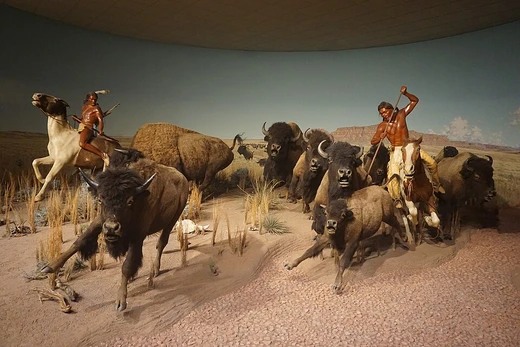
A 3-D reconstruction of Charles M. Russell's buffalo jump painting is displayed at the Helena State Capital Museum in Helena, Montana.
More in Hunting of the American Bison
Sources
Compiled from Wikipedia and the sources listed below. Text from Wikipedia is available under CC BY-SA 4.0; this entry is adapted from it.
- Wikipedia: Buffalo jump (CC BY-SA 4.0).
Spotted an error? Know more?
Reader corrections go straight into our review queue. Suggest an edit · How this site is sourced