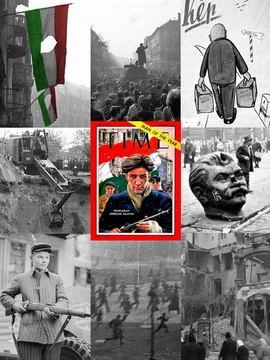
Battle of the Corvin Passage
A pivotal battleground of the 1956 Hungarian Revolution.
The Battle of the Corvin Passage was a key engagement during the Hungarian Revolution of 1956. It is remembered as one of the most important battlegrounds of the conflict. A statue near Corvin–negyed metro station marks the site.
Quick Facts
- Part of
- Hungarian Revolution of 1956
- Date
- 24 – 29 October 1956 (first phase); 4 – 9 November 1956 (second phase)
- Location
- Budapest, Hungary
- Result
- Hungarian Victory (October 24); Soviet Victory (November 9)
Facts from the source article.
Did You Know?
- The Corvin Passage was recognized as strategic due to its importance as a traffic junction and its proximity to the Kilian Barracks and Budapest Radio Station.
- The narrow streets of the passage limited the movement of larger vehicles such as tanks and trucks.
- The uprising began on October 23, 1956, driven by a lack of jobs, declining quality of life, and economic failure.
Early battle
László Iván Kovács first fought at the Corvin Passage in October 1956 after earlier demonstrating at a radio station and using a gun on Üllői Avenue against Soviet tanks. On October 26 he joined other armed revolutionaries in Corvin, eventually leading a unit of 1,000. He set up his base in the Corvin cinema, where his successor later also commanded. The Corvin soldiers had already repelled a Soviet offensive on October 24, inflicting heavy casualties. The Soviets then gathered intelligence and launched a renewed offensive on October 28 under Gennady Ivanovich Obaturov, who had participated in the 1944 Budapest offensive. Overreliance on heavy artillery, poor intelligence, and insufficient planning caused the offensive to fail. The Soviets withdrew from the city on October 29 until October 31. After November 1, Kovács was replaced by Gergely Pongrátz for unknown reasons, who continued the defense until November 9.
Under Gergely Pongrátz
Nicknamed 'Bajusz' for his twirly mustache, Gergely Pongrátz commanded 4,000 militia, facing a renewed Soviet offensive that attacked on November 5. His soldiers fought from building windows, destroying Soviet tanks with makeshift Molotov cocktails, reportedly destroying 12 tanks and inflicting heavy casualties. Under heavy Soviet artillery and mortar fire, the defense became steadily more difficult. After 300 troops deserted on November 6, the fighting became solely guerrilla.
More in Hungarian Revolution of 1956
Spotted an error? Know more?
Reader corrections go straight into our review queue. Suggest an edit · How this site is sourced