STS-84
Sixth Shuttle-Mir docking transferred fourth successive U.S. crew member.
Last updated
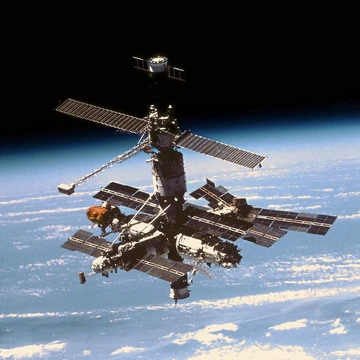
STS-84 was a crewed spaceflight mission by Space Shuttle Atlantis to the Mir space station. It was the sixth Shuttle/Mir docking mission under the NASA/Mir program.
Mission highlights
The STS-84 mission marked the sixth time a space shuttle docked with the Russian Mir station, part of a larger NASA/Mir program that included nine total dockings and seven extended stays by American astronauts on the Russian outpost. Before STS-84, the shuttle missions STS-71, STS-74, STS-76, STS-79, and STS-81 had already performed similar dockings. In this program, American astronauts traveled to and from Mir aboard the shuttle, while Russian cosmonauts used their Soyuz spacecraft for launch and landing.
These missions broadened U.S. research capabilities on Mir by delivering supplies for experiments and bringing samples and data back to Earth. During STS-84, a total of 3,318 kilograms of water and other supplies moved between Atlantis and Mir. While the two spacecraft were linked, 465 kilograms of water, 383.2 kilograms of American science gear, 1,168.6 kilograms of Russian supplies, and 178.1 kilograms of miscellaneous items went to Mir. On the return trip, Atlantis carried 407.1 kilograms of American science materials, 531.2 kilograms of Russian supplies, 14 kilograms of European Space Agency equipment, and 170.7 kilograms of miscellaneous items.
The highlight of this sixth docking was the exchange of the fourth consecutive American crew member to live on Mir. Astronaut C. Michael Foale swapped places with Jerry Linenger, who had arrived at Mir on January 15, 1997, aboard STS-81. Linenger spent 123 days on Mir and a total of just over 132 days in space from launch to landing, ranking him second among Americans at the time, behind Shannon Lucid, for longest time in orbit. Another milestone during his stay was the one-year anniversary of continuous U.S. presence in space, which started when Lucid reached Mir on March 22, 1996.
Several notable events occurred while Linenger was aboard. On April 29, 1997, he took part in the first joint U.S.-Russian spacewalk, a five-hour extravehicular activity with Mir 23 commander Vasily Tsibliyev. They attached an Optical Properties Monitor to the station’s exterior, which would stay there for nine months to study how the space environment affects optical surfaces like telescope mirrors. Earlier, on February 23, a fire broke out on the 11-year-old station.
The blaze caused only minor damage, but the crew had to wear protective masks for about 36 hours while the cabin air was cleaned.
More in Human Spaceflights to Mir
Sources
Compiled from Wikipedia and the sources listed below. Text from Wikipedia is available under CC BY-SA 4.0; this entry is adapted from it.
- Wikipedia: STS-84 (CC BY-SA 4.0).
Spotted an error? Know more?
Reader corrections go straight into our review queue. Suggest an edit · How this site is sourced