
Bridge of Arta
Stone bridge rebuilt many times since Roman foundations.
Last updated
Where it is
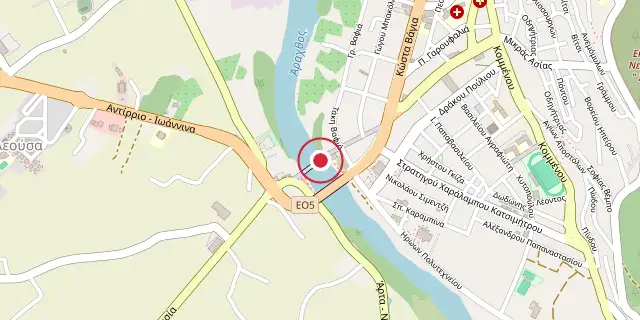
Coordinates: 39°09′07″N 20°58′30″E (39.1520, 20.9750) · Open in OpenStreetMap
Coordinates and connected clubs: the infobox of Wikipedia: Bridge of Arta (CC BY-SA 4.0). Map: drawn by Codexery from OpenStreetMap tiles.
The Bridge of Arta is a stone span over the Arachthos River, located just west of the city of Arta in northwestern Greece. Its foundations may date back to Roman times or even earlier, but the structure has been rebuilt numerous times.
Folklore
The current bridge is likely a 17th-century Ottoman construction. It is best known for the folk ballad "The Bridge of Arta," which tells of a human sacrifice required to keep the bridge standing. This ballad inspired several Greek proverbs and expressions about endless delays, echoing the line: "All day they were building it, and in the night it would collapse."
History
According to the Epirote chronicler Panayiotis Aravantinos, the bridge was first built under the Roman Empire. Some traditions hold that it was rebuilt when Arta became the capital of the Despotate of Epirus, possibly under Michael II Doukas (r. 1230–1268). The present bridge is Ottoman, likely from 1602–06 or perhaps 1613. From Greece’s annexation of Arta in 1881 until the First Balkan War in 1912, the bridge’s highest point marked the border between the Ottoman Empire and the Kingdom of Greece.
In the folk ballad, which belongs to the acritic songs tradition, 45 masons and 60 apprentices worked under a Head Builder, but each night the bridge’s foundations collapsed. A bird with a human voice told the Head Builder that he must sacrifice his wife to make the bridge stand. As she was buried alive in the foundations, she cursed the bridge to tremble like a leaf and those crossing it to fall like leaves. Then, remembering her brother might cross the bridge, she changed her curses into blessings: the bridge would shake only as mountains do, and passersby would fall only as birds of prey do.
Parallels
Immurement is a common motif in Balkan folklore. Parallels include the Serbian epic "The Building of Skadar" and the Romanian folk poem "The Argeș Monastery." A similar legend involves Merlin and King Vortigern: his tower collapsed each night until advisors suggested sacrificing a child and mixing its blood into the mortar.
Lore & Background
According to the Epirote chronicler Panayiotis Aravantinos, the bridge was first built under the Roman Empire. Some traditions say it was rebuilt when Arta became capital of the Despotate of Epirus, possibly under Michael II Doukas (r. 1230–1268). The current bridge is Ottoman, probably from 1602–06 or perhaps 1613. From the annexation of Arta in 1881 to the outbreak of the First Balkan War in 1912, the highest point of the bridge was the border between the Ottoman Empire and the Kingdom of Greece.
The folk ballad 'The Bridge of Arta' tells a story of human sacrifice during its building. According to the ballad, 45 masons and 60 apprentices, under the leadership of the Head Builder, were building a bridge, but its foundations would collapse each night. Finally a bird with a human voice informed the Head Builder that, in order for the bridge to remain standing, he should sacrifice his wife. As she is being buried alive in the foundations, she curses the bridge to flutter like a leaf, then changes her curses to blessings so that her brother, who might pass, would not fall.
A Layered History of Stone and Empire
The Bridge of Arta spans the Arachthos river on the western edge of Arta, a city in northwestern Greece, and its physical form is the product of centuries of repeated reconstruction. The Epirote chronicler Panayiotis Aravantinos attributed the very first construction to the Roman period, though some traditions entertain the possibility of even older foundations beneath the current structure.
When Arta rose to become the capital of the Despotate of Epirus, local tradition holds that the crossing was rebuilt, possibly during the reign of Michael II Doukas between 1230 and 1268. The version of the bridge that stands today is almost certainly an Ottoman work, most likely erected between 1602 and 1606, though some sources point to 1613. The structure also carried a geopolitical weight: after Arta was annexed in 1881, the bridge's highest point served as the literal boundary line between the Ottoman Empire and the newly established Kingdom of Greece, a role it retained until the First Balkan War broke out in 1912.
The Ballad of the Buried Bride
The folk ballad that gives the bridge its name belongs to the family of acritic songs and tells a haunting tale of construction and sacrifice. In the narrative, a Head Builder leads a crew of forty-five masons and sixty apprentices in the task of spanning the river, yet every single night the day's work crumbles back into ruin. The impasse is broken when a bird speaking with a human voice reveals the hidden condition: the bridge will hold only if the Head Builder offers his own wife as a living foundation. As she is sealed into the earth beneath the stonework, she unleashes a curse, wishing the structure to tremble like a leaf and every traveler to tumble the same way.
Then, remembering that her brother travels far and might one day cross the very span she is condemned beneath, she softens her words into something closer to blessings. She rewords her curse so that the bridge trembles only as tall mountains tremble, and passers fall only as birds of prey fall. The transformation from malice to measured harm gives the ballad its emotional core.
Proverbs Born from a Broken Bridge
The most enduring legacy of the Bridge of Arta may not be its stonework at all but the language it spawned. The ballad's central image of labor undone overnight became the seed from which a cluster of Greek proverbs and customary expressions grew, all orbiting the theme of interminable delay and futile effort.
The ballad's own line, in which the builders toil all day only to watch their work collapse before dawn, became a ready-made metaphor for any project that seems to make no forward progress no matter how much energy is poured into it. These expressions entered everyday Greek speech as shorthand for bureaucratic stalling, stalled negotiations, and the general frustration of watching repeated attempts fail to produce a lasting result. The bridge thus functions in Greek culture less as a mere piece of infrastructure and more as a narrative engine, a story so deeply embedded in the collective imagination that its imagery can be summoned to describe any situation where effort and outcome remain stubbornly disconnected.
A Motif That Crosses Borders
The story of a structure that refuses to stand until a human life is buried in its foundations is far from unique to Greece. The practice of immurement, sealing a person alive within a building to ensure its permanence, recurs across Balkan and broader European folklore. In Serbia, the epic poem known as The Building of Skadar carries the same narrative skeleton, and Romanian tradition preserves a parallel in the folk poem about the Argeș Monastery.
The motif also surfaces in the British and Welsh legends surrounding Merlin, where King Vortigern attempts to raise a defensive tower against Ambrosius and Uther Pendragon. As with the Arta ballad, the tower's work is destroyed each night, and his counselors advise that a child's blood mixed into the mortar will finally make the structure hold. Scholar Artemis Leontis has examined how the Bridge of Arta sits at the intersection of classical and Balkan literary traditions, underscoring that this particular story of sacrifice and stonework belongs to a shared mythological vocabulary stretching from the Aegean to the British Isles.
Reader's Guide
The Bridge of Arta holds significance as both a physical structure and a cultural symbol. Its repeated reconstructions from Roman times through the Ottoman period reflect the strategic importance of the crossing.
The bridge's highest point served as a border between the Ottoman Empire and the Kingdom of Greece from 1881 to 1912, marking a geopolitical boundary. The folk ballad associated with the bridge has permeated Greek culture, generating proverbs and customary expressions about endless delays, drawn from the line 'All day they were building it, and in the night it would collapse.' The theme of immurement in the ballad parallels similar folklore in Balkan peoples, such as the Serbian epic 'The Building of Skadar' and the Romanian 'The Argeș Monastery,' as well as a legend about Merlin and Vortigern. The bridge thus stands as a nexus of engineering history, national borders, and enduring folk tradition.
More in Human sacrifice in folklore and mythology
Sources
Compiled from Wikipedia and the sources listed below. Text from Wikipedia is available under CC BY-SA 4.0; this entry is adapted from it.
- Wikipedia: Bridge of Arta (CC BY-SA 4.0).
Spotted an error? Know more?
Reader corrections go straight into our review queue. Suggest an edit · How this site is sourced