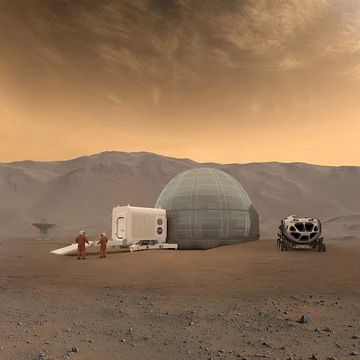
Austere Human Missions to Mars
A scaled-down NASA Mars mission concept from 2009.
Austere Human Missions to Mars is a NASA concept from 2009 for a reduced-cost human mission to Mars. It proposes a modified version of Design Reference Architecture (DRA) 5.0, aiming to achieve similar exploration goals with a smaller crew and lower funding. As of 2015, the concept had not been adapted to the Space Launch System that replaced the Constellation program.
Quick Facts
- Year released
- 2009
- Agency
- NASA
- Crew size
- 4
- Launch cadence
- Every four years
- Surface habitat mass
- 52 metric tons
- Pressurized rover power
- 5 kilowatt Stirling radioisotope generator each
Facts from the source article.
Key measures
It uses standardized systems to launch a crew of four every four years, scaled down from DRA 5.0's crew of six. Cost savings come from avoiding high-risk or high-cost technology development and maximizing commonality: a blunt-body entry vehicle without deployable decelerators, aerobraking instead of aerocapture, no liquid hydrogen, standard bipropellant propulsion, radioisotope surface power, and multiple Ares V launchers.
Mission
The mission uses a Crew Exploration Vehicle (Orion class) to lift the crew to Earth orbit, where it docks with a Mars Transit Habitat (TransHab) that supports four crew for up to three years. A Mars descent/ascent vehicle (MDV/MAV) takes the crew from orbit to the surface and back, with a Contingency Consumables Module that can be jettisoned. A Mars surface habitat (SurfHab) and a Surface Power and Logistics Module are transferred in advance. A standardized LOX/LH2 propulsive stage sends the Descent/Ascent Vehicle (DAV), surface habitat, and cargo elements to Mars orbit uncrewed; the DAV aerocaptures into Mars orbit. The surface habitat and cargo likely perform direct entry. The combined DAV allows an abort to orbit. Technologies considered include supersonic retro-propulsion, but the design remains traditional with a large heat shield and retro rockets. The surface habitat may use an inflatable structure and its descent propellant tanks for waste storage. The Power/Logistics lander carries two pressurized rovers (each for two crew) powered by 5 kilowatt Stirling radioisotope generators, plus two mobile generators, consumables, and science equipment. The surface habitat has two 5 kilowatt radioisotope Stirling generators and an ISRU oxygen generator, but unlike DRA 5.0 or Mars Direct, ISRU does not produce propellant for ascent.
More in Human Missions to Mars
Spotted an error? Know more?
Reader corrections go straight into our review queue. Suggest an edit · How this site is sourced