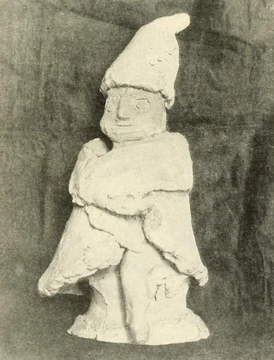
Trilby, or the Fairy of Argyll
A Scottish household spirit's tragic love for a married woman.
Last updated
Trilby, or the Fairy of Argyll is an 1822 literary fairy tale novella by French author Charles Nodier. It tells the story of a Scottish household spirit who falls in love with the married woman of the house, leading to both their deaths. The work was a popular piece of the Romantic movement and inspired multiple ballets and an opera.
Quick Facts
- Author
- Charles Nodier
- Year of publication
- 1822
- Original language
- French
- Genre
- Literary fairy tale novella
- Notable adaptations
- La Sylphide (ballet, 1832), The Mountain Sylph (opera, 1834)
Facts from the source article.
Plot
Trilby is a Scottish household spirit who dwells in the hearth of a fisherman named Dougal and his wife Jeanie. He divides his time between tending the cottage and boats and playing pranks. Though in love with Jeanie, he shows himself only when she is half-asleep. After she tells Dougal about him, Dougal brings in Ronald, a monk from Balva monastery.
Ronald threatens to trap Trilby inside a birch tree in the burial ground for a thousand years if he does not leave. Trilby disappears. Jeanie grows sad and dreams of him not as a playful childlike figure but as a handsome young chief of Clan MacFarlane, who was exiled for defying the monks of Balva. Without Trilby, Dougal’s fishing luck turns sour.
One year later, the couple joins a pilgrimage to Balva monastery. Dougal hopes to pray for treasure in a precious casket; Jeanie hopes to forget Trilby. Ronald tells the pilgrims that most of the MacFarlane family is cursed for not paying tribute to the monks and urges them to curse all Scottish spirits. Jeanie spots a painting of John Trilby MacFarlane in the monastery and recognizes it as Trilby.
Instead of cursing him, she prays to Saint Columba for strength to remain charitable. A small old man hires Jeanie to row him to her cottage. On the way, he says he is Trilby’s father. When Jeanie admits she loves Trilby and blames herself for his banishment, the man reveals he is Trilby himself, claiming Columba was his brother and that her prayers drew him back.
He is unafraid of a thousand years of captivity. Trilby jumps overboard when Dougal arrives carrying a jeweled ivory casket his nets snagged from the lake. Jeanie takes the casket home and hears Trilby’s voice inside, asking her to say she loves him so he can escape. She refuses, staying faithful to her marriage.
Ronald visits Dougal, and Jeanie sees them praying by a large birch tree in the burial ground. From the tree she hears Trilby’s voice fading. She leaps into an open grave and dies. Her gravestone bears her last words: “A thousand years are but a moment to those who are never meant to be separated.”
Writing history
In spring 1821, Nodier traveled with three friends to Ben Lomond, Scotland, the home of his literary idol Sir Walter Scott. He did not meet Scott but published a book about the trip, Promenade de Dieppe aux montagnes d’Écosse, which was successful enough to have an English translation.
In the preface to Trilby, Nodier said the subject came from a preface or note to one of Scott's novels. He admitted to taking liberties with Scottish place names, writing Argail for Argyll and Balva for Balvaig, since this was a work of imagination. The novella was well received in France; Victor Hugo's 1828 book Odes et Ballades included a poem addressed to the character.
Adaptations
Several ballets and an opera have been based on Trilby. La Sylphide, written by Adolphe Nourrit and choreographed by Filippo Taglioni, premiered 12 March 1832 at the Paris Opera and is considered the first Romantic ballet. It reversed the gender of the main roles and changed the supporting characters: James, a young Scottish farmer, is engaged to Effie but is enticed by the Sylphide, a female sylph; the witch Madge tricks him into giving the Sylphide a magic shawl that makes her lose her wings and die.
Marie Taglioni, the choreographer's daughter, danced the Sylphide and became one of the first international ballet stars. August Bournonville adapted La Sylphide for the Royal Danish Ballet in 1836, and his version remains in that ballet's repertoire. La Sylphide was adapted as the opera The Mountain Sylph by John Barnett and Thomas James Thackeray in 1834. Its plot is almost unrecognizable from Trilby: it starts similarly to La Sylphide but ends happily, with the sylph Eolia marrying the peasant Donald after being rescued from the fiend Astaroth.
Translations
A Spanish translation, Trilby, ó, El duende de Argail, was published by Juan Oliveres in 1842. The first English translations appeared in 1895, prompted by the success of George du Maurier's 1894 novel Trilby, which sold a hundred thousand copies in four months and caused 'Trilbymania'.
Nathan Haskell Dole's translation, Trilby, the Fairy of Argyle (Boston: Estes and Lauriat, 1895), spent most of its introduction discussing du Maurier's book. Minna Caroline Smith's translation, Trilby the Fairy of Argyle (Boston: Lamson, Wolffe, 1895), was published days later in competition. More recent English translations include Smarra & Trilby by Judith Landry (1993, Dedalus Books) and Trilby / The Crumb Fairy by Ruth Berman (2015, Black Coat Press).
Did You Know?
- The monk Ronald tells pilgrims that charity or mercy towards evil is a sin, a contradiction as charity is a traditional Christian virtue.
- Dougal is so interested in the jeweled casket that he does not notice he is losing his wife's love.
- The revelation that the MacFarlanes were economic rivals of the monks points out Ronald's hypocrisy.
More in Household Deities
Sources
Compiled from Wikipedia and the sources listed below. Text from Wikipedia is available under CC BY-SA 4.0; this entry is adapted from it.
- Wikipedia: Trilby, or the Fairy of Argyll (CC BY-SA 4.0).
Spotted an error? Know more?
Reader corrections go straight into our review queue. Suggest an edit · How this site is sourced