Avelignese
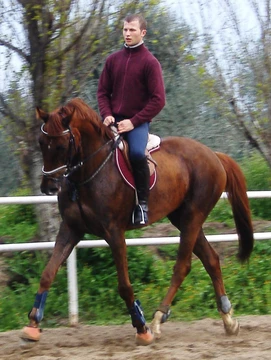
A chestnut mountain horse with flaxen mane and tail.
The Avelignese, also known as the Haflinger, is a breed of horse developed in Austria and northern Italy during the late 19th century. It is always chestnut with a flaxen mane and tail, and is known for its hardiness in mountainous terrain. The breed traces its ancestry to the Middle Ages and all individuals can be traced back to the foundation sire 249 Folie.
Quick Facts
- Features
- Small horse, sturdy build, chestnut coat body color with flaxen mane and tail
- Country
- Austria, Italy
Facts from the source article.
Breed characteristics
The name Haflinger comes from the village of Hafling, now in northern Italy; the breed is also called Avelignese from the Italian name for Hafling, Avelengo. Haflingers are always chestnut, ranging from light gold to rich golden chestnut or liver, with white or flaxen mane and tail. Height has increased since World War II; the desired height today falls between specified minimum and maximum, with breeders discouraged from breeding undersized horses.
The breed has a refined head, light poll, medium-length neck, pronounced withers, sloping shoulders, and deep chest. The back is medium-long and muscular; the croup is long, slightly sloping, and well-muscled. Legs are clean with broad, flat knees and powerful hocks. Gaits are rhythmic and ground-covering: the walk relaxed but energetic, the trot and canter elastic and athletic with some knee action.
Temperament requirements for a quiet, kind nature are part of official breed standards. Some sources recognize two types—a shorter, heavier draft type and a taller, lighter riding type—but all breed organizations register only one type. The Food and Agriculture Organization recognizes both an Avelignese and an Avelignese Tradizionale in Italy, though as of 2007 only 13 of the latter existed.
History
The history of the Haflinger traces to the Middle Ages, with two main theories of origin. One holds that they descend from horses abandoned in Tyrolean valleys by East Goths fleeing Byzantine troops after the fall of Conza in 555 AD, possibly influenced by Oriental bloodlines. A light mountain pony was recorded in the Etsch Valley in 1282, likely an ancestor. Another suggestion is descent from the prehistoric forest horse.
The breed has close connections to the Noriker. The modern breed was officially established in Hafling in the Etschlander Mountains, then in Austria-Hungary. Arabian influence was reinforced by the stallion El Bedavi, imported to Austria in the 19th century; his half-Arabian great-grandson El-Bedavi XXII was sire of the foundation stallion 249 Folie, born in 1874. Folie's dam was a native Tyrolean mare.
All purebred Haflingers must trace to Folie through one of seven stallion lines. Oriental stallions Dahoman, Tajar, and Gidran were also used early on but discontinued.
Uses
Haflingers were bred for versatility in under-saddle disciplines while remaining solid enough for draft and driving work. Originally developed for mountainous regions, they were used as packhorses and for forestry and agricultural work. In the late 20th century, the Indian Army attempted to breed pack animals from Haflingers but failed due to the breed's inability to withstand desert heat. The Austrian Army still uses Haflingers as packhorses in high Alpine terrain with slopes up to 40% and steps up to 40 cm; about 70 horses are held by the 6th Infantry Brigade in Hochfilzen.
The German Army also uses them for rough terrain and demonstrations. Today the breed is used in draft and pack work, light harness and combined driving, and under-saddle events including western classes, trail and endurance riding, dressage, show jumping, vaulting, and therapeutic riding. They serve as dressage horses for children and are suitable for adults. In the 1970s, Prince Philip, Duke of Edinburgh, competed with a driving team of four Haflingers.
In Italy, Haflingers provide a large percentage of national horse meat production, most slaughtered between 10 and 18 months. The breed also produces the majority of horse milk consumed in Germany.
Registration
Breed organizations in many countries document Haflinger pedigrees and ownership, most linked through the World Haflinger Federation (WHF), established in 1976. The WHF sets international breeding guidelines, objectives, and rules for studbook selection and performance tests, and authorizes European and world shows. It comprises 21 member organizations in 22 countries, including the Italian Associazione Nazionale Allevatori Cavalli di Razza Haflinger Italia. National organizations become members by agreeing to promote pure breeding and maintain hereditary characteristics. Member organizations must maintain both a purebred studbook and a separate part-bred studbook for animals with Arabian or other bloodlines.
More in Horse Breeds Originating in Italy
Spotted an error? Know more?
Reader corrections go straight into our review queue. Suggest an edit · How this site is sourced