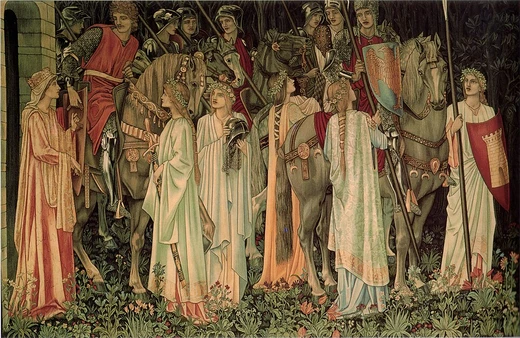
Lancelot-Grail Cycle
A 13th-century French prose cycle central to Arthurian legend.
Its five-branch form is structured around the search for spiritual purity through the Grail Quest and the chivalric adventures of Arthur's knights.[1] The Lancelot-Grail Cycle, also referred to as the Vulgate Cycle or the Prose Lancelot, is a collection of medieval prose romances that developed over time.[2]
Quick Facts
- Ascribed to
- Self-attributed to Gautier Map
- Language
- Old French
- Date
- 1210–1235
- Genre
- Chivalric romance, pseudo-chronicle
- Subject
- Matter of Britain
Facts from the source article.
Making and release
The cycle is dated between approximately 1210 and 1240.[3][4] The various parts were composed separately and put together in a sequence that likely does not reflect the five-part arrangement reached by the second quarter of the thirteenth century.[1] One theory identifies a single master-mind planner, the so-called "architect," who may have written the main section and overseen other scribes.[5] Another theory holds that a group of anonymous French Catholic monks wrote the cycle or at least the Queste part.[6]
Evidence indicates that the Lancelot Proper was likely the initial component written, possibly starting as a standalone narrative.[7] The narratives concerning Joseph and Merlin, which were derived from Robert de Boron's work, were incorporated into the cycle at a later point, likely prior to 1235, functioning as background stories.[8][9] Who actually authored the cycle remains unidentified, though the prevailing scholarly view is that several individuals contributed to its creation.[5] Ferdinand Lot is credited with coining the widely used contemporary designation, the Lancelot-Grail Cycle.[10]
What the cited sources add
The cycle had considerable influence on Arthurian prose romance, with parts incorporated into the Prose Tristan.[2] A new cycle known as the Post-Vulgate Cycle, which does not make Lancelot the central character, has survived in fragments in various languages.[2] The Lancelot-Grail Project website enumerates nearly 150 French manuscripts, some of which are incomplete, while others, like British Library Add MS 10292–10294, hold the full cycle.[11]
References
- "The Story: Outline of the Lancelot-Grail Romance", www.lancelot-project.pitt.edu. facts only, no text reused. lancelot-project.pitt.edu
- "What is the Lancelot-Grail?", www.lancelot-project.pitt.edu. facts only, no text reused. lancelot-project.pitt.edu
- Wikipedia, "Lancelot-Grail Cycle" (CC BY-SA 4.0), which cites: "Vulgate cycle medieval literature", Encyclopædia Britannica (original not read by us) en.wikipedia.org
- Wikipedia, "Lancelot-Grail Cycle" (CC BY-SA 4.0), which cites: "Lancelot-Grail Cycle - Medieval Studies - Oxford Bibliographies - obo", www.oxfordbibliographies.com; "Vulgate cycle medieval literature", Encyclopædia Britannica; Lupack, "The Oxford Guide to Arthurian Literature and Legend", Oxford University Press, 2005 (original not read by us) en.wikipedia.org
- Wikipedia, "Lancelot-Grail Cycle" (CC BY-SA 4.0), which cites: Brandsma, Frank. "LANCELOT PART 3." Arthurian Literature XIX: Comedy in Arthurian Literature, vol. 19, Boydell & Brewer, Woodbridge, Suffolk; Rochester, NY, 200; Lacy, "The Fortunes of King Arthur", DS Brewer, 2005; Lie 1987, p. 13-14; Matarasso, "The Redemption of Chivalry: A Study of the Queste Del Saint Graal", Librairie Droz, 1979; Lie 1987, p. 13-14; Carman, "A Study of the Pseudo-Map Cycle of Arthurian Romance", The University Press of Kansas, 1973 (original not read by us) en.wikipedia.org
- Wikipedia, "Lancelot-Grail Cycle" (CC BY-SA 4.0), which cites: "Vulgate cycle medieval literature", Encyclopædia Britannica; Norris, Ralph, "Sir Thomas Malory and "The Wedding of Sir Gawain and Dame Ragnell" Reconsidered", Arthuriana, 2009, p. 82–102; Frese, Dolores Warwick, "Augustinian Intrusions in the "Queste del Saint Graal": Converting 'Pagan Gold' to Christian Currency", Arthuriana, 2008, p. 3–21; Sévère, "Galahad, Percival, and Bors: Grail Knights and the Quest for "Spiritual Friendship"", Arthuriana, 2015, p. 49–65; Karen Pratt, The Cistercians and the Queste del Saint Graal . King's en.wikipedia.org
- Wikipedia, "Lancelot-Grail Cycle" (CC BY-SA 4.0), which cites: Dover 2003, p. 87; Lacy, "The Fortunes of King Arthur", DS Brewer, 2005; Brandsma 2010, p. (original not read by us) en.wikipedia.org
- Wikipedia, "Lancelot-Grail Cycle" (CC BY-SA 4.0), which cites: Sunderland 2010, p. 6 (original not read by us) en.wikipedia.org
- Wikipedia, "Lancelot-Grail Cycle" (CC BY-SA 4.0), which cites: Lacy 2010a, p. viii (original not read by us) en.wikipedia.org
- Wikipedia, "Lancelot-Grail Cycle" (CC BY-SA 4.0), which cites: "The History of the Holy Grail", Boydell & Brewer Ltd, 2010; Korrel, "An Arthurian Triangle: A Study of the Origin, Development, and Characterization of Arthur, Guinevere, and Modred", Brill Archive, January 1984; Norris, "A New Companion to Malory", Boydell & Brewer, 2019, p. 36 (original not read by us) en.wikipedia.org
- Wikipedia, "Lancelot-Grail Cycle" (CC BY-SA 4.0), which cites: "Lancelot-Grail Manuscripts- Chronology and Geographical Distribution", www.lancelot-project.pitt.edu (original not read by us) en.wikipedia.org
Each numbered sentence above was checked against the source it cites before publication. Sentences citing Wikipedia adapt text from the English Wikipedia article Lancelot-Grail Cycle (contributors), used under CC BY-SA 4.0; this entry is available under the same licence. Other sources were used for facts only; no text or images are copied from them.
More in Holy Grail in Fiction
Spotted an error? Know more?
Reader corrections go straight into our review queue. Suggest an edit · How this site is sourced