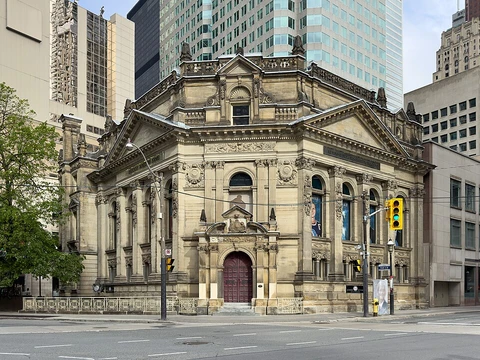
Harold Ballard
Owner of Maple Leafs and Gardens; won four Stanley Cups.

Harold Edwin Ballard (1903–1990) was a Canadian businessman and sportsman best known as the majority owner of the Toronto Maple Leafs of the National Hockey League (NHL) and their home arena, Maple Leaf Gardens. He was also the owner of the Hamilton Tiger-Cats of the Canadian Football League (CFL) and is one of only seven people to have his name on both the Stanley Cup and the Grey Cup.
Quick Facts
- Position
- Owner
- Birth Date
- 30 July 1903
- Birth Place
- Toronto, Ontario, Canada
- Death Date
- 11 April 1990 · 1903 · 07 · 30
- Career Highlights
- Hockey Hall of Fame (1977) / Grey Cup champion (1986)
- Cfhof
- harold-e-ballard
- Cfhofyear
- 1987
Facts from the source article.
Lore & Background
Ballard joined the Maple Leafs organization in 1940, running the Toronto Marlboros senior and junior teams. In 1957 he moved up to the Leafs as part of a committee overseeing hockey operations, later known as the 'Silver Seven'. In November 1961, he became part-owner after Conn Smythe sold most of his shares to a consortium including Ballard, Stafford Smythe, and John W. H. Bassett. Ballard fronted Stafford Smythe most of the $2.3 million purchase price. As executive vice president, he played a key role in the Leafs' dynasty that won Stanley Cups in 1962, 1963, 1964, and 1967.
Ballard soon displayed tendencies that made him one of the most detested owners in NHL history. After the advent of colour television, he installed a new lighting system that caused glare for players; when Hockey Night in Canada's president balked at paying for the upgrade, Ballard grabbed a fireman's ax and threatened to cut the TV cable. He also removed a large portrait of Queen Elizabeth II to make room for more seats, remarking, 'She doesn't pay me, I pay her. Besides, what the hell position can a queen play?' He booked The Beatles for three tours, but on the 1965 tour he sold tickets for two shows despite an agreement for one, turned up the heat, shut off water fountains, delayed concerts, and sold only large soft drinks at triple price.
In 1969, Ballard and Stafford Smythe were charged with tax evasion for using Maple Leaf Gardens Ltd. to pay personal expenses. Bassett, then chairman, won an 8–7 board vote to fire them, but did not force them to sell their shares, a strategic blunder. Ballard became majority owner in February 1972 and held that role until his death in 1990.
Reader's Guide
Ballard's significance lies in his dual role as owner of both the Toronto Maple Leafs and Maple Leaf Gardens, and his influence on the financial performance of the arena. Within three years under the new ownership group, profits at the Gardens tripled to just under $1 million. He negotiated lucrative advertising deals and greatly increased seating capacity, expanding the building's use for concerts and conventions. His four Stanley Cup wins as part-owner (1962, 1963, 1964, 1967) mark the Leafs' last championship era. Off the ice, his tenure was marked by controversial and confrontational behavior, including the tax evasion charges in 1969 and his aggressive dealings with broadcasters and performers. He also owned the Hamilton Tiger-Cats from 1978 to 1988, winning a Grey Cup in 1986. His legacy is that of a builder who delivered championships but whose methods and personality made him widely detested. He was inducted into the Hockey Hall of Fame in 1977 and the Canadian Football Hall of Fame in 1987.
Did You Know?
- Ballard was born Edwin Harold Ballard but later reversed his names and referred to himself as Harold E. Ballard.
- He was appointed assistant manager of the Varsity Grads team that won the hockey gold medal at the 1928 Winter Olympics.
- In 1962, Ballard tried to introduce a hockey-style penalty box to soccer, but FIFA did not allow the rule change.
Early Foundations and the Road to the NHL
Fletcher entered the hockey world in 1956 as a scout for the Montreal Canadiens working under Sam Pollock, before taking on the general manager role with the Verdun Blues junior club. His next major step came in 1966 when the expansion St. Louis Blues hired him as their Eastern Canada scout; he climbed to assistant general manager and helped steer the franchise to the Stanley Cup Final in each of its first three seasons, a streak that remains unmatched. His first true GM assignment arrived in January 1971, when a mid-season leadership overhaul at the Kansas City Blues of the Central Hockey League placed him in the top seat. By 1972 he was handed the reins of the expansion Atlanta Flames, his first NHL GM post. Over the decades that followed, his reputation as a sharp negotiator and strategic thinker earned him the enduring nicknames 'The Silver Fox' and 'Trader Cliff,' monikers that stuck with him throughout an eight-decade career spanning scouting, management, and advisory roles across multiple franchises.
The Calgary Flames and the 1989 Stanley Cup
Fletcher remained with the Flames through their 1980 relocation from Atlanta to Calgary, and the next decade became the defining stretch of his career. He guided the club to two Smythe Division titles, two Campbell Conference championships, and two Presidents' Trophies awarded to the league's top regular-season team. He also took on the role of general manager for Team Canada at the 1981 Canada Cup, a testament to the trust the sport's governing circles placed in him. In 1988 he made a landmark move by signing Sergei Priakin, the first player from the Soviet Union to suit up in the NHL. The capstone arrived in 1989, when Calgary outlasted the Montreal Canadiens in the Finals to claim the Stanley Cup—the franchise's sole championship to date. Fletcher's blend of sustained regular-season excellence and playoff delivery in Calgary cemented his standing as one of the most accomplished executives of his generation.
The Maple Leafs Era and the Gilmour Trade
Fletcher landed in Toronto in 1991 as chief operating officer, president, and general manager, stepping in shortly after the death of longtime owner Harold Ballard. Crucially, the new ownership showed no appetite for meddling in hockey operations, granting Fletcher a level of autonomy he had never before enjoyed. On January 2, 1992, he pulled off a blockbuster deal with his former Flames counterpart Doug Risebrough, trading five players including Gary Leeman and Craig Berube for Doug Gilmour, Jamie Macoun, and three others. He also hired Pat Burns as head coach that year. The 1992–93 season delivered franchise records of 44 wins and 99 points, with Gilmour posting a career-best 127 points and winning the Selke Trophy while Burns captured the Jack Adams Award—the first major individual honors for Leaf players since 1967. The Hockey News named Fletcher Executive of the Year. Yet despite reaching the conference finals in both 1993 and 1994, the Leafs never advanced to the Stanley Cup Final during his six seasons, and by the fall of 1996 some media outlets began openly questioning his methods.
Later Roles, the Lightning Connection, and Hall of Fame Legacy
After his initial Toronto stint, Fletcher joined the Tampa Bay Lightning in 1999 as a senior advisor to GM Jacques Demers, a position he held for two seasons before Demers exited the organization. Demers later disclosed that he had recruited Fletcher largely because of his own functional illiteracy, admitting in his biography that Fletcher and Jay Feaster performed most of the day-to-day GM work. In 2001 Fletcher moved to the Phoenix Coyotes as GM and executive vice-president, though he ceded the GM title to Mike Barnett within months; both were dismissed in April 2007 following a season that marked the worst record since the team's 1996 relocation from Winnipeg. He returned to Toronto in January 2008 as interim GM, served six months, then transitioned into an advisory role with Maple Leaf Sports & Entertainment, a post he occupied until his death in June 2026. Elected to the Hockey Hall of Fame in 2004, he had previously spent seven years on its board of directors and served on its selection committee, rounding out a career that touched virtually every corner of the professional game.
Frequently Asked Questions
Who is Harold Ballard?
Harold Edwin Ballard (1903–1990) was a Toronto-born Canadian businessman who became the majority owner of the NHL's Toronto Maple Leafs and their home venue, Maple Leaf Gardens. He simultaneously held ownership of the Hamilton Tiger-Cats in the CFL, making him a rare dual-sports figure.
What was Harold Ballard's role with the Maple Leafs?
He entered the organization as a senior executive in 1957, gained a partial ownership stake in 1961, and assumed full majority control in February 1972. He held that top ownership position continuously until his death in 1990, overseeing every major roster and front-office decision during that span.
How many Stanley Cups did Harold Ballard win?
The Maple Leafs lifted the Stanley Cup four times under his ownership: in 1962, 1963, 1964, and 1967. He also added a Grey Cup title in 1986 with the Hamilton Tiger-Cats, a combination that places him among only seven people in North American sports history to have both trophies.
Why is Harold Ballard considered important in hockey history?
His nearly four-decade tenure shaped an entire era of Maple Leafs hockey, producing both legendary championship runs and deeply controversial roster and front-office decisions that fans still debate. His dual Stanley Cup and Grey Cup legacy cements a unique place in Canadian sports lore.
When and where did Harold Ballard die?
Ballard passed away on April 11, 1990, in Toronto, Ontario, at the age of 86. He had been born in the same city on July 30, 1903, and spent his entire professional life in the Toronto area.
More in Hockey Hall of Fame Builders and Executives 1-24
Spotted an error? Know more?
Reader corrections go straight into our review queue. Suggest an edit · How this site is sourced