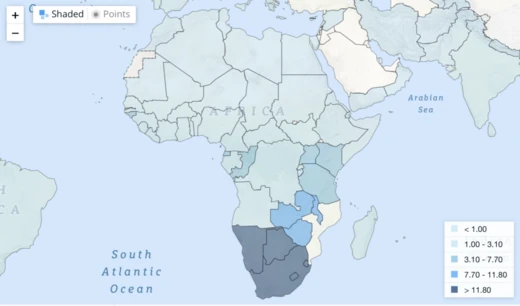
HIV/AIDS in Rwanda
Rwanda's HIV prevalence has stabilized since the late 1990s.
Rwanda faces a generalized HIV epidemic, with a prevalence rate of 3.1 percent among adults aged 15 to 49. The rate has remained relatively stable, with an overall decline since the late 1990s. Women are at higher risk than men, and young women aged 15 to 24 are twice as likely to be infected as young men in the same age group.
Quick Facts
- Urban hiv prevalence
- 6%
- Rural hiv prevalence
- 2%
- First hiv case reported
- 1983
Facts from the source article.
Overview
HIV/AIDS is a disease caused by the human immunodeficiency virus, leading to a range of health complications. Despite extensive research, many questions about its origins and how it became an epidemic remain unanswered. In the early 1980s, the global AIDS epidemic was initially thought to affect only homosexual men and intravenous drug users. However, in Africa, cases appeared across many different groups. Some proposed reasons for HIV’s emergence in 20th-century Africa include rapid population growth, shifts in population structure, and medical procedures that may have accelerated human-to-human transmission.
In Rwanda, HIV/AIDS is a major public health issue because deaths from the disease create serious social and economic problems for both individuals and the government. The first HIV infection in the country was recorded in 1983. The estimated rate of new infections, or incidence, is 0.11%, and this figure has remained stable.
Most information on national HIV prevalence in Rwanda comes from the antenatal care sentinel surveillance system, which tracks women attending prenatal clinics. While this system does not provide estimates for the general population, it offers data specific to those women. The Rwanda Demographic and Health Surveys (RDHS) of 2005, 2010, and 2014–2015 included HIV testing, allowing for a better understanding of infection patterns among people of reproductive age, including men aged 15–59, who are not covered by antenatal surveillance. The 2014–2015 RDHS was the third such survey to anonymously link HIV test results with behavioral and demographic information from both men and women, following the 2005 survey. These surveys provide national, population-based trends on HIV prevalence for women aged 15–49 and men aged 15–59. For the first time, the 2014–2015 RDHS also tested children aged 0–14.
Since 2005, HIV prevalence in Rwanda has remained stable at 3% among adults aged 15–49, with 4% of women and 2% of men affected. Prevalence is higher in urban areas (6%) than in rural areas (2%). In the capital, Kigali, the rate is 6%, while each of the other provinces has a prevalence of 2–3%.
National policy and programmatic responses to the HIV/AIDS epidemic
Rwanda first began tracking HIV/AIDS in 1984, setting up a system for hospitals and health centers to report new cases. The country moved quickly and consistently in its early response. In 1985, the Ministry of Health and the Red Cross launched one of Africa’s earliest and most successful blood donor screening programs. The following year, Rwanda became the first nation anywhere to carry out and publish a nationwide HIV/AIDS seroprevalence survey. By 1987, it had created a National AIDS Program with help from the World Health Organization.
The civil war started in 1990. From April to July 1994, genocide killed roughly 800,000 Rwandans, displaced nearly four million people, and wrecked the country’s health infrastructure. During the genocide, the government could barely prevent or treat HIV/AIDS. The International Criminal Tribunal for Rwanda documented the widespread use of rape as a weapon, with between 250,000 and 500,000 women and girls assaulted. Deliberately infecting victims with HIV was a known tactic. Still, the precise impact of these atrocities on HIV/AIDS rates remains unclear.
After the genocide, the health system lay in ruins. Life expectancy had fallen to just 30 years, and one in four children died before age five. From 1990 to 2002, new AIDS cases rose steadily, with 1,000 to 4,000 reported each year. Then came sharp jumps: over 6,000 cases in 2003 and more than 12,000 in 2004. Overall, HIV prevalence appears to have leveled off since its early-1990s peak, partly because of the genocide’s effects.
To rebuild, Rwanda turned to a community-based health insurance model called Mutuelles de Santé. Under this system, members pay premiums based on their income and a 10% fee per visit. This approach helped address the shortage of skilled health workers and made national ownership of healthcare a central goal in the country’s post-war recovery.
HIV interventions and achievements
Rwanda has adopted multiple approaches to combat HIV/AIDS, including public education, social programs, condom distribution, voluntary medical male circumcision, and efforts to stop mother-to-child transmission. HIV testing and counseling are offered at no cost in all public health facilities and accredited private clinics. To reach remote areas with limited healthcare access, regular outreach campaigns are conducted alongside community groups, private companies, non-governmental organizations, and faith-based organizations. In 2013, Rwanda began using finger-prick blood tests for HIV in all health centers. The number of facilities providing voluntary counseling and testing grew from 15 in 2001 to 493 by 2013.
Special focus is placed on preventing HIV among vulnerable groups, particularly female sex workers, who were seen as crucial to curbing the virus's spread. In 2010, HIV prevalence among sex workers stood at 51%. To address this, national guidelines for HIV prevention among this group were created and shared as part of the HIV National Strategic Plan for 2013–2018. The USAID-funded ROADS II project played a key role in providing training, mentorship, and peer groups to boost knowledge of HIV and prevention methods, as well as distributing condoms through peer education.
Condom distribution has increased through social marketing and quick-sale outlets, with the private sector also promoting condom use. Between 2009 and 2013, an additional 5 million condoms were distributed. In 2014, the rate of male circumcision among men aged 15 to 49 was 30%. Voluntary medical male circumcision was included in the 2013–2018 National Strategic Plan for HIV. Surgical kits for the procedure were supplied to all facilities, and two healthcare workers per facility were trained. These services are now offered regularly.
Prevention of mother-to-child transmission services have been expanded nationwide, with 97% of all health facilities providing them by 2013. The national strategy to eliminate mother-to-child transmission for 2011–2015 integrated these services into the regular healthcare system. Community health workers actively seek out women who have missed follow-up appointments.
Financing for the national HIV response
In Rwanda, spending on HIV is monitored using the Health Resource Tracking tool. Every year, all health sector participants—including government bodies and development partners—must report what they spent on HIV in the previous fiscal year and what they have budgeted for the current one. The 2014 Global AIDS Response Progress Report for Rwanda contains national HIV financing data for the 2011–2012 and 2012–2013 fiscal years. The country’s main HIV development and funding partners are the Global Fund to Fight AIDS, Tuberculosis and Malaria and PEPFAR. Other partners, such as international foundations, NGOs, bilateral agencies, and the United Nations, contribute financial and technical support and help shape HIV policy and programs. These development partners collaborate with the Rwandan government to set and meet the goals of the National Strategic Plan 2013–2018. They engage in joint planning and coordination, submitting annual reports and budgets so the government can track and make the best use of their resources. Rwanda has a shared monitoring and evaluation system run by the Rwanda Biomedical Center-HIV Division, which partners can use for reporting. Both national and international partners are urged to work together to maximize time spent helping beneficiaries and to reduce the reporting workload. In fiscal year 2011–2012, total public and external funding for HIV/AIDS in Rwanda came to USD 234.6 million. Of that sum, USD 17.7 million (7.6%) was from public sources, while USD 216.8 million (92.4%) came from external sources. This total does not include out-of-pocket expenses or private sector contributions. Among external funders, the Global Fund provided 48.8% of all HIV/AIDS funding, followed by the U.S. government at 39.3%, international NGOs at 2.8%, and UN agencies at 1.8%. Smaller contributions came from bilateral organizations: the Government of Luxembourg and Swiss Development Cooperation together accounted for 0.2% of total HIV/AIDS funding. The only other multilateral contributor was the World Bank, which supplied 0.01% of the total.
More in HIV/AIDS in Africa
Spotted an error? Know more?
Reader corrections go straight into our review queue. Suggest an edit · How this site is sourced