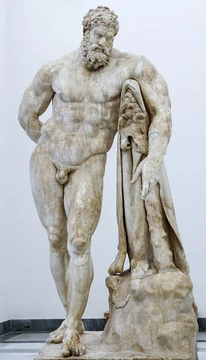
A Libyan Myth
Dio Chrysostom's allegorical Libyan monster myth, featuring Heracles.

via Wikipedia: A Libyan Myth · see source
A Libyan Myth (Λιβυκὸς Μῦθος, Oration 5 in modern corpora) is a short speech or speech-fragment by Dio Chrysostom, telling the story of a mythical creature from Libya, perhaps Lamia, as an allegory for human passions, especially lust. The work is also important for an understanding of Dio's ideas about myth as allegory. It is debated whether the work is a stand-alone speech or an alternative ending to On Kingship IV.
Quick Facts
- Author
- Dio Chrysostom
- Title
- A Libyan Myth (Λιβυκὸς Μῦθος)
- Modern corpus
- Oration 5
- Key figure
- Heracles
- Related work
- On Kingship IV
Facts from the source article.
Attribution and background
The work begins and ends abruptly, with a short introduction and no conclusion. In On Kingship IV, Dio writes that the same story appears there, though the myth's text is not actually present in that speech. Hans von Arnim suggested that A Libyan Myth was originally written as an alternative ending to On Kingship IV and later turned into an independent work with a short preface added, possibly by Arethas of Caesarea. This theory remains possible but unproven. Rudolf Hirzel believed the myth was entirely invented by Dio, but several ancient authors refer to 'Libyan myths' as a genre of fable associated with Cybissus of Libya, and the title implies Dio expected the tale to be recognised as falling within that genre.
Summary
The work opens with a short prologue explaining that myths can be useful when they carry allegorical meanings, like fruit-bearing branches grafted onto a barren plant. Dio states that the Libyan myth is an allegory for human passions (epithymiai). The first section describes a monster living on the shores of Syrtis in Libya, with the head, neck, and breasts of a beautiful woman, hidden claw-like hands, a scaly body, and a tail ending in a snake's head. It catches most prey by force, but humans through trickery, witchcraft, and lust. Although Dio does not name it, this appears to be Lamia. He then explains the allegorical meaning. In the second section, an anonymous Libyan king leads an expedition to the monsters' nest and sets it on fire, but after the king and his army camp for the night, surviving monsters attack and kill them all. Later, Heracles successfully eliminates the monsters as part of his labours to 'tame the Earth.' Dio explains that this allegory concerns eliminating passion from an individual's soul, which is like a forbidding land full of difficult monsters; most people make only a passing effort and are destroyed when their passions reemerge, while a few truly tame their souls as Heracles tamed the Earth. In the third section, set in historical times, a group of Greeks travelling through the Libyan desert with an armed escort to visit the Oracle of Ammon at Siwah see a Libyan woman partially buried in the sand. Two young men take her for a local hetaera, but she kills them by putting her snake part forward, leaving a corpse that rapidly putrefies. The Libyan guides refuse to let the other Greeks touch the corpse, so that they would not all be killed. The text breaks off abruptly, without explaining the meaning of this portion, which is probably intended as an exercise for the reader.
Analysis
Dio was skeptical about myth, seeing it as pointless unless used as an allegory to teach morality. This attitude likely comes from Plato, who in the Phaedrus dismissed efforts to find a factual basis in myths as a waste of time, yet often created and retold myths as allegories for philosophical ideas. Dio’s description of the soul’s passionate part as a monster or beast also echoes Plato, who in the Republic compared the irrational part of the soul to a many-headed beast. Dio’s writing contains close verbal similarities to both Platonic passages. The idea of Libya as a harsh, dangerous landscape was common in Greek and Roman sources, and Dio treats it as a metaphor for the human soul: Heracles’ conquest of that landscape symbolizes his mastery over his own soul. This same allegorical reading of Heracles’ Libyan journey appears in Apollonius of Rhodes’ Argonautica and in Herodorus of Heraclea’s history of Heracles. Dio’s account has a very close verbal parallel with Herodorus, and in other works Dio presents Heracles as a model for the Cynic sage. The same tradition underlies Lucan’s depiction of Cato the Younger crossing the Libyan desert in his Civil War, widely seen as an allegory for the Stoic struggle against vice. Dio’s myth shares similarities with Lucian’s The Dipsads and the vine-women episode in A True Story. Like Dio, Lucian stresses that myth is false, and the two accounts have structural and thematic parallels, but Lucian does not claim his stories teach moral lessons. Lucian’s works were probably inspired by Dio’s myth, but they are not straightforward copies.
More in Heracles
Spotted an error? Know more?
Reader corrections go straight into our review queue. Suggest an edit · How this site is sourced