Sudan ebolavirus
A filovirus causing Sudan virus disease, with no approved vaccine.
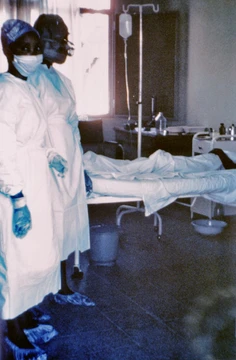
Sudan ebolavirus is a virological taxon within the genus Ebolavirus, family Filoviridae, order Mononegavirales. Its sole member, Sudan virus (SUDV), causes Sudan virus disease, which is clinically indistinguishable from Ebola caused by the Zaire strain but is less transmissible.
Quick Facts
- First discovered
- 1977
- First known outbreak
- June to November 1976 in modern-day South Sudan
- First identifiable case
- 27 June 1976
- Outbreak infections
- 284
- Outbreak deaths
- 151
- Risk group
- World Health Organization Risk Group 4 Pathogen
- Biosafety level
- Biosafety Level 4-equivalent containment
Facts from the source article.
Did You Know?
- A virus of the species Sudan ebolavirus is a Sudan virus if its genome diverges from the prototype Sudan virus variant Boniface by ≤10% at the nucleotide level.
- The ecology of SUDV is unclear and no reservoir host has been identified; bats have been suspected because infectious Marburg virus has been isolated from bats and traces of Ebola virus were found in bats.
- SUDV is basically uncharacterized on a molecular level, but its genomic sequence and organization are similar to other ebolaviruses, so knowledge from EBOV is assumed to apply.
Nomenclature
The name Sudan ebolavirus combines Sudan, the country where Sudan virus was first discovered, with the taxonomic suffix ebolavirus denoting an ebolavirus species. Introduced in 1998 as Sudan Ebola virus, it was renamed Sudan ebolavirus in 2002. A virus belongs to this species if it is endemic in Sudan or Uganda, has three gene overlaps (VP35/VP40, GP/VP30, VP24/L), and its genomic sequence differs from Ebola virus by at least 30% but from Sudan virus by less than 30%. Sudan virus (SUDV) is one of six known ebolaviruses and one of four causing Ebola virus disease in humans and other primates. It is a Select agent, a Category A Priority Pathogen, a Category A Bioterrorism Agent, and listed for export control by the Australia Group.
Previous designations
First described in 1977 as a new strain of Ebola virus, it was called Ebola haemorrhagic fever in a 1978 WHO report on the 1976 Sudan outbreak. In 2000 it became Sudan Ebola virus, renamed Sudan ebolavirus in 2002. Earlier abbreviations included EBOV-S and SEBOV. The virus received its final designation, Sudan virus (SUDV), in 2010.
Vaccine development
As of 2022, six experimental vaccines exist, but only three have entered human clinical trials. The Public Health Agency of Canada developed a candidate rVSV vaccine for Sudan ebolavirus; Merck, which was developing it, discontinued development, and Merck's monopolies on rVSV techniques are unavailable to others. GeoVax was developing MVA-SUDV-VLP, a modified vaccinia Ankara virus producing Sudan virus-like particles; early data showed it 100% effective at preventing death in animals. An adenovirus-based vaccine previously licensed by GSK was donated to and further developed by the Sabin Vaccine Institute with the Vaccine Research Center at the US National Institute of Allergy and Infectious Diseases; as of October 2022, it will be offered to contacts of known SUDV cases in the 2022 Uganda Ebola outbreak as part of a clinical trial.
More in Hemorrhagic Fevers
Spotted an error? Know more?
Reader corrections go straight into our review queue. Suggest an edit · How this site is sourced