Malebolge
Eighth circle of Hell punishing simple fraud in ten ditches.
Last updated
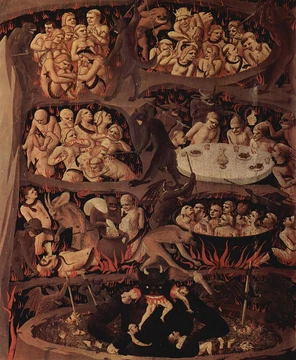
Malebolge, meaning 'evil ditches,' is the eighth circle of Hell in Dante Alighieri's Inferno, reserved for the punishment of simple fraud. It is a funnel-shaped cavern divided into ten concentric trenches, with long causeway bridges radiating from the outer circumference to the center. At its center lies the ninth and final circle, Cocytus, making Malebolge one of the deepest and most severe regions of Hell.
Quick Facts
- Circle
- Eighth
- Category of sin
- Simple fraud
- Number of bolgias
- 10
- Leader of malebranche
- Malacoda
- Final circle beyond
- Cocytus (ninth circle)
Facts from the source article.
Overview
In Dante's version of Hell, the depth of a circle and placement within it reflect the severity of punishment. Malebolge, as the eighth of nine circles, is among the worst places in Hell. It punishes 'simple' fraud—fraud committed without particularly malicious intent—as opposed to 'compound' fraud, which is punished in the ninth circle. Sinners here include counterfeiters, hypocrites, grafters, seducers, sorcerers, and simoniacs.
Dante and his guide Virgil enter Malebolge by riding the monster Geryon, who has the face of an honest man but the tail of a scorpion, descending from the seventh circle where the violent are punished. They plan to cross using the system of bridges, but many ledges and bridges were destroyed during the Harrowing of Hell, forcing them to cross some bolgias on foot and rely on demons for guidance. Eventually they reach the inner ledge, where after encountering giants such as Nimrod, Ephialtes, and Briareus, Virgil convinces the giant Antaeus to lower them to the ninth circle's frozen lake, Cocytus.
The Malebranche
Thirteen demons called the Malebranche, meaning 'Evil Claws,' guard the fifth bolgia of Malebolge. Their leader is Malacoda ('evil tail'), and the others include Scarmiglione, Barbariccia, Alichino, Calcabrina, Cagnazzo, Libicocco, Draghignazzo, Ciriatto, Graffiacane, Farfarello, Rubicante, and a thirteenth who is never named. They attempt to deceive Virgil and Dante by directing them to a path that does not exist.
The Ten Bolgias
The ten ditches of Malebolge punish specific sins in descending order. In the first bolgia, panderers and seducers march single file while horned demons lash them. The second bolgia holds flatterers immersed forever in a river of human excrement, including Thaïs the hetaira. In the third, simoniacs are turned upside down in baptismal fonts cut into rock, their feet set ablaze by oily fires; Pope Nicholas III is found there, and he tells Dante that Pope Boniface VIII will follow.
The fourth bolgia punishes sorcerers, astrologers, and seers whose heads are twisted backward, forcing them to walk backward and blinded by tears; Tiresias and his daughter Manto reside there. In the fifth bolgia, barrators—speculators, extortionists, and unscrupulous businessmen—are thrown into boiling pitch and tar, guarded by the Malebranche with grappling hooks. The sixth bolgia punishes hypocrites, who wear heavy lead robes lined with lead over a golden exterior; Caiaphas and the Sanhedrin are crucified and staked to the ground, marched upon by the hypocrites.
More in Hell in Popular Culture
Sources
Compiled from Wikipedia and the sources listed below. Text from Wikipedia is available under CC BY-SA 4.0; this entry is adapted from it.
- Wikipedia: Malebolge (CC BY-SA 4.0).
Spotted an error? Know more?
Reader corrections go straight into our review queue. Suggest an edit · How this site is sourced