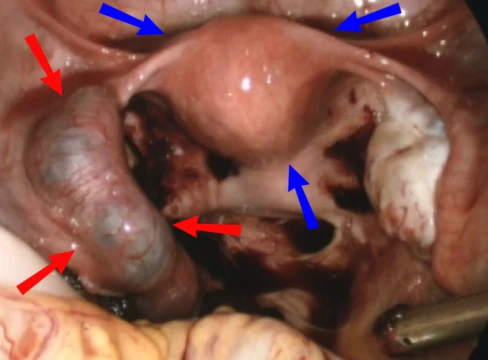
Cervical weakness
Cervical weakness can cause painless dilation and preterm birth.
Last updated
Cervical weakness, also known as cervical incompetence or cervical insufficiency, is a pregnancy condition in which the cervix dilates and thins before term, often without contractions. It can lead to miscarriage or preterm birth during the second and third trimesters, affecting about 1% of pregnancies and accounting for roughly 8% of second trimester recurrent miscarriages.
Quick Facts
- Prevalence
- complicates about 1% of pregnancies
- Normal cervical length threshold
- at least 30 mm / 1.18 in
Facts from the source article.
Diagnosis
Diagnosis of cervical weakness is challenging and typically relies on a history of painless cervical dilation after the first trimester, without contractions or labor and in the absence of other clear pathology. Some providers assess cervical length in the second trimester using ultrasound, though short cervical length is considered a marker of preterm birth rather than cervical weakness itself. Other proposed but unvalidated diagnostic tests include hysterosalpingography, radiographic imaging of balloon traction on the cervix, assessment with Hegar or Pratt dilators, a balloon elastance test, and graduated cervical dilators to calculate a cervical resistance index. A common definition of cervical weakness is a cervical length of less than 25 mm at or before 24 weeks of gestational age, with the risk of preterm birth increasing as cervical length decreases.
Treatment
Cervical weakness is generally treated only when it appears to threaten a pregnancy. The primary treatment is cervical cerclage, a surgical procedure that reinforces the cervical muscle by placing sutures above the cervical opening to narrow the canal. Cerclage is usually performed through the vagina with a speculum, or alternatively through an abdominal incision, which allows placement of the stitch at the exact level needed, particularly when the cervix is very short, effaced, or distorted.
Cerclages are typically performed between weeks 12 and 14 of pregnancy, with sutures removed between weeks 36 and 38 to avoid labor complications. Rare complications reported in the literature include hemorrhage from vein damage during the procedure and fetal death due to uterine vessel occlusion. A study evaluating pregnancy outcomes after cervical conization found no significant differences with cerclage, suggesting it is not superior to no intervention for women with cervical insufficiency due to prior cone biopsy; cerclage can induce preterm contractions without preventing premature delivery, so it is recommended sparingly in such cases.
A cervical pessary, a silicone ring placed at the cervical opening early in pregnancy and removed before delivery, is being studied as an alternative to cerclage with fewer potential complications, though further research is needed to determine its equivalence or superiority.
More in Health Issues in Pregnancy
Sources
Compiled from Wikipedia and the sources listed below. Text from Wikipedia is available under CC BY-SA 4.0; this entry is adapted from it.
- Wikipedia: Cervical weakness (CC BY-SA 4.0).
Spotted an error? Know more?
Reader corrections go straight into our review queue. Suggest an edit · How this site is sourced