Sirona (goddess)
Celtic healing goddess of springs, consort of Apollo Grannus.
Sirona, also known as Đirona or Dirona, was a Celtic healing goddess linked to thermal and curative springs. She is primarily known as the partner of Apollo Grannus, appearing alongside him in many Latin inscriptions and carvings, though some dedications honor her alone. Her key symbols, a snake and a bowl of eggs, represent healing and rebirth.
Quick Facts
- Name variants
- Sirona
- Đirona
- Dirona
- Tsirona
- Consort
- Apollo Grannus (also Apollo Sol)
- Cult area
- Eastern Gaul, the Germanies, Danube provinces (Raetia, Noricum, Pannonia, Dacia), Rome
- Major sanctuary
- Hochscheid (Hunsrück, Treveri territory)
- Number of dedications
- About thirty Latin inscriptions
- Key attributes
- Snake
- bowl of eggs
- fruit
- ears of grain
- grapes
- small dog
Facts from the source article.
Name
The goddess is known only from Latin inscriptions, where her name usually appears as Sirona, though it is sometimes written as Dirona. At the Hochscheid sanctuary, an altar shows the S carved with a horizontal line through it, a method used to represent a Gaulish sound that Latin could not express. This variation between S and D is thought to point to an original initial sound like st or ts, which the tau gallicum Đ also represents, leading to the reconstructed form Stirona. Her name uses the theonymic suffix -ona, also seen in other Gaulish goddesses such as Epona, Matrona, and Damona. Most scholars trace the first part to the Proto-Indo-European word for 'star', h₂ster, which becomes Proto-Celtic sterā-, giving a meaning like 'star goddess'. Ranko Matasović suggests that if Sirona belongs to this root, it may preserve the lengthened form stīr-ōnā. Another theory links the name to a Celtic word for 'ox' or 'heifer'. Under this interpretation, Sirona is directly comparable to Damona, whose name means 'divine ox', and to the Galatian royal name Deiotaros, meaning 'divine bull'.
Cult
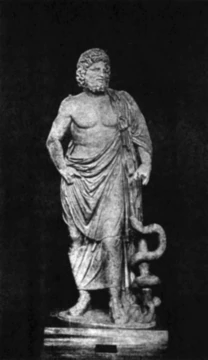
Sirona was the partner of the Celtic Apollo, who was most often called Grannus, a deity associated with healing and hot springs. The Roman emperor Caracalla, according to Cassius Dio, asked Apollo Grannus, along with Asclepius and Serapis, for a cure in the early 200s AD, which indicates how highly regarded this healing god was. In some inscriptions, her companion is just called Apollo, without the Grannus title, and in one case he appears as Apollo Sol. Her worship was mainly found in the German provinces and eastern Gaul, especially along the upper Moselle valley among the Treveri people and around Mainz. Other dedications come from the lands of the Aedui and the Leuci, and from farther away: the Danube regions of Raetia, Noricum, and Pannonia, the province of Dacia, and the city of Rome. An early offering from Bordeaux, made by a man with a Celtic name, is a bit outside this main area. Grannus himself had an even broader cult, stretching to Grand in the Vosges, Aachen (called Aquae Granni), Rome, and as far north as Scotland and Sweden. Those who made dedications to Sirona included imperial procurators, town council members, a retired legionary, temple wardens, and often women. Several inscriptions mention Sirona alone, without Apollo, which scholars think means she had her own independent status and was not just a female counterpart to the god. She appears by herself in places like Bordeaux, Trier, Mühlburg, Wiesbaden, and Mainz. At Corseul in Brittany, she is called Tsirona and is paired with the emperor’s divine spirit, a combination that suggests she was highly esteemed. Her main sanctuary was at Hochscheid, in the Hunsrück region between Trier and Mainz, in Treveran territory, where the local people took a special interest in her cult. In the 100s AD, a temple was built around a spring whose water filled a small basin, and visitors left figurines, coins, and other gifts. The shrine was richly decorated for such a remote location and may have been funded by the owner of a nearby villa. Two cult statues from this site are considered among the best examples of Romano-Celtic art. Apollo is shown in a classical style as a young, naked god resting his lyre on a griffin. Sirona wears a long robe and a diadem, with a snake coiled around one forearm, and in her other hand she holds a bowl containing three eggs.
Interpretation
Sirona is widely seen as a goddess linked to healing and fertility, particularly associated with curative springs. Her images back this up. The snake, a symbol of fertility, healing, and the underworld, often appears with eggs that represent renewal. A similar pairing of a snake with grain or fruit shows up for the related healing goddess Damona, whose statue at Alesia features a head crowned with grain and a hand wrapped around a snake. The serpent is one of several native animal attributes, much like the bear of Artio or the stag of Cernunnos. In other depictions, Sirona holds fruit and grain, as at Sainte-Fontaine, or grapes, as at Mainz. Small clay figurines also show her seated like a mother goddess with a small dog, possibly indicating a healing role.
Her name is usually traced to a word meaning 'star', which has led some to view her as an astral deity. Jan de Vries cautiously considered her as possible evidence for a Celtic star cult. Paul-Marie Duval thought her link to the solar Apollo supported this star interpretation. Helmut Birkhan places her among celestial gods, as the consort of a sun god, while also comparing her to mother goddesses due to her healing powers. A different derivation from a word for 'ox' would instead put her among bovine deities.
Sirona is often paired with Apollo Grannus, a common type of Gallo-Roman divine couple where the god has a Roman name—sometimes with a Celtic surname—while the goddess keeps a purely Celtic one. Bernhard Maier suggests this naming difference might show the native goddess being subordinated to the Roman god. Edith Mary Wightman saw it as reflecting conquerors marrying local women.
Since her images appear both alone and with Apollo, James MacKillop argues that Sirona was already a goddess of fertility and healing before the Roman period and survived the blending of Gaulish and Roman religion. He adds that her cult was later replaced by that of Borvo across much of the Celtic world.
More in Health Deities
Spotted an error? Know more?
Reader corrections go straight into our review queue. Suggest an edit · How this site is sourced