Frequently Asked Questions
The most-asked questions about gymnastics.
What is gymnastics?
Gymnastics is an Olympic sport in which athletes perform acrobatic and artistic routines on specialized apparatus or on the floor. It is governed internationally by the International Gymnastics Federation (FIG) and is split into several distinct disciplines, the most prominent being artistic and rhythmic gymnastics.
What are the main disciplines of gymnastics?
The primary disciplines are artistic gymnastics (men's and women's), rhythmic gymnastics, trampoline, and acrobatic gymnastics. Artistic gymnastics is the most widely followed, with men competing on six apparatus and women on four.
Who are the most celebrated gymnasts in the sport's history?
Names like Nadia Comăneci, Simone Biles, Larisa Latynina, and Kohei Uchimura are consistently cited as the sport's greatest figures. Simone Biles, in particular, has broken multiple all-time Olympic and World Championship medal records and introduced dozens of skills named after her.
What happened with the 'perfect 10' scoring?
Nadia Comăneci became the first gymnast to score a 10.0 in Olympic competition at the 1976 Montreal Games. FIG retired the 10.0 cap in 2006 by switching to an open-ended Code of Points that separates execution and difficulty scores, so no single number can represent a 'perfect' routine anymore.
How does gymnastics scoring work today?
Routines are judged on two components: a Difficulty score (D-score) that tallies the value of each element, and an Execution score (E-score) that starts at 10 and deducts for form errors. The two are added together, with small deductions for things like falls or out-of-bounds steps.
What is the difference between men's and women's artistic gymnastics?
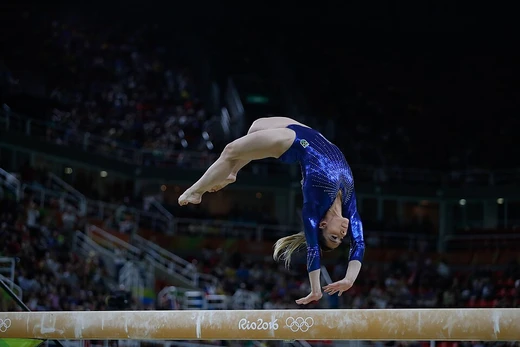
Men compete on six events—floor, pommel horse, rings, vault, parallel bars, and horizontal bar—while women compete on four: vault, uneven bars, balance beam, and floor exercise. The apparatus sets reflect different physical emphases, with men's routines emphasizing strength and women's routines emphasizing flexibility and artistry.
Where can I follow gymnastics outside the Olympics?
The FIG World Championships, held annually, are the sport's premier non-Olympic competition and determine qualification spots for the next Games. Continental and national championships, plus USA Gymnastics or other national-federation competitions, offer additional regular-season coverage.
What are some of the most iconic moments in gymnastics history?
Nadia Comăneci's first perfect 10 in 1976, Simone Biles's four-gold performance at Rio 2016, and her 2016 withdrawal from multiple finals to protect her physical and mental health are often highlighted. The 2008 Beijing men's team final, in which the U.S. squad came back from a 3.6-point deficit, is another frequently cited classic.
How do young athletes typically get into gymnastics?
Most competitive gymnasts begin in pre-school or early-elementary developmental classes and progress through a structured level system set by their national federation. In the U.S., for example, athletes advance through Levels 1–10 before competing at the elite international standard.
What should a newcomer watch first to get oriented?
A recent Olympic all-around final or a FIG World Championship team final gives a quick, high-energy overview of every apparatus and the scoring in action. Pairing that with a short documentary or highlight reel of a current star like Simone Biles or Rebeca Andrade helps put names and routines in context.