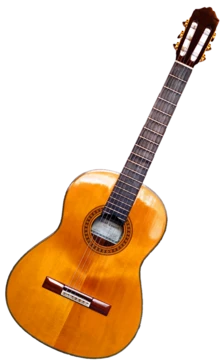
Eleven-string alto guitar
Last updated
The eleven-string alto guitar, also called the altgitarr, archguitar, or Bolin guitar, is a type of extended-range classical guitar invented by Swedish luthier Georg Bolin in the 1960s. Original Bolin models are now scarce and highly sought after. This eleven-string instrument is considered ideal for performing lute works, especially those by Bach and Weiss.
Quick Facts
- Developer
- Georg Bolin
- Country of origin
- Sweden
- Decade of development
- 1960s
- Number of strings (variant)
- 13
- Primary use
- Performing lute music
Facts from the source article.
History
Georg Bolin first constructed the 11-string alto guitar in collaboration with Swedish guitarist Per-Olof Johnson in the 1960s. Johnson, who was fond of lute music, sought a way to play renaissance lute music using guitar technique. The design introduced two main elements: tuning the first six strings a minor third higher (hence the name "alto guitar"), equivalent to a capo on the third fret of a normal prime guitar, and adding five extra strings for low notes.
Makers
Current luthiers building 11-string alto guitars, primarily in Sweden, include Heikki Rousu and Roger Strömberg. Ermanno Chiavi in Switzerland builds 11-string guitars as well, though his guitar has the scale length of a normal classical guitar (650mm) and is tuned in the same manner, so it is technically not an "alto" guitar. Liberto Planas, based in Paris, is considered a leading expert with over 90 instruments of his signature.
More in Guitars
Sources
Compiled from Wikipedia and the sources listed below. Text from Wikipedia is available under CC BY-SA 4.0; this entry is adapted from it.
- Wikipedia: Eleven-string alto guitar (CC BY-SA 4.0).
Spotted an error? Know more?
Reader corrections go straight into our review queue. Suggest an edit · How this site is sourced