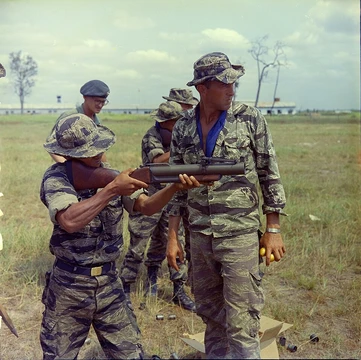
Milkor MGL
Six-shot revolver grenade launcher for squad firepower.
Last updated
The Milkor MGL is a lightweight 40 mm six-shot revolver-type grenade launcher developed and manufactured in South Africa by Milkor (Pty) Ltd. It was demonstrated as a concept to the South African Defence Force in 1981 and officially accepted into service as the Y2 in 1983. The weapon has since been adopted by over 50 countries, with total production exceeding 50,000 units.
Design
The Milkor MGL is a shoulder-fired 40 mm grenade launcher that fires at low velocity. Its six-round magazine works like a revolver cylinder, driven by a spring. This cylinder turns on its own as the weapon fires, but after each reload you must wind it back up. The launcher accepts most 40x46 mm grenades.
Features
Its parts include a lightweight steel barrel with progressive rifling, a sight assembly, a frame with the firing mechanism, the spring-driven revolving cylinder, and a folding stock. A safety switch sits above the rear pistol grip and can be flipped from either side; the weapon will not fire if dropped. To load, you release the cylinder axis pin and swing the steel frame away. Then you unlatch the rear of the cylinder, which includes the pistol grip, and pivot it counter-clockwise to show the chambers.
You put your fingers into empty chambers and rotate the aluminium cylinder to tension the spring. After that, you insert grenades one by one—the cylinder cannot be removed—close the frame, and lock it with the axis pin. Pulling the trigger starts a double-action that cocks and releases the firing pin.
Sights
Gas pressure pushes a piston, unlocking the cylinder so the spring can rotate it until the next chamber lines up with the firing pin. If a round misfires, you can just pull the trigger again. The Y2 model uses an Armson Occluded Eye Gunsight, a collimator sight that shows a single aiming post. You keep both eyes open, and the post appears on the target, with both in focus.
This sight helps estimate range: the post matches the height of a man at 200 meters. It also has tritium illumination for low light, lasting at least ten years. The range quadrant is marked in 25-meter steps. Each MGL comes with a sling, cleaning kit, and user manual.
Variants
After over 12 years of production and user feedback, a redesign known as the MGL Mk-1 was introduced in 1996, making the weapon more user-friendly and reliable while simplifying maintenance. All previously supplied weapons can be upgraded to the Mk 1 configuration, with parts such as the steel barrel interchangeable using a few special tools and cutting dies. Two product-improved variants appeared in 2004: the Mk 1S replaces the aluminum frame with a stronger stainless steel body, a conventional trigger unit, and Picatinny rail support on the top, sides, and bottom of the forend; the Mk 1L shares these features but has a 140 mm long cylinder to fit special-purpose grenades like tear gas canisters and less-lethal impact rounds too long for shorter cylinders, and also includes a sliding buttstock. In 2006, the Milkor 37/38mm Multiple Anti-Riot (MAR) replaced the 40mm less-lethal Yima; it is largely identical to other MGL models but adapted to fire standard 37/38mm less-lethal riot control rounds.
The Milkor SuperSix MRGL, developed in 2012, features a new recoil reduction system, redesigned stock, strengthened construction, and new optics, and can fire low-velocity and medium-velocity munitions with a maximum range of 800 to 1200 m. It can fire six rounds in less than 3 seconds, with a standard six-shot area coverage of at least 20 x 60 m. Milkor USA, Inc. produces copies of the Milkor MGL but has no affiliation or working relationship with Milkor (Pty) Ltd. Milkor USA previously produced the Mk 1S as the MGL-105 and the Mk 1L as the MGL-140, referring to their respective chamber lengths.
More in Grenade Launchers
Sources
Compiled from Wikipedia and the sources listed below. Text from Wikipedia is available under CC BY-SA 4.0; this entry is adapted from it.
- Wikipedia: Milkor MGL (CC BY-SA 4.0).
- Word definitions: the Codexery glossary, each quoted from its Wikipedia article.
Spotted an error? Know more?
Reader corrections go straight into our review queue. Suggest an edit · How this site is sourced