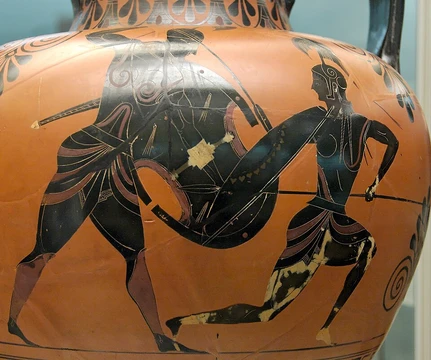
The Minotaur
The Bull of Minos: a half-man, half-bull creature imprisoned in the Labyrinth, slain by Theseus.
Last updated
The Minotaur, also known as Asterion or Asterius, is a mythical creature with the head and tail of a bull and the body of a man.[1]
Quick Facts
- Also known as
- Asterion, Asterius
- Mythological origin
- Offspring of Pasiphaë and a bull sent by Poseidon
- Dwelling
- Labyrinth at Knossos, Crete
- Slain by
- Theseus
Facts from the source article.
Key facts and history
Athens was compelled to send select young men and unwed young women as a sacrificial meal for the Minotaur.[2] The Athenian prince Theseus volunteered to slay the Minotaur, promising his father Aegeus he would change the ship's black sail to white if successful.[3] Theseus killed the Minotaur with his sword, a club, or his bare hands, then led the Athenians out of the Labyrinth.[4] On the return journey, the crew neglected to replace the black sail, and Aegeus, presuming his son dead, killed himself by leaping into the sea.[5]
Pasiphaë, the spouse of Minos, conceived the Minotaur after she developed a passion for a bull sent by Poseidon and copulated with it inside a hollow wooden cow that Daedalus built for her.[6] Pasiphaë gave birth to Asterius, the Minotaur; he became savage and, because he had no natural food source as the unnatural offspring of a woman and a beast, he ate human beings to survive.[6][7] Minos ordered Daedalus to build a huge Labyrinth near the royal palace at Knossos, and the Minotaur was confined inside it.[7][8] Ariadne, the daughter of Minos, assisted Theseus in finding his way through the Labyrinth by providing him with a ball of thread.[4]
What the cited sources add
Catullus's poem describes Athens as compelled by a cruel plague to pay penalties for the killing of Androgeon by giving the Minotaur select young men and unwed young women as a sacrificial meal.[2] Catullus also notes that Theseus vowed to fight the Minotaur, seeking either death or the spoils of praise.[2]
References
- Wikipedia, "Minotaur" (CC BY-SA 4.0), which cites: Kern, "Through the Labyrinth", Prestel, 2000 (we also read that source) en.wikipedia.org
- Catullus, "Carmen 64". facts only, no text reused. rudy.negenborn.net
- Wikipedia, "Minotaur" (CC BY-SA 4.0), which cites: "Isocrates, Helen, section 27", www.perseus.tufts.edu (original not read by us) en.wikipedia.org
- Wikipedia, "Minotaur" (CC BY-SA 4.0), which cites: Graves, "The Greek Myths: 1", Penguin, 1955, p. 339 (original not read by us) en.wikipedia.org
- Wikipedia, "Minotaur" (CC BY-SA 4.0), which cites: Apollodorus, "Bibliotheke" (original not read by us) en.wikipedia.org
- Wikipedia, "Minotaur" (CC BY-SA 4.0), which cites: Apollodorus, "Library"; Chicago, "The Dinner Party (Heritage Floor): Pasiphae", BrooklynMuseum.org (original not read by us) en.wikipedia.org
- Wikipedia, "Minotaur" (CC BY-SA 4.0), which cites: "Metamorphoses: Theseus and the Minotaur", Cambridge Schools Classics Project, 6 October 2020 (original not read by us) en.wikipedia.org
- Wikipedia, "Minotaur" (CC BY-SA 4.0) en.wikipedia.org
Each numbered sentence above was checked against the source it cites before publication. Sentences citing Wikipedia adapt text from the English Wikipedia article Minotaur (contributors), used under CC BY-SA 4.0; this entry is available under the same licence. Other sources were used for facts only; no text or images are copied from them.
More in Greek Myths
Sources
Compiled from Wikipedia and the sources listed below. Text from Wikipedia is available under CC BY-SA 4.0; this entry is adapted from it.
- Wikipedia: Minotaur (CC BY-SA 4.0).
Spotted an error? Know more?
Reader corrections go straight into our review queue. Suggest an edit · How this site is sourced