Gertrude Caton Thompson
English archaeologist who confirmed Great Zimbabwe as an African civilisation.
Gertrude Caton Thompson, born in London in 1888, was an English archaeologist who worked in Egypt, Zimbabwe, Malta, and South Arabia during an era when few women entered the field. She developed a method for excavating sites and advanced knowledge of Paleolithic to Predynastic societies in Zimbabwe and Egypt. Her roles included positions with the Prehistoric Society and the Royal Anthropological Institute. Her interest in archaeology began with a 1911 trip to Egypt and lectures at the British Museum, and an inheritance in 1912 funded her later work.
Quick Facts
- Born
- 1 February 1888
- Birthplace
- London, England
- Died
- 18 April 1985
- Place of death
- Broadway, Worcestershire, England
- Occupation
- archaeologist
- Education
- British School of Archaeology in Egypt
- University College London
- University of Cambridge
- Known for
- Abydos, Egypt
- Oxyrhynchus
- Faiyum
Facts from the source article.
Work in Egypt
Gertrude Caton Thompson spent much of the 1920s digging in Egypt for the British School of Archaeology Egypt, though she also carried out fieldwork in Malta. She took part in excavations at Abydos, El-Badari, and Qau el Kebir, among other sites. Her particular focus was on prehistoric Egypt, and she was among the first archaeologists to study the entire span from the Palaeolithic through to the Predynastic period. Beyond finding artifacts, she arranged for their display at the Egyptian Exhibition in England.
Many of these objects now belong to the British Museum’s permanent collection, with smaller holdings at the Ashmolean Museum in Oxford and the Birmingham Museum and Art Gallery. While working in the Badari region between 1923 and 1924, she examined prehistoric settlement remains at Hemamieh. Her approach there was notably careful: she divided the site into ten-by-thirty-foot sections, excavated in precise six-inch levels, and recorded the exact location of every artifact.
She also pioneered the use of aerial surveys to identify archaeological sites. These methods were far ahead of their time and distinguished her from her peers and most who came after. In 1925, together with geologist Elinor Wight Gardner, she conducted the first combined archaeological and geological survey of the northern Faiyum, aiming to link ancient lake levels with archaeological layers. There she discovered the earliest known farming civilization in the region, dating to around 4000 BC.
Over the next two years, working for the Royal Anthropological Institute, they uncovered two previously unknown Neolithic cultures, primarily through excavations at Kom K and Kom W. Caton Thompson and Wight Gardner also investigated prehistoric sites at Kharga Oasis during three expeditions from 1930 to 1933. Caton Thompson had first visited the oasis in 1928, during her expedition to Zimbabwe. Because the Kharga Scarp held many Palaeolithic sites, she was able to excavate numerous stone tools, using meticulous soil analysis and careful recording of how objects related to one another.
This method transformed the way archaeological sites were surveyed and studied. The flint tools she brought back to London are now permanently housed at the Institute of Archaeology in London. Her book “Kharga Oasis in Prehistory” was the first publication from the new Athlone Press of the University of London. She established that the Kharga Scarp contained water without rainfall, which had supported a Neolithic civilization. This work led to broader research on the Palaeolithic cultures of North Africa, which she published in 1952.
Great Zimbabwe
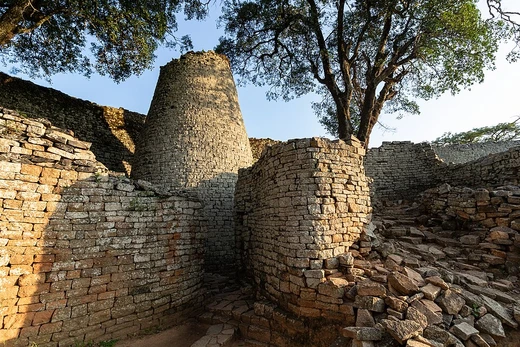
In 1928, the British Academy invited Caton Thompson to investigate the origins of ruins in south-eastern Zimbabwe, near Lake Mutirikwe. The site contained multiple buildings within three sets of structures. Caton Thompson assembled an all female expedition for the Zimbabwe excavations, which was the first of its kind. Known since the 16th century, Great Zimbabwe had been previously excavated by James Theodore Bent and David Randall-MacIver and there was debate as to whether the site was the work of Africans (MacIver's view) or of some other civilisation.
Caton Thompson used ceramics, which were similar to what modern villagers were using, and structures such as terrace walls to determine who built the structures from the site. Working with Kathleen Kenyon, Caton Thompson's excavations led her to the view that Zimbabwe was the product of a 'native civilisation', publishing her results in a book called 'The Zimbabwe Culture' in 1931. The assertion attracted considerable press attention and was received negatively by many within the archaeological community.
She received hate mail from Victor Loret and Alfred Charles Auguste Foucher, whose views on the Great Zimbabwe she challenged. Caton Thompson claimed to keep hostile letters from local experts in a file marked 'insane'. Modern archaeologists now agree that the city was the product of a Shona-speaking African civilisation.
Later life
In 1932, she employed Mary Leakey to illustrate her book The Desert Fayum, greatly influencing her later career in palaeoanthropology. Towards the end of 1937 Caton Thompson and Elinor Gardner, accompanied by Freya Stark, initiated the first systematic excavation in the Yemen at Hadhramaut (coincidentally, also a region explored by Theodore Bent). However, relations between Caton Thompson and Stark were notoriously strained, with Stark deriding an anonymous but identifiable female archaeologist in her book A Winter in Arabia in 1940.
Caton Thompson retired from fieldwork after the Second World War. A long time friend of Dorothy Hoare, a colleague from Cambridge, Caton Thompson bought and shared a house with Hoare. After Hoare married Jose 'Toty' M. de Navarro, son of the American actress Mary Anderson, and himself another Cambridge lecturer in archaeology, the Navarros continued to share the house with Caton Thompson. When she and the Navarros retired from academic life in 1956, Caton Thompson moved with them to their home in Broadway, Worcestershire - Court Farm.
Nonetheless, she continued to engage with her interest in African history, playing an active role in the Third Pan-African Congress on Prehistory, held in Livingstone in 1955. She also went on to write the new introduction for the American edition of the book 'The Zimbabwe Culture', published in 1971. Caton Thompson went on to have her memoirs released as an autobiography entitled 'Mixed Memoirs' in 1983. She would reside with them and their son, Michael for the rest of her life. She died in 1985, in her 97th year at Broadway, Worcestershire.
Awards and honours
Caton Thompson was awarded the Cuthbert Peek award of the Royal Geographical Society in 1932. She was also the first woman to receive the Rivers and Huxley Medals from the Royal Anthropological Institute in 1934 and 1946. In 1938 she was offered the post of Disney Professor of Archaeology at Cambridge but rejected the offer.
Frequently Asked Questions
When and where was Gertrude Caton Thompson born?
Gertrude Caton Thompson was born on 1 February 1888 in London, England.
Where did Gertrude Caton Thompson study?
Gertrude Caton Thompson studied at British School of Archaeology in Egypt, University College London and University of Cambridge.
What is Gertrude Caton Thompson known for?
Gertrude Caton Thompson is known for Abydos, Egypt, Oxyrhynchus and Faiyum.
More in Great Zimbabwe
Spotted an error? Know more?
Reader corrections go straight into our review queue. Suggest an edit · How this site is sourced