Lake Champlain
Last updated

Department of Defense. Department of the Navy. Bureau of Ships. 9/18/1947-5/1/19 · Public domain
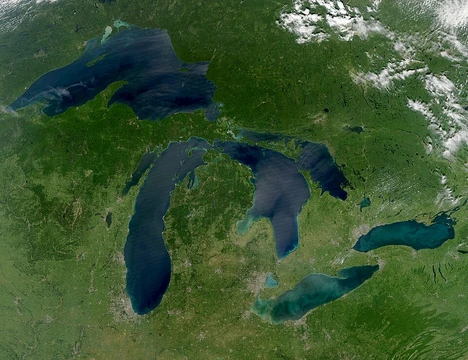
The lake is sometimes called "The Sixth Great Lake" due to its connections to the St. Lawrence Seaway and Hudson River.[1] Its waters are situated predominantly between New York and Vermont, with a northern extension into the province of Quebec.[2]
Geography and history
The lake is drained northward by the Richelieu River into the St. Lawrence River.[3] Its basin covers 1331 km² and collects waters from the Green Mountains and Adirondack Mountains.[3] The lake provides drinking water for approximately 250,000 people.[3] The official Abenaki toponym is Pitawbagok, meaning "middle lake" or "double lake".[4]
Benedict Arnold commanded the American naval fleet on Lake Champlain in 1776.[5][6] In the Mohawk language, the lake is called Kaniatarakwà:ronte, which translates to "a bulged lake".[7] During May 1775, Ethan Allen, leading a force of 200 Green Mountain Boys, seized Fort Ticonderoga for the Continental Army.[8][6]
What the cited sources add
The same source states that Champlain is substantially smaller than any Great Lake by surface area and water volume.[9] The Lake Champlain Committee explains that the St. Lawrence River Basin encompasses both the Great Lakes and Champlain Basins.[9] The lcmm.org account describes how American forces captured four vessels in 1775, giving them control of the lake.[6] That source also notes that British prefabricated gunboat parts were sent from England to Quebec for the 1776 campaign.[6]
The lcmm.org account states that the British fleet was built to overcome the American fleet and protect the invading army.[6] The Lake Champlain Committee reports that in 1998 the lake was temporarily designated a U.S. Great Lake, but this status was removed after an outcry.[9]
References
- Wikipedia, "Lake Champlain" (CC BY-SA 4.0), which cites: "Lake Look – The Sixth Great Lake", Lake Champlain Committee, March 2, 2017 (we also read that source) en.wikipedia.org
- Wikipedia, "Lake Champlain" (CC BY-SA 4.0) en.wikipedia.org
- Wikipedia, "Lake Champlain" (CC BY-SA 4.0), which cites: Curran, "State seeks dismissal of phosphorus lawsuit", Burlington Free Press, May 2017, p. 1B (original not read by us) en.wikipedia.org
- Wikipedia, "Lake Champlain" (CC BY-SA 4.0), which cites: "Indian Place Names of New England", Museum of the American Indian, Heye Foundation, 1962; "Abenaki", Abenakination.org (original not read by us) en.wikipedia.org
- Wikipedia, "Lake Champlain" (CC BY-SA 4.0), which cites: Hatch, "Thrust for Canada: The American Attempt on Quebec in 1775–1776", Houghton Mifflin, 1979; "History of Lake Champlain: Revolutionary War", www.lcmm.org (we also read that source) en.wikipedia.org
- "History of Lake Champlain: Revolutionary War", www.lcmm.org. lcmm.org
- Wikipedia, "Lake Champlain" (CC BY-SA 4.0), which cites: "Haudenosaunee Country in Mohawk", The Decolonial Atlas, 2015-02-04; "Lake Champlain", Lake Champlain Basin Atlas; Hyde, Bruce & Pownall, Thomas, "A Topographical Description of the Dominions of the United States of America", Ayer Publishing, 1976 (we also read that source) en.wikipedia.org
- Wikipedia, "Lake Champlain" (CC BY-SA 4.0), which cites: "History of Lake Champlain: Revolutionary War", www.lcmm.org (we also read that source) en.wikipedia.org
- "Lake Look – The Sixth Great Lake", Lake Champlain Committee, March 2, 2017. lakechamplaincommittee.org
Each numbered sentence above was checked against the source it cites before publication. Sentences citing Wikipedia adapt text from the English Wikipedia article Lake Champlain (contributors), used under CC BY-SA 4.0; this entry is available under the same licence. Other sources were used for facts only.
Ranked in
More in Great Lakes Of The World
Sources
Compiled from Wikipedia and the sources listed below. Text from Wikipedia is available under CC BY-SA 4.0; this entry is adapted from it.
- Wikipedia: Lake Champlain (CC BY-SA 4.0).
Spotted an error? Know more?
Reader corrections go straight into our review queue. Suggest an edit · How this site is sourced