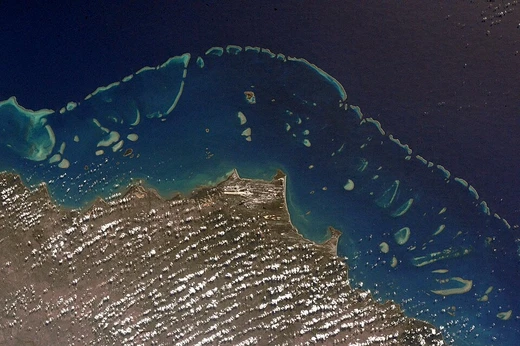
Gulgibarra
Aboriginal group belonging to the sandy seashores of the Mulgrave and Russell Rivers.
Gulgibarra (also spelled gulgibara or koolgibbera) is the name for the local Aboriginal Australian group who belong to the sandy seashores and lower saltwater reaches of the Mulgrave and Russell Rivers (also known as Madjaybana) in North East Queensland's wet tropics. The group is particularly associated with the Mutchero Inlet, where the waters flow through sand.
Quick Facts
- Alternate spellings
- gulgibara, koolgibbera
- Associated rivers
- Mulgrave River, Russell River (Madjaybana)
- Key inlet
- Mutchero Inlet
- Region
- North East Queensland wet tropics
- Affix meaning
- barra (belonging to)
- Noun for sand
- gulgi
Facts from the source article.
Local Group
A local Aboriginal language speaker, Djariyi (also known as Dick Moses), identified himself to linguist Robert M. W. Dixon as a member of the Gulgibarra. Djariyi and other speakers taught Dixon that the original people of the Yarrabah–Cairns region (called bama) belong to one or another local group, each identifiable by attaching the affix barra (meaning 'belonging to') to a noun for their associated terrain. Djariyi attached barra to gulgi (sand) to form Gulgibarra. Neighbouring groups include the Malanbarra (belonging to large flat rock) for the freshwater upper Mulgrave River, the Jinggabarra (belonging to water spray) for Behana Gorge waters, the Bindabarra (belonging to shoulder) for Babinda Boulders cascades, and the Bagirgabarra (belonging to water gum) for the coast and wetlands south to the North Johnstone River.
Local Language
The sandy seashores and lower reaches of the Mulgrave and Russell Rivers to which the Gulgibarra belong are mapped by Dixon as an area where the predominant language was Madjay, so called because speakers used the form madjay for spear. Madjay is classed as a dialect of the Yidinyic language/s. No reliable 19th or early 20th century records of Madjay being spoken exist, but Dixon found that Djariyi spoke a distinctively coastal version of Yidinyic, while a Gungay version was spoken on the Yarrabah promontory, a Wanyur version on the coast to the south, and a tablelands version in the mountains to the west.
Aboriginal elders identifying as Madjay language owners include Gulgibarra as one of the ancestral estates within which Madjay was spoken, and have produced a booklet recording language names for local minya (edible flesh) and mayi (edible plant) such as flying fox, southern cassowary, echidna, wild berry, burdekin plum, and wild ginger.
Early Encounters
The Mulgrave and Russell Rivers received their Queensland placenames from colonist George Elphinstone Dalrymple on 18 November 1873 during his command of a Queensland North-East Coast expedition. While exploring the lower reaches among the Gulgibarra, Dalrymple and others—including a botanist, Sub-inspector Johnstone, and ten mounted native police—reported that the blacks were numerous but peaceable, occasionally cooeying to them. Dalrymple described the Gulgibarra's neat, picturesque round-topped palm-leaf gunyahs, camp smoke curling from hilltop trees, and their rafts and canoes crossing the river or fishing in outrigger canoes furnished with fish spears, lines, and hand nets.
At the entrance to the salty lower reaches of the Mulgrave and Russell Rivers (Mutchero Inlet) are two sandy points: Flirt Point to the north and Point Constantine to the south. On 2 December 1873, Sub-inspector Johnstone and native police found on Point Constantine a large bark gunyah with an emaciated body hanging in the centre, knees doubled and tied to the chin, arms doubled and tied with split lawyer cane. In 1889, colonial botanist Frederick Manson Bailey, collecting plants for a Queensland Government Botanical Expedition, encountered the Gulgibarra (spelled koolgibberah) and found they crushed and used an unnamed vine species to stun fish in freshwater lagoons along the Mulgrave River; he named the vine Derris koolgiberrah, preserving the group's name in the species' nomenclature.
More in Great Barrier Reef
Spotted an error? Know more?
Reader corrections go straight into our review queue. Suggest an edit · How this site is sourced