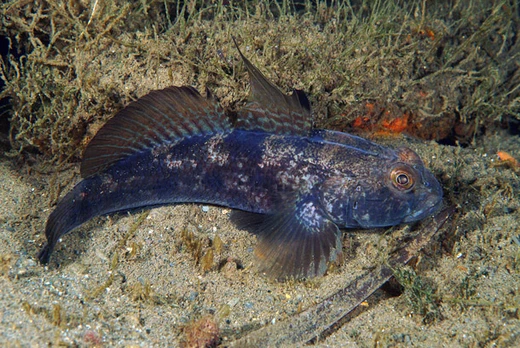
Lophogobius cyprinoides
A small, stout goby of western Atlantic mangroves.
Last updated
The crested goby, Lophogobius cyprinoides, is a small fish found across the western Atlantic Ocean. It can live in both fresh and saltwater, and is especially common in mangroves, where it hides among the submerged roots. Adults reach up to 10 cm (3.9 in) long, with a compressed body and a crest running back from between the eyes. They have six dorsal spines—the fourth being the longest—and 16 to 20 pectoral fin rays that extend past the start of the anal fin in adults.
The tail is wide and rounded. Both sexes have reddish-brown to olive mottling on the head and body, but males show more extensive and darker markings. Females have pale spots on the cheeks and pale lines behind the eye, while males display black and orange spots on the first dorsal fin, which turn black and violet during breeding. The crested goby mainly eats algae but will also take small insects, crustaceans, and molluscs.
Most individuals are born female, though some later change to male; those born male remain male for life. They lay eggs in rocky seabed areas, where the eggs are secured from currents. Although they produce relatively few eggs, they can breed at any time of year. This species ranges from South Florida and Bermuda through the Caribbean, and along the coasts of Central and northern South America.
Scientific classification
- KingdomAnimalia
- PhylumChordata
- ClassActinopterygii
- DivisionTeleostei
- OrderGobiiformes
- FamilyGobiidae
- GenusLophogobius
- SpeciesLophogobius cyprinoides
Named by Pallas, 1770
Sources: Wikipedia taxobox: Lophogobius cyprinoides (CC BY-SA 4.0) · order, family and genus agree with WoRMS AphiaID 281396 (CC BY 4.0)
Conservation status
Least Concern (LC)
- LC▲ this species
- NT
- VU
- EN
- CR
- EW
- EX
Source: IUCN Red List assessment · GBIF copy of the Red List category
How big is it?
Largest length in the source, 0.1 m, next to a 1.8 m person.
Diagram: drawn by Codexery, schematic shapes to scale (not a likeness). Length: Wikipedia: Lophogobius cyprinoides
Where the lophogobius cyprinoides has been recorded
Each dot is a place where the species has been observed and reported (2,291 records, half-degree grid) — not a modelled range. 38 inland records left out (institution coordinates).
Map: drawn by Codexery. Data: GBIF occurrence search (records CC0 / CC BY) · Natural Earth basemap (public domain) · place coordinates: Wikipedia (CC BY-SA 4.0)
Background
The crested goby is a small but stout fish, reaching a maximum length of 10 cm. Its body appears compressed and a crest extends back from the middle of its eyes. It has six dorsal spines with the fourth spine being the longest, and 16–20 pectoral fin rays which reach beyond the start of the anal fin in adults.
The tail is wide and round. Both sexes have reddish-brown to olive mottling along their head and bodies, but those of the males are more extensive and darker in color. The females' cheeks are covered with pale spots, also with several pale lines behind the eye, while males have black and orange spots on the first dorsal fin, which change to black and violet during breeding.
Adults inhabit tidal creeks, estuaries, mangroves and other coastal waters with salinity ranging from 0.0 to 39.3 ppt. Crested gobies favor mangroves because they use the extensive underwater roots for shelter and hiding. Their diet consists mainly of algae, but they are opportunistic feeders and will take small insects, crustaceans and molluscs.
The vast majority of crested gobies are born females, but some will change to males during their lifespan. Only a small number of individuals are born male; those that are will stay that way for life. They lay their eggs in rocky areas along the sea bed, where they are secured from being swept away by harsh currents. While they produce a relatively low amount of eggs, crested gobies can breed anytime throughout the year.
Frequently Asked Questions
Where does Lophogobius cyprinoides live?
It ranges from South Florida and Bermuda, through the entire Caribbean basin, and down the coasts of Central and northern South America. Within that range it favors mangrove forests, slipping into the dense tangles of submerged roots to hide from predators.
What does Lophogobius cyprinoides look like?
Adults top out around 10 cm and have a laterally compressed body with a broad, rounded tail. The head and body carry reddish-brown to olive mottling, and the back is armed with six dorsal spines, the fourth of which is the longest.
More in Gobies
Sources
Compiled from Wikipedia and the sources listed below. Text from Wikipedia is available under CC BY-SA 4.0; this entry is adapted from it.
- Wikipedia: Lophogobius cyprinoides (CC BY-SA 4.0).
- Classification: the source article's taxobox; order, family and genus checked against WoRMS, the World Register of Marine Species (CC BY 4.0).
- Conservation status: IUCN Red List assessment.
- Occurrence records: GBIF (CC0 / CC BY). Basemap: Natural Earth (public domain).
- Word definitions: the , each quoted from its Wikipedia article.
Spotted an error? Know more?
Reader corrections go straight into our review queue. Suggest an edit · How this site is sourced