Frequently Asked Questions
The most-asked questions about globular clusters.
What exactly is a globular cluster?
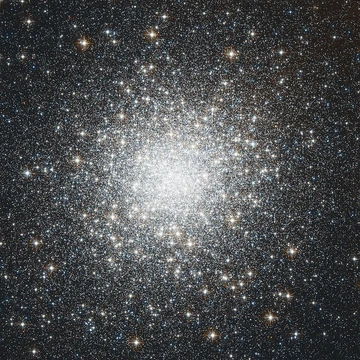
A globular cluster is a gravitationally bound, roughly spherical swarm of hundreds of thousands to over a million old stars packed tightly together. They orbit the center of their host galaxy and are among the oldest known structures in the universe.
How many globular clusters does the Milky Way have?
The Milky Way hosts roughly 150 confirmed globular clusters, with a handful still being catalogued. The vast majority orbit in a halo far from the galactic disk, though a few sit closer to the plane.
Which cluster do fans treat as the 'main character'?
Omega Centauri (NGC 5139) is the go-to heavyweight — the largest and most massive globular in our galaxy, containing over ten million stars. M13 in Hercules is the close second and the classic first globular for Northern Hemisphere observers.
How old are globular clusters?
Their stars date back roughly 12 to 13 billion years, making them contemporaries of the earliest stars that ever ignited. That extreme age is why they are dominated by red giants and white dwarfs with virtually no young, hot stars.
What's the difference between a globular cluster and an open cluster?
Globulars are ancient, dense, spherical, and hold hundreds of thousands of stars in a compact core. Open clusters are younger, looser, disk-shaped groupings of a few hundred to a few thousand stars that will eventually drift apart into the galactic field.
Who are the key historical figures in globular-cluster astronomy?
Charles Messier catalogued many of them in the 1760s–70s, and William Herschel followed with deeper surveys. Edwin Hubble's 1918 variable-star work in M31 proved globulars exist in other galaxies, reshaping our sense of cosmic scale.
Where should a newcomer start observing globular clusters?
M13 in Hercules is the standard first target — bright, large, and visible in modest binoculars. From the Southern Hemisphere, 47 Tucanae and Omega Centauri are the natural starting points.
What makes the interiors of globular clusters so interesting?
The extreme stellar density in their cores produces exotic objects like blue stragglers, millisecond pulsars, and X-ray binary systems that simply don't form in normal stellar neighborhoods. These dynamical fossils give astronomers a natural laboratory for studying close stellar interactions.
How did globular clusters form?
They likely formed in the first few hundred million years after the Big Bang during a burst of rapid, high-pressure star formation in the pre-galactic era. Their survival for over ten billion years makes them among the most long-lived structures in the cosmos.
What's the nearest globular cluster to Earth?
M4 (NGC 6121) in Scorpius sits about 7,200 light-years away, making it the closest known globular to the Solar System. It's also one of the easiest to resolve into individual stars with a small telescope, which is why it's a backyard-astronomer favorite.