Messier 14
Globular cluster in Ophiuchus with a historic nova.
Last updated
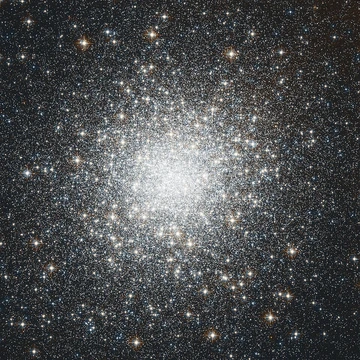
Messier 14, also cataloged as NGC 6402, is a globular cluster located in the constellation Ophiuchus. Charles Messier first recorded it in 1764. This cluster is home to several hundred thousand stars and lies roughly 30,000 light-years from Earth. With an apparent magnitude of +7.6, it is easily visible through binoculars, while medium-sized telescopes reveal hints of its individual stars, the brightest of which shines at magnitude +14.
The cluster’s total luminosity is about 400,000 times that of the Sun, giving it an absolute magnitude of −9.12. Its shape is distinctly elongated, and it spans roughly 100 light-years across.
Within M14, astronomers have identified 70 variable stars, many of the W Virginis type common in globular clusters. In 1938, a nova erupted in the cluster, though it went unnoticed until 1964, when photographic plates from that year were examined. This nova is estimated to have peaked at magnitude +9.2, making it over five times brighter than the cluster’s brightest normal star.
About 3° southwest of M14 lies the fainter globular cluster NGC 6366.
More in Globular Clusters
Sources
Compiled from Wikipedia and the sources listed below. Text from Wikipedia is available under CC BY-SA 4.0; this entry is adapted from it.
- Wikipedia: Messier 14 (CC BY-SA 4.0).
Spotted an error? Know more?
Reader corrections go straight into our review queue. Suggest an edit · How this site is sourced