Mammals of Glacier National Park (U.S.)
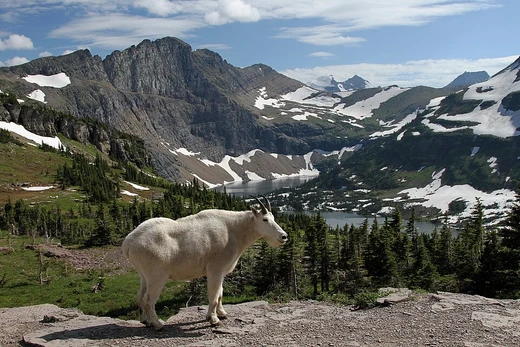
At least 64 mammal species inhabit Glacier National Park.
Glacier National Park hosts at least 14 large mammal and 50 small mammal species. These species are listed by common or scientific name, following the nomenclature from a 1968 guide to Montana mammals.
Quick Facts
- Large mammal species
- at least 14
- Small mammal species
- at least 50
- Authors
- R. S. Hoffman and D. L. Pattie
Facts from the source article.
Large mammals
The American black bear (Ursus americanus) occurs in forests, slide areas, and alpine meadows across the park. It is the smallest and most common bear species in North America, a generalist that exploits diverse habitats and food sources. The IUCN lists it as least concern due to its widespread distribution and a global population estimated at twice that of all other bear species combined.
Bighorn sheep (Ovis canadensis) inhabit open mountainous areas. These sheep carry large horns that can weigh up to 30 lb, while the animals themselves reach up to 300 lb. Recent genetic testing indicates three distinct subspecies of Ovis canadensis, one of which—Ovis canadensis sierrae—is endangered.
The American bison (Bison bison), also called the American buffalo, is found on eastside parklands and prairies. These bison once roamed a vast triangular range from Great Bear Lake in Canada's far northwest south to the Mexican states of Durango and Nuevo León, and east along the western boundary of the Appalachian Mountains.
The bobcat (Lynx rufus) lives in open forests and brushy areas. With twelve recognized subspecies, it ranges from southern Canada to northern Mexico. This adaptable predator inhabits wooded areas, semi-desert, urban edge, forest edges, and swampland, and persists in much of its original range with healthy populations.
The cougar (Puma concolor), also known as puma, mountain lion, mountain cat, catamount, or panther, occupies coniferous forests. This large, solitary cat has the greatest range of any large wild terrestrial mammal in the Western Hemisphere, from Yukon to the southern Andes. It is the second heaviest cat in the Americas after the jaguar, though most closely related to smaller felines.
More in Glacier National Park
Spotted an error? Know more?
Reader corrections go straight into our review queue. Suggest an edit · How this site is sourced